

Bermudagrass is the most common turfgrass species grown on golf courses and sports fields in the Southeastern US. Bermudagrass culture has extended widely into the transition zone (i.e. an area between Philadelphia and Richmond and extending west through Cincinnati, St. Louis and Kansas City). It’s important to note, that bermudagrass originated in tropical regions in Africa, and is commonplace in South America and parts of Asia (Beard,1973).Conversely, most of our cool-season grasses originated from Europe.
Breeding programs at Oklahoma State University have developed more and more winter hardy bermudagrass cultivars. The first “so-called winter hardy cultivar” was ‘Mid-Iron’, which was released from Kansas State Univ. in the 1970’s. Today, ‘Latitude 36', ‘Tahoma 31’ and ‘Ironcutter' are considered to be among the most winter hardy cultivars of bermudagrass. Bermudagrass since has become widely used on sports fields in the mid-Atlantic. Indeed, the Baltimore Ravens and the Philadelphia Eagles play on bermudagrass fields- way past natural dormancy into December and January. There is a trick to growing bermudagrass on NFL fields as elucidated by Steven McDonald MSc., [President of Turfgrass Disease Solutions]. According to Steve, “Northern bermudagrass fields are over-seeded with perennial ryegrass in September and during cold weather they are tarped and heated; fields also are treated with green pigments. Traffic between the hash-marks destroys bermudagrass, and fields may need to be re-sodded in November-December. Replacement sod is grown on plastic using 4 inches of a USGA specified sand rootzone mix.
The two greatest limiting environmental factors on bermudagrass survival include winter damage and shade. Winter damage can be sub-categorized to include: direct low temperature injury (ice crystals or denaturation of proteins); water-logged soils and/or ice cover; desiccation (dehydration); and traffic. The growth of bermudagrass slows greatly once the daily average temperatures fall below 60ºF in early October in our region. When temperatures average below 50ºF, bermudagrass ceases growth and foliage begins to turn brown; eventually turf enters a state of winter dormancy. Low temperature kill of bermudagrass occurs when daily average temperatures fall below 23ºF and direct kill occurs when temperatures reach 10ºF (McCarty, 2002).
In our region, it would take a few weeks of night temperatures below 20ºF to cause direct-winter damage. Excessively wet soils that freeze, especially where ice forms in water puddles, is the most common form of winterkill in the mid-Atlantic. Any combination of freezing and thawing soils and ice cover, causes ice crystal formation inside stem cells (i.e., crowns, stolons and rhizomes), which destroys cell walls and membranes. Ice encasement is the “double whammy” causing death due to carbon dioxide [CO2 ] build-up (as well as ethanol and other toxic inorganic chemicals) combined with oxygen depletion (anoxia). Finally, areas subject to frequent winds, in combination with cold (< 32ºF and into the 20’s and teens ºFi.e., subfreezing) and very dry soil conditions, can cause tissue desiccation (i.e., water is physiologically pulled out of stem tissues and plants wither). In the mid-Atlantic, desiccation mostly occurs on south facing slopes in winter where there is no snow cover in combination with wind and soil drought (especially in sand-based rootzones). Sub-freezing temperatures alone also may cause desiccation (i.e., movement of water out of stems) causing winter-kill.
Symptoms of Winterkill in Bermudagrass: Following the first frosts in autumn, green crescent-shaped areas may be noted throughout bermudagrass. The crescents correspond to areas protected from early frost. At this point in the fall, little if any damage has occurred where crescents are noted. Winterkill does not become apparent until late spring when there is no green-up. Affected turfs often are large, irregularly- shaped areas of brown grass that is stone dead. Smaller dead spots may be evident, which are likely to recover fairly rapidly. Shade debilitates bermudagrass and often times these sites are severely damaged in winter, especially in wet shade [where crown hydration likely occurs –see Part 1] The presence of living annual bluegrass [Poa] in dead bermudagrass areas in spring is commonplace because annual bluegrass has superior cold tolerance (except crown hydration), when compared to bermudagrass. Hence, the presence of Poa suggested that bermudagrass was directly killed by low temperature stress.

Crescent -shaped frost patterns as bermudagrass enters dormancy. Courtesy of M. Goatly.
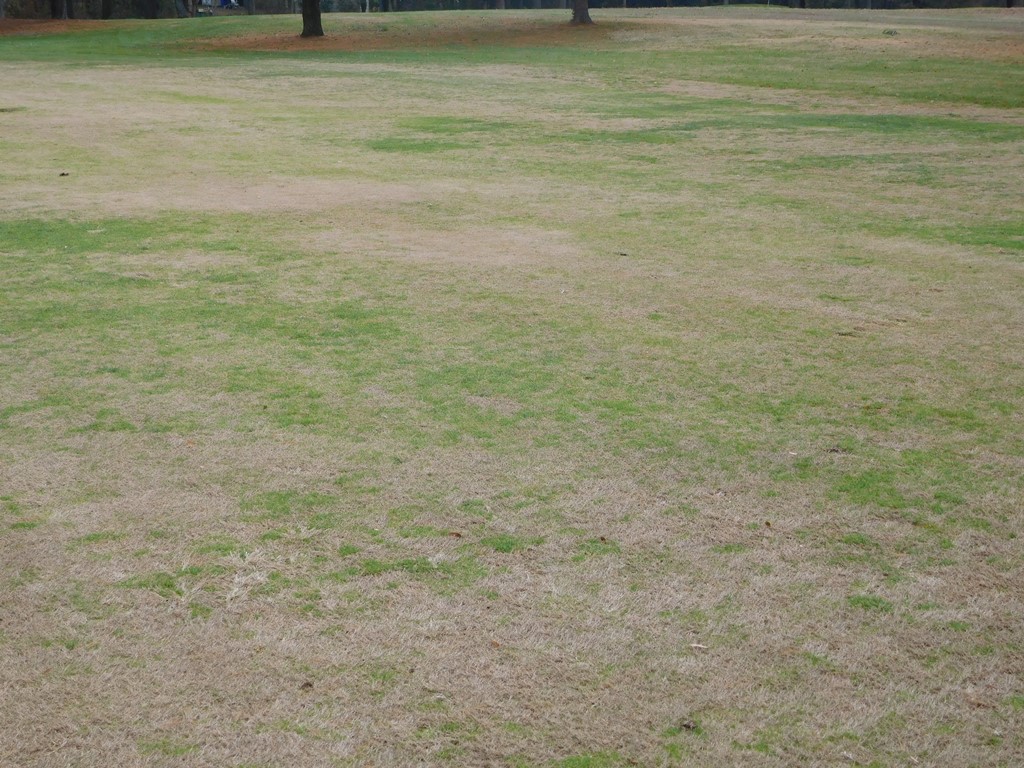
Widespread winterkill of bermudagrasss in an open environment suggesting that direct low temp kill or desiccation was the mechanism. Cold tolerant annual bluegrass survives.
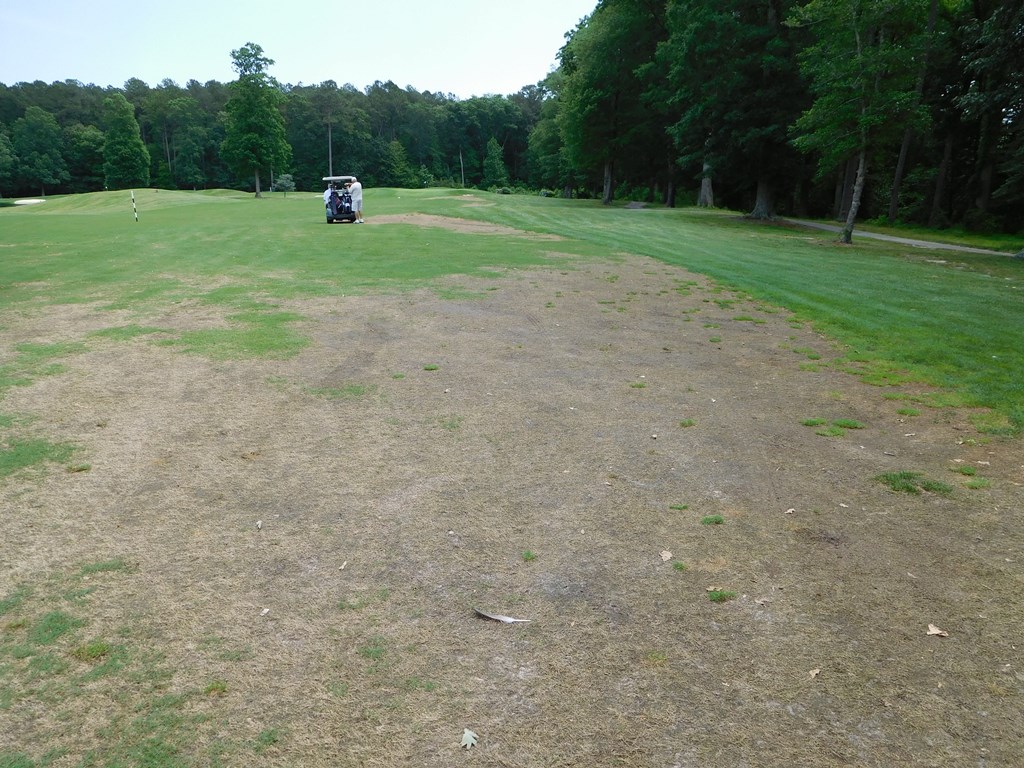
Bermudagrass competely winter killed in wet shade.
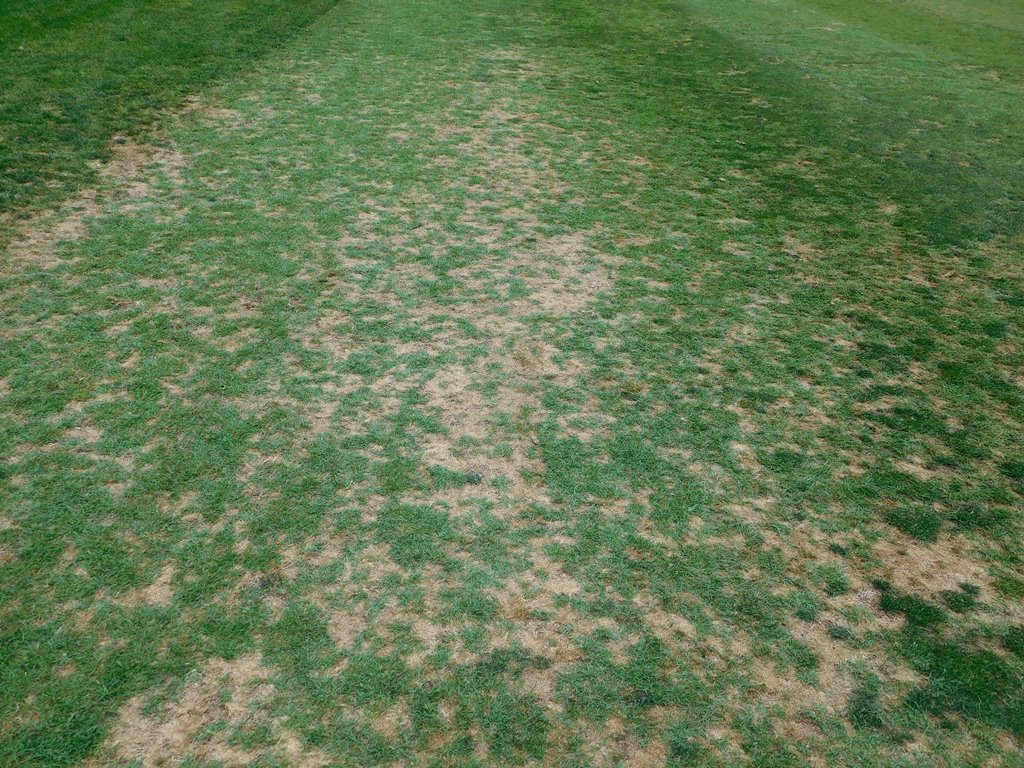
Bermudagrass struggles after winter at the edge of fairways where carts often run.
In 2015, Steve McDonald, MSc. noted widespread bermudagrass winterkill in the mid-Atlantic. A lot of it was desiccation. Desiccation (i.e. dehydration) refers to the removal of water from tissues in response to extreme drying conditions and/or subfreezing temperatures. Desiccation is most common in sand-based rootzones when winter drought causes water to be drawn out of stem tissues (i.e., an equilibrium where water moves from moist stems outward into drier sandy soils during periods of winter drought and/or subfreezing temperature stresses). High, open and windswept areas are damaged the most via desiccation; whereas wind- protected areas are not as badly impacted. Conversely, summer drought seldom kills bermudagrass because of its specialized “heat tolerant mechanisms,” which allow plants to enter dormancy in the absence of irrigation. Under irrigation, there are specialized mechanisms that protect proteins from high temperature stresses. Remember, bermudagrass is native to Africa and other tropical areas, and thus is well adapted to hot, wet and/or dry conditions.
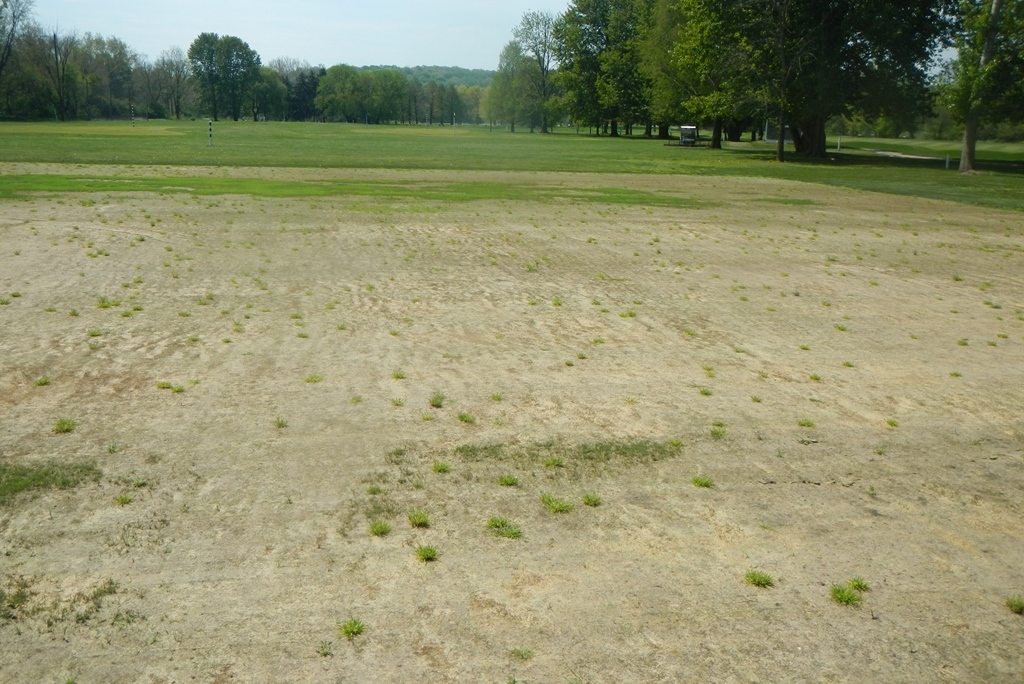
Latitude 36 tee -winter killed- probably due to direct low temperatures given that area is somewhat protected from wind- note surviving green grass is Poa annua. Courtesy of S. McDonald
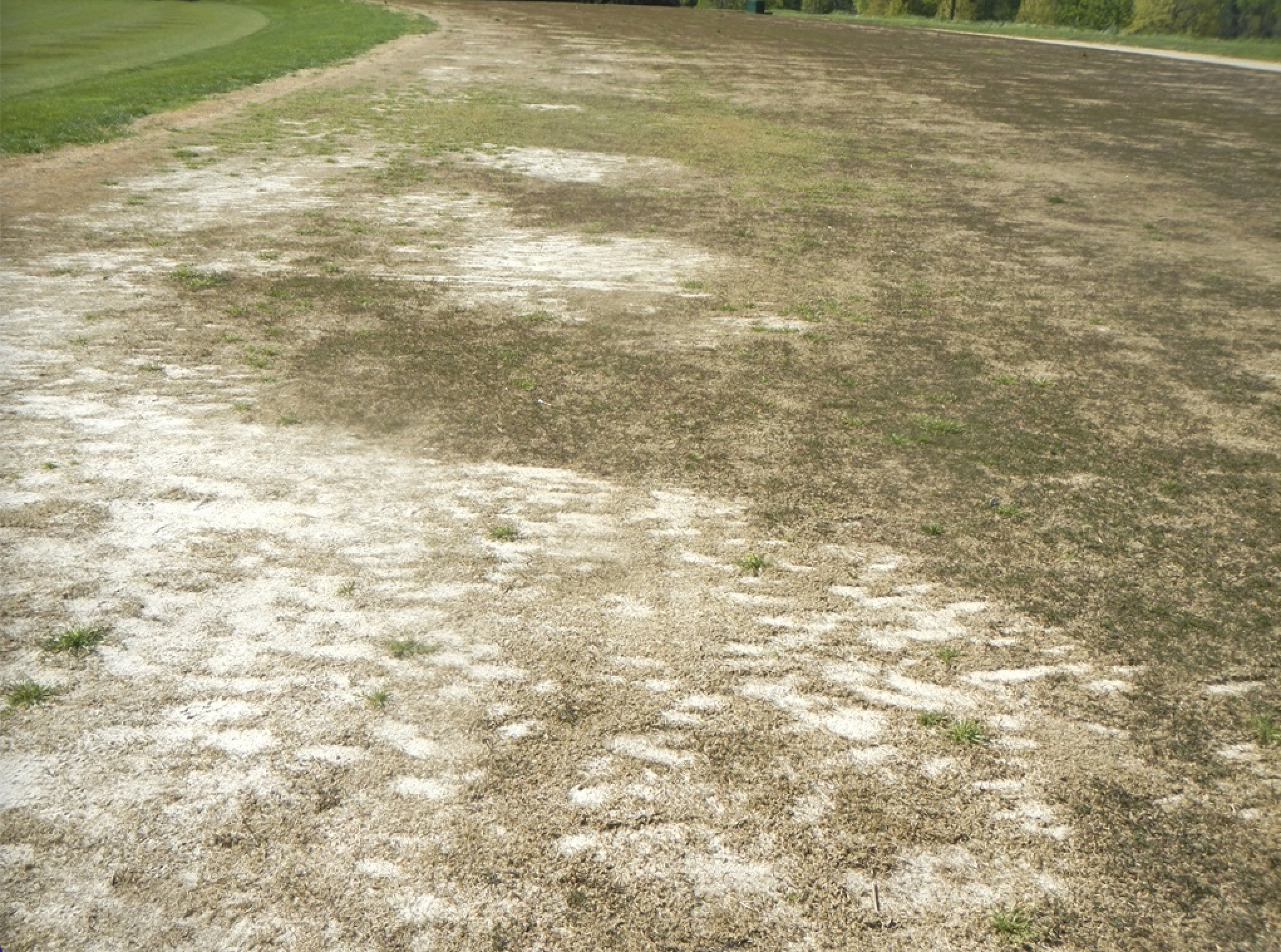
More winterkill in worn areas where divots have been topdressed with sand; causing desiccation-dehydration. Courtesy of S. McDonald
Traffic also plays a huge role in bermudagrass winterkill. Accompanying photos from Steve McDonald tell the story. Note, where heavily divoted areas were top-dressed with sand into late autumn exhibited enhanced kill- again, sand in the divot mix plays a major role in promoting desiccation. University of Maryland Byrd Stadium traditionally was grassed with Tufcote bermudagrass. After football season, the field often was used for lacrosse from February to May. The result of traffic, from mostly lacrosse and football between the hash-marks, predisposed the bermudagrass turf to winterkill.
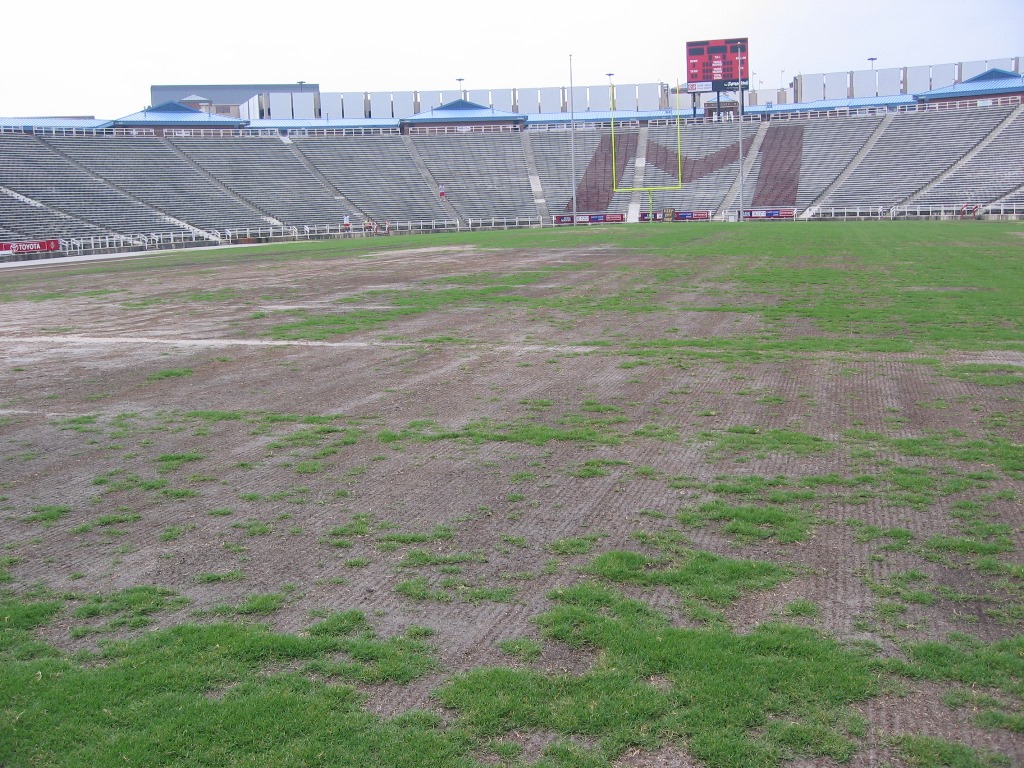
Lacrosse played in Februrary and March predisposed bermudagrass field to winterkill via traffic.
Diagnosing winter-kill in bermudagrass. By March, managers want to know the status of their bermudagrass and whether it was adversely impacted by winter. First and foremost in diagnosing winter-kill is to use the “snap-test” of bermudagrass stolons. If you manage bermudagrass, and have taken time to scratch around, you probably have found greening stolons. There is a simple test to determine if your bermudagrass is alive and well in late winter. Even if you see some greening of stolons, it is important to do a quick check. If stolons are otherwise water-soaked (mushy like cooked veggies) –they were winter damaged. Simply bend the stolon, and if it snaps, it is alive and well.

Simple scratch test tells you if stolons are green; March 2020.
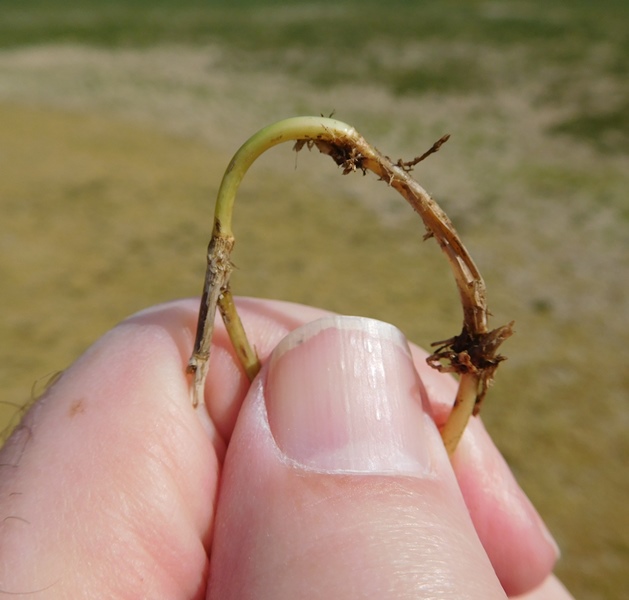
If stolons are healthy they will bend- a good sign of survival.
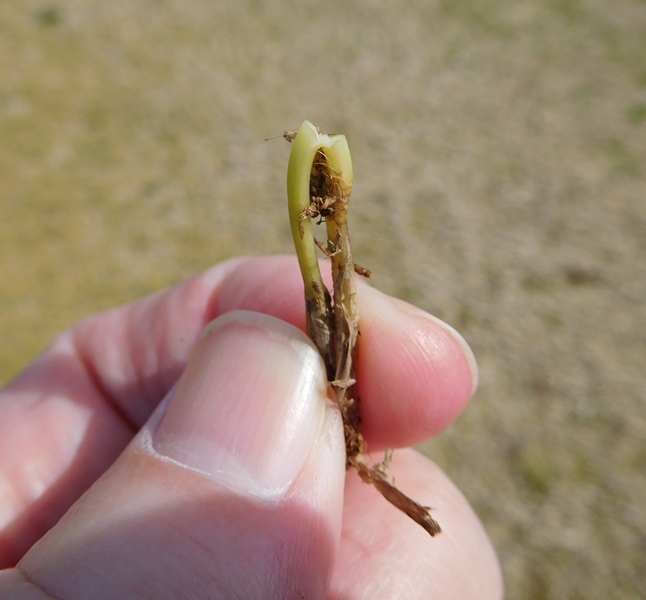
If the stolon snaps -it is alive and well.
Next approach is to dig plants and wash off soil and slice stems (crowns, stolons and/or rhizomes) with a razor blade and look closely, using a hand lens, for white tissue. If stems are tan-brown, and/ or water-soaked-soft or mushy, they are likely to die. However, if crowns and other stems are pearly white and firm –they have survived any recent sudden drops in daily average temperatures (esp. night plunges into the 20’s ºF for several nights in a row).
To be more certain, remove plugs from areas most vulnerable to winterkill including poorly drained, shaded and/or high traffic areas. As a “control” collect plugs from full sun areas known to be among the healthiest parts of the playing areas. Plant plugs using native soil into flats or pots with holes to ensure good drainage. Place plugs in a south facing window or better yet place plugs under grow lights in a warm area of the shop. Keep the soil moist. If crowns are healthy –you should see some first signs of greening in about 10-14 days under grow lights. After 2-3 weeks, assess the percent of the plug area that has green foliage, which provides a good estimate of what to expect in the field.
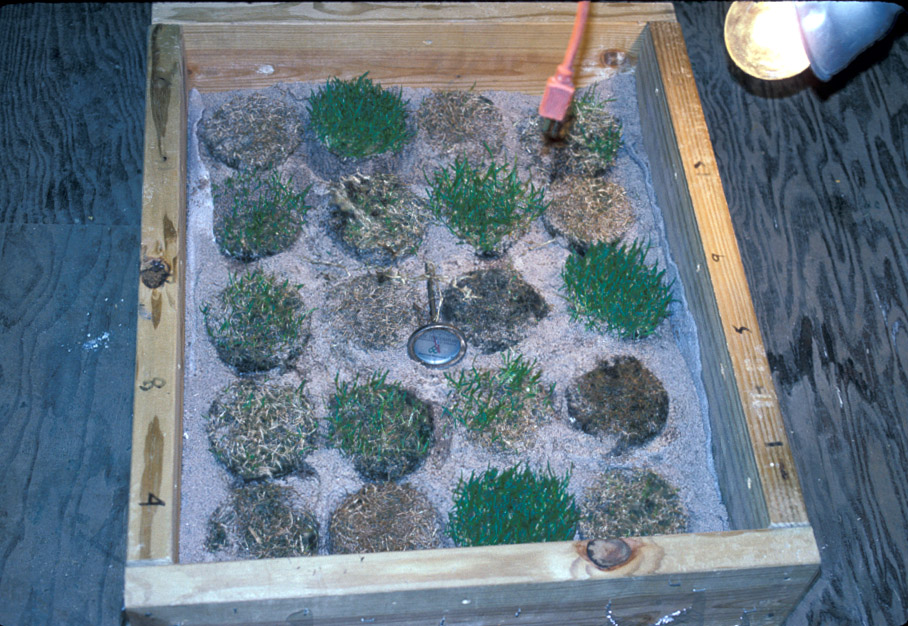
Plant suspected winter damaged plugs in native soil and place under a grow lights to best assess survival percentages.
Cultural Low Temperature Management of Bermudagrass
1. Plant low temperature tolerant cultivars like Latitude 36, Tahoma 31, Ironcutter, others;
2. Divert carts away from heavily trafficked areas;
3. Use temporary tees where appropriate (e.g., small tees are subjected to heavy divoting);
4. Improve water drainages, especially in shaded areas;
5. Improve sunlight penetration by selective tree removal; prune roots along tree lined fairways;
6. Avoid nitrogen (N) fertilization after mid-September;
7. Apply potassium (K) according to soil testing. I’m a firm believer in applying N:K in a 1 to 1 ratio every time N is applied. Apply K alone before winter dormancy;
8. Slowly increase mowing height in late summer and throughout autumn.
9. Control thatch
10 .When building bermudagrass tees, use a sandy mix with 10-20% soil (i.e., dirty mix) to reduce the potential for desiccation *.

*Steven McDonald is a valued friend who has assisted me in providing up-to-date information and photos for Turf Tip articles for several years. Steve is the President and Chief Agronomist for Turfgrass Disease Solutions. He earned a BS in Turfgrass Management from Delaware Valley University and an MS in Turfgrass Pathology from the University of Maryland. He consults for turfgrass professionals on every aspect of turfgrass management. Steve spends the majority of his time visiting golf courses from Virginia north to New England. He conducts more than 100 field research trials every year on a wide variety of plant protection materials, pest biology investigations and fertilizer performance. Steve also serves as an adjunct instructor for Rutgers University and Delaware Valley University.
References:
Fry, J and B. Huang. 2004. Applied Turfgrass Science and Physiology. John Wiley & Sons, NJ.
McCarty, L.B. and G. Miller, 2002. Managing Bermudagrass Turf. Ann Arbor Press, MI.