
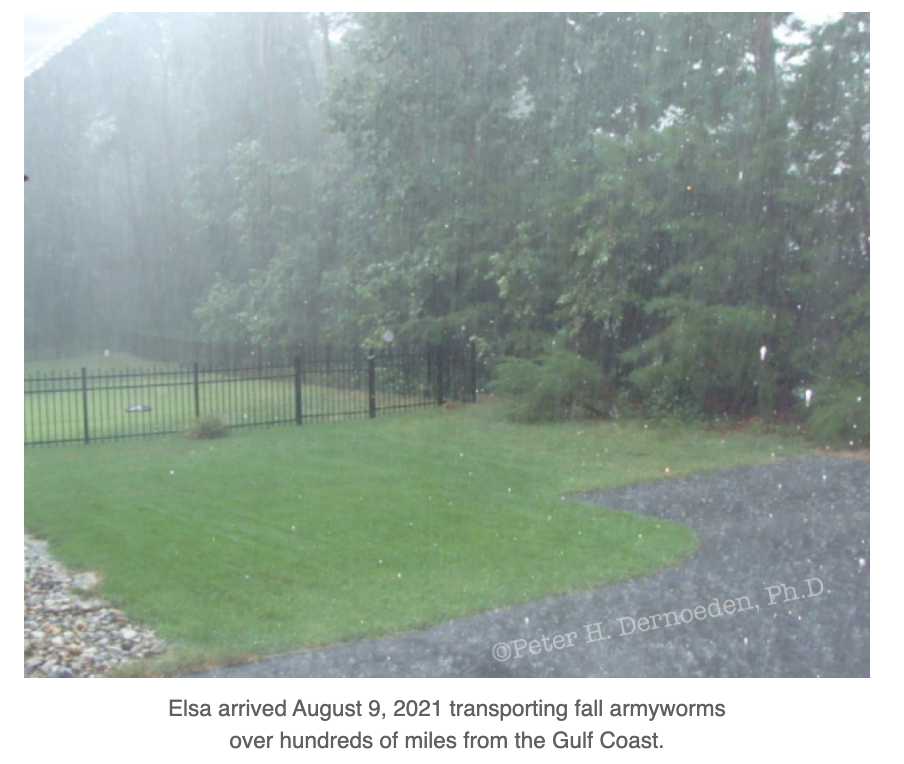
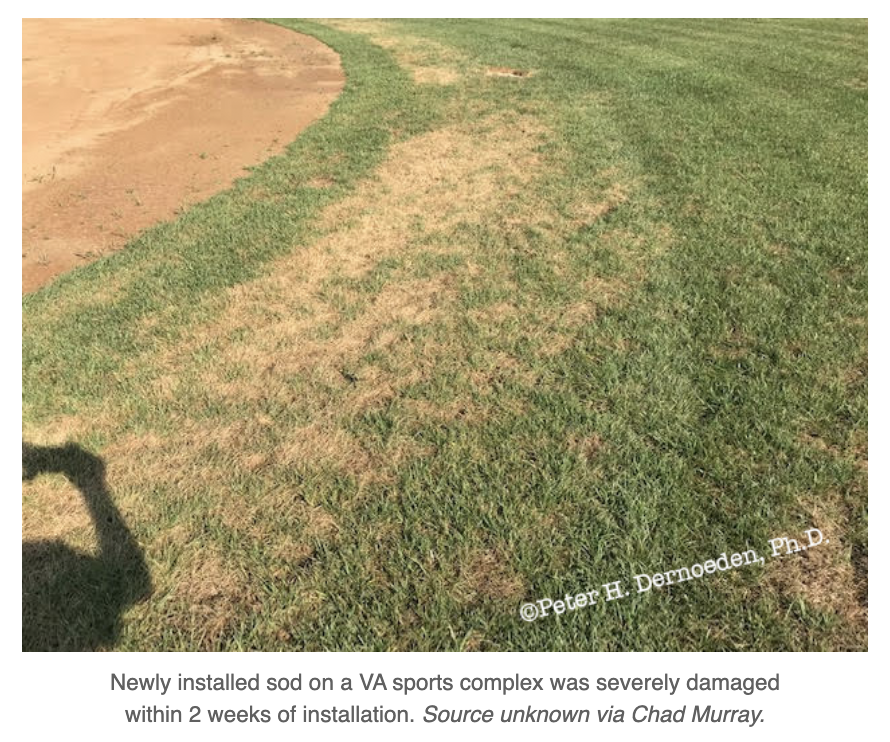
In about the last ten days, sod growers and installers began to experience a seemly mysterious loss of mostly tall fescue-Kentucky bluegrass turf. In more recent days, LCO’s have gotten complaints and have found the same problem- “Fall Armyworms.” Just last week (Aug. 27), I noted a sudden turf collapse of my backyard. I thought I had damaged the turf by mowing during the heat of the day, when the grass was under severe heat stress. On closer inspection it turned out to be fall armyworm. In over 45 years of being a “Turf Nerd,” I think I have seen armyworms only once or twice. Since fall armyworms are mostly a pest in the Southern U.S., it is believed that this scourge arrived courtesy of the tropical storm Elsa on August 9, 2021 –or perhaps from an earlier storm. Damage has been reported from New Jersey to Virginia, but I think it is more widespread. Tropical storms, originating over the Gulf Coast, and coming into the mid-Atlantic during Hurricane season in August and September, are largely responsible for some of the most devastating outbreaks of gray leaf spot in perennial ryegrass on golf course back in the 1990’s. It is amazing, but true, tropical storms emanating in the Gulf Coast can carry fungal spores, weed seeds and insects many hundreds of miles to the mid-Atlantic in just a few days.
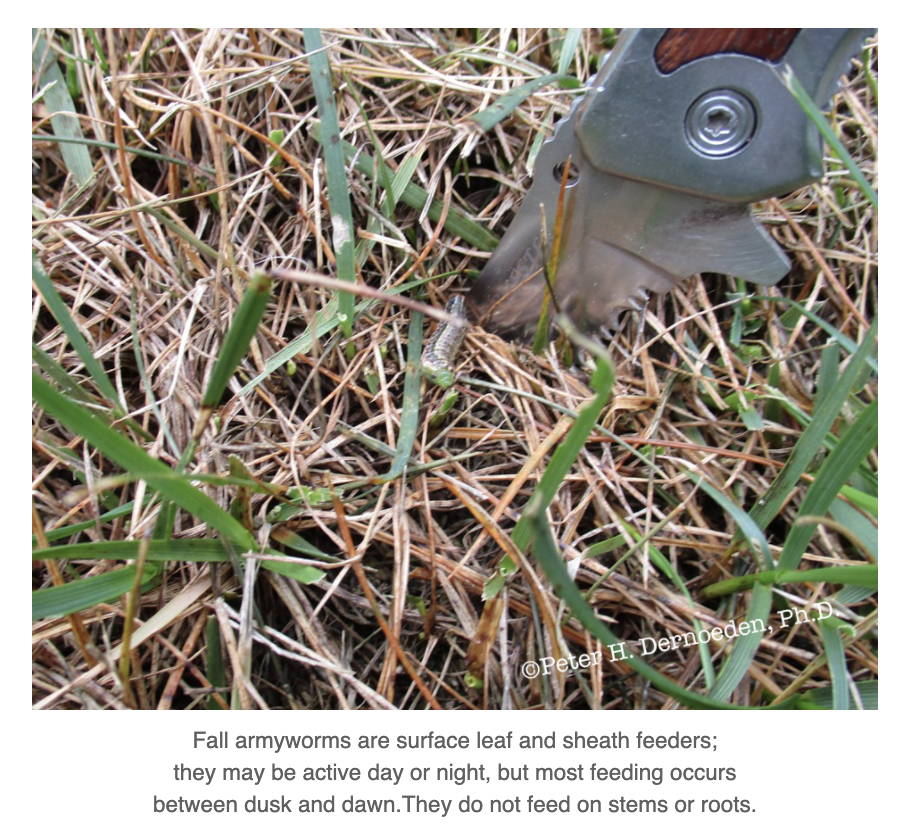
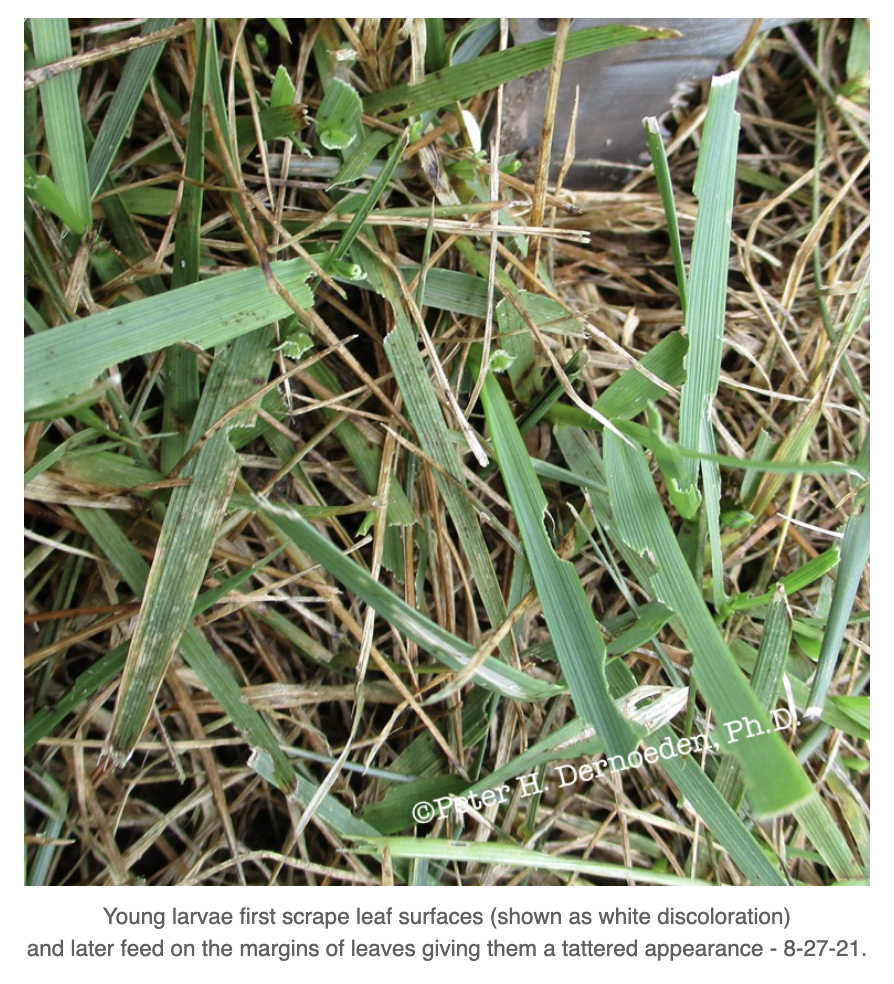
Biology and Feeding Habits: Armyworms, like cutworms, cause their damage in turf in the larval (fleshy caterpillars) stages. Fall armyworms feed day and night, but mostly between dusk and early morning hours. Cutworms on the other hand are strictly night feeders. Larvae reside in thatch and/or upper root-zone depth, but they only feed on leaves and sheaths. They have strong pincer mouthparts called mandibles. Young larvae like to feed by scraping leaf surfaces and chewing on leaf margins causing a tattered-ragged look. As larvae grow larger, they chew-off lower leaf sheaths (avoiding stem tissues). On close inspection, you can see how the insect cleanly cuts off leaves and sheaths in almost a scissors-like precision. They can mow down a lawn or a sod field in a few days
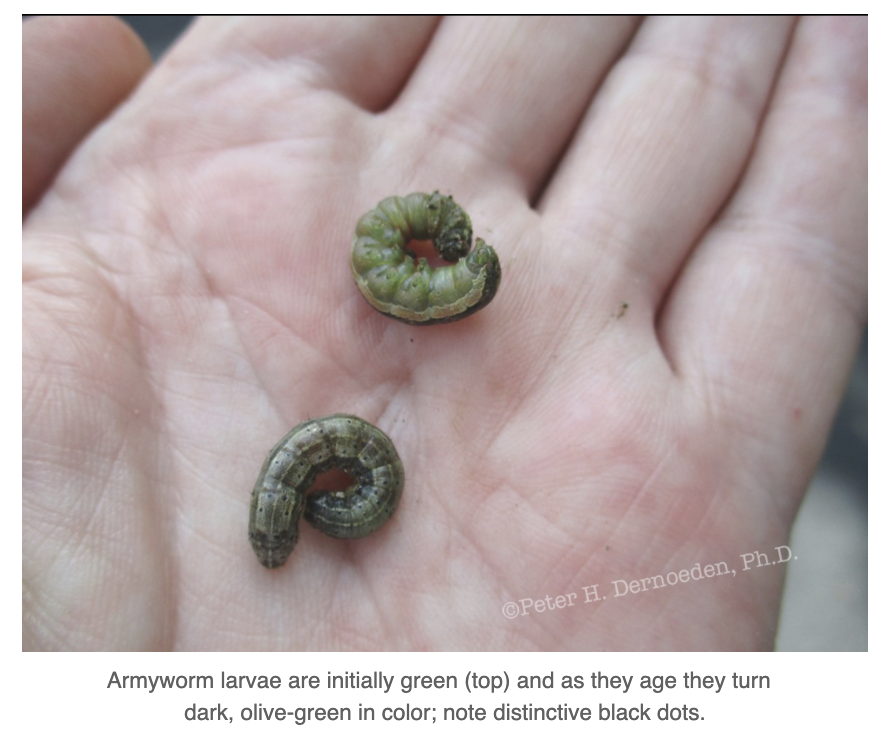
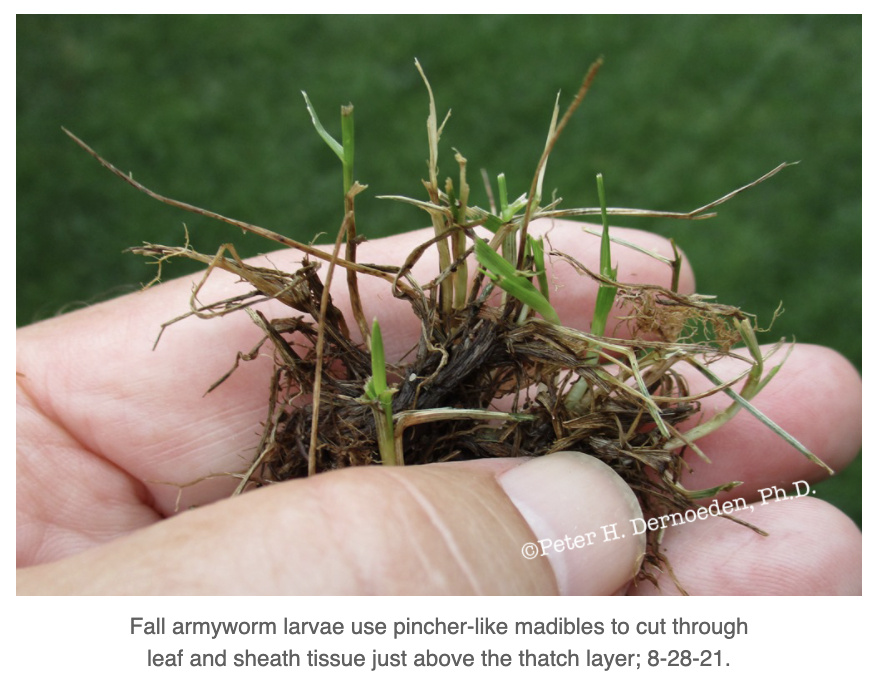
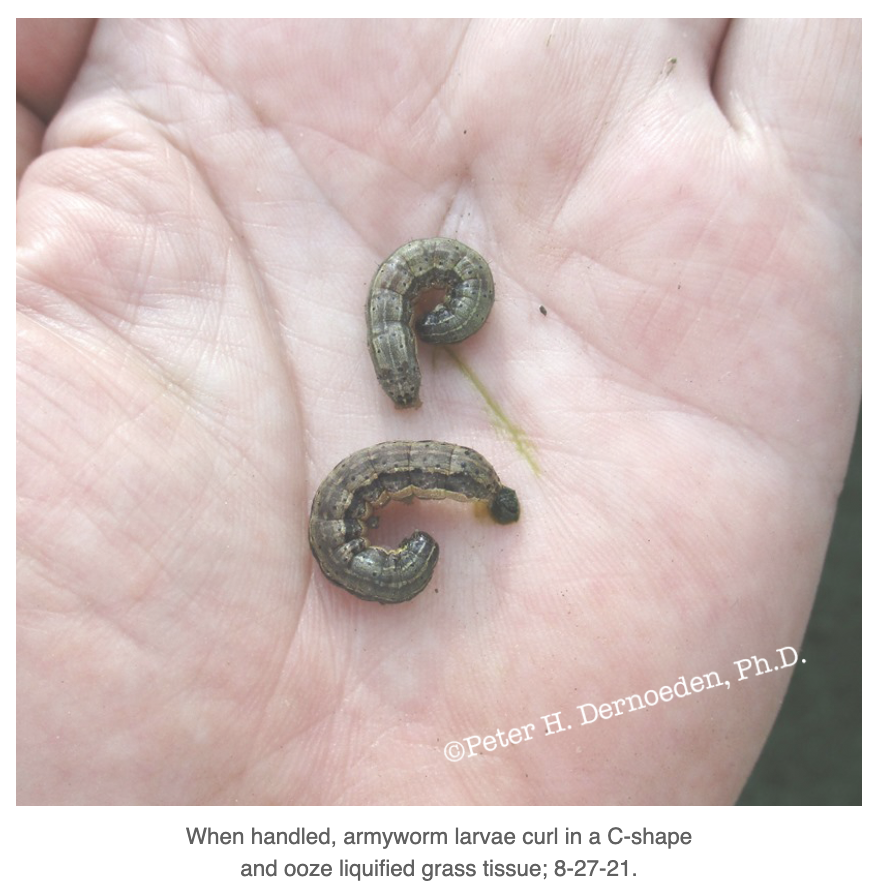
Adults are medium-sized moths. They are dark-gray and have a wing span of about 1.5inches. They are mostly dusk fliers and you are not likely to notice them. They lay eggs in masses on grass blades and newly hatched worm-like larvae are tiny (about 1/16th inch long). Young larvae are usually green, but I have seen some that have a brownish color. As they feed and grow larger and larger, fall armyworm larvae take on mostly a dark, olive-green and almost black color; while the undersides may remain a lighter-green color. At full maturity, larvae range from 1.5 to 2.0 inches long. When handled, larvae curl- in a C-shape (probable defense mechanism against predatory birds) and deposit large amount of oozing green liquefied leaves. Since eggs are laid in masses (one female moth can produce up to 750 eggs). Eggs hatch in just 2-3 days in hot weather. Once the larvae emerge, they may be seen moving across turf in large numbers; hence the name armyworms. They have tiny black dots on their backs and a whitish inverted Y-shaped marking on their heads. After about two weeks of heavy feeding, they go into a resting stage called “pupation.” Pupae develop in underling thatch and soil and develop a dark-red brown color (like old leather) and are somewhat cylindrical- shaped, and shiny. Pupae undergo “metamorphosis” – a mysterious change in form and physiology, and develop into moths. In summer, the entire sequence from egg-larva-pupa -adult can occur in as little as 21 days.
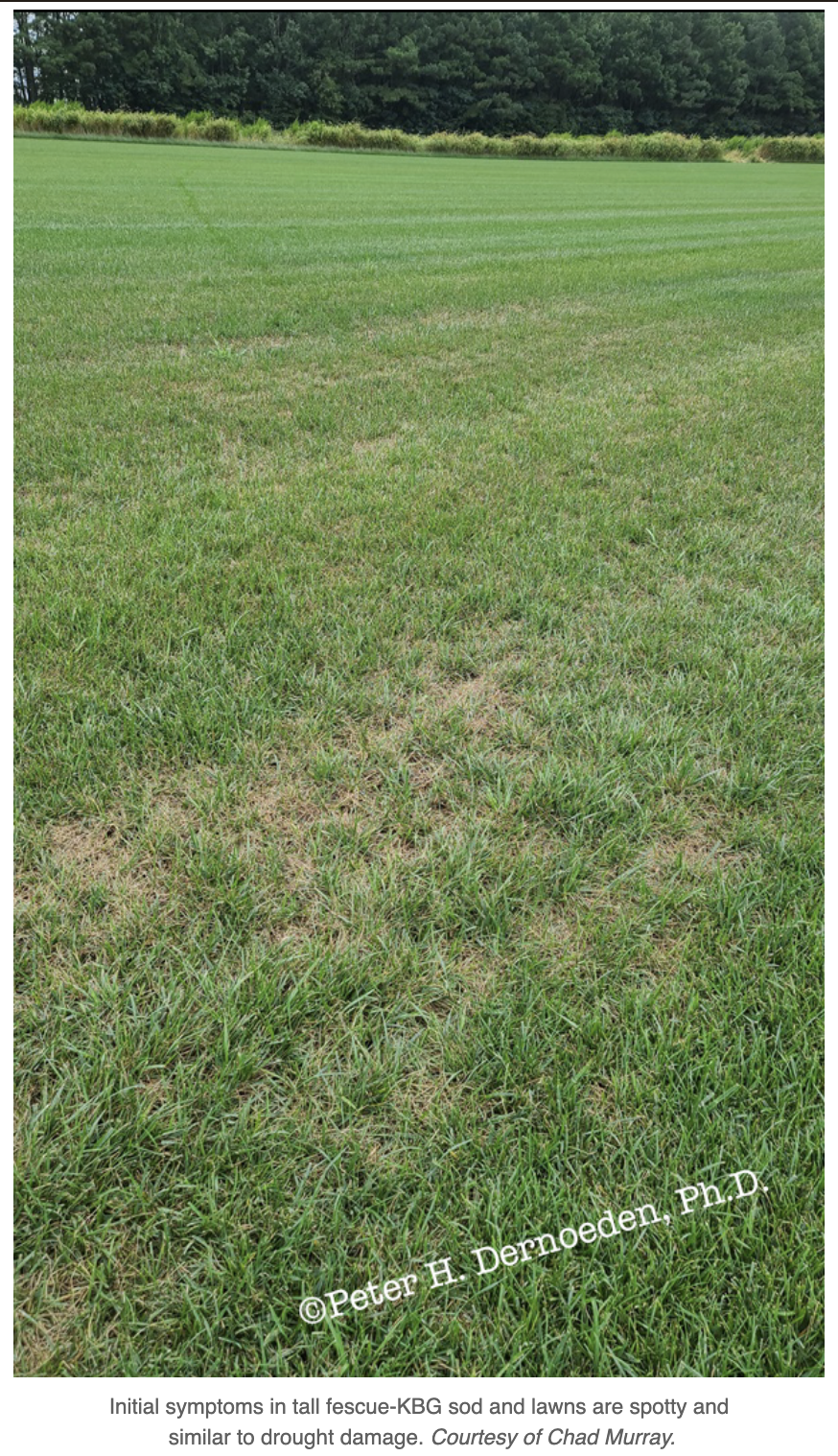
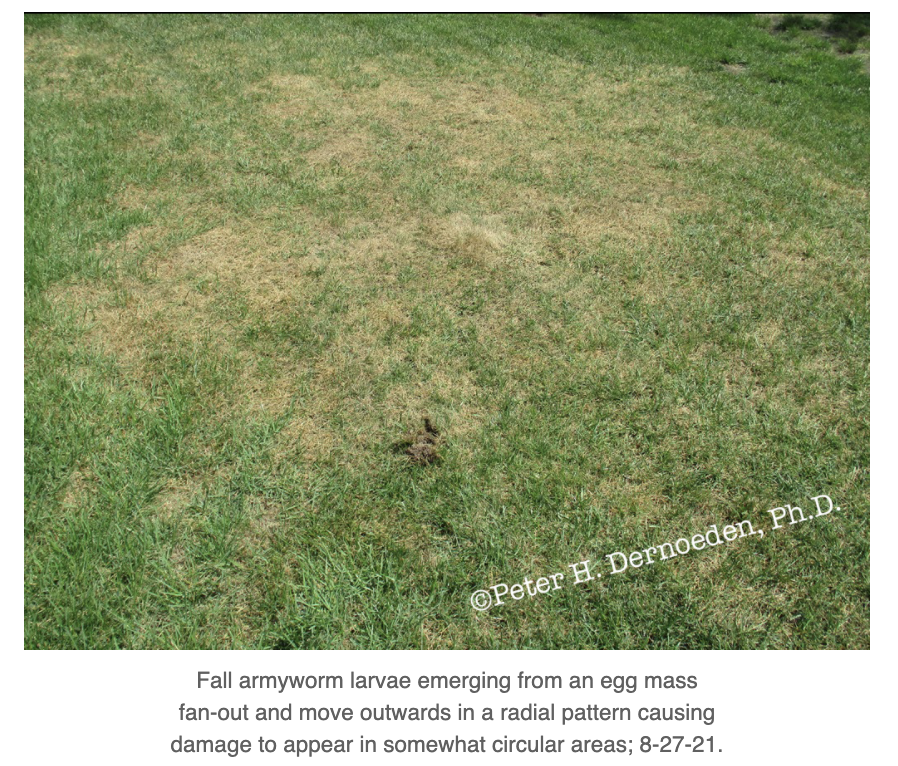
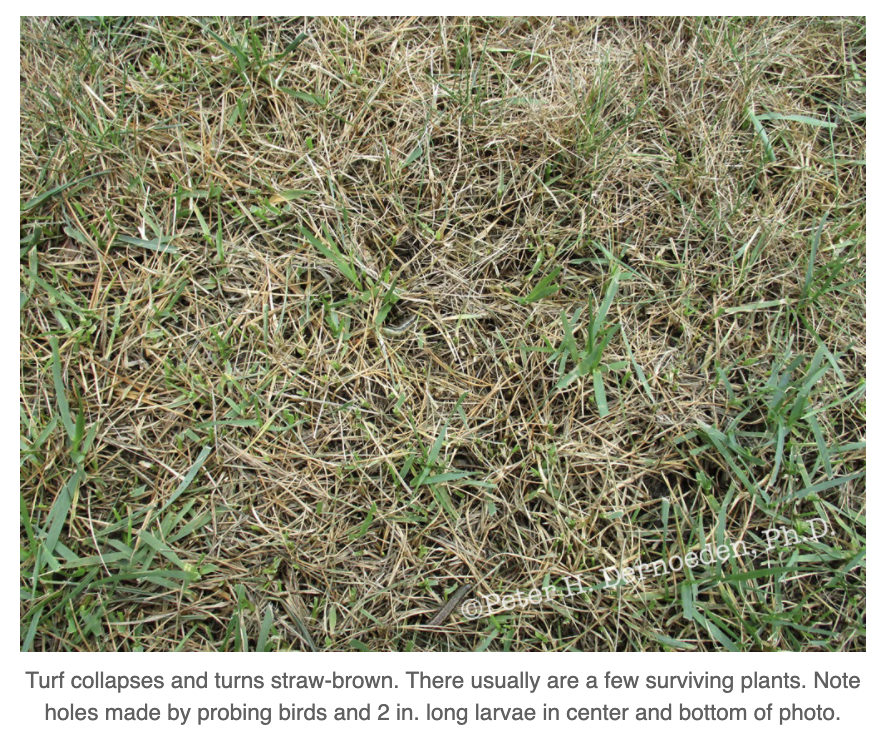
Symptoms of Damage: In many cases, the initial injury appears “spotty” just like drought stress damage. Large areas collapse rapidly during periods of heat and drought and eventually turf turns a straw- brown color. When many larvae hatch from eggs laid a single spot, the “army” of armyworms fan-out and move through turf in a radial pattern; in this case, damage appears as somewhat circular and/or irregular areas of tan or brown turf. There usually are a few plants that escape damage. Being voracious eaters, turf collapse can happen overnight during hot and dry weather. Birds are major predators. Birds somehow see changes in turf color under stress, and begin probing in search of some juicy insect “desert” living just under the surface. The probing activity usually leaves numerous, small and round openings in the browning and/or dead surface mat.
Control: Pyrethroid insecticides generally are used to control surface feeding insects. I’m not an entomologist, so I yield to the specialists to advise you on control options and timings. I thank Charity Givens (Lawns Unlimited, Milton, DE) and Chad Murray (Murray Sod Farm, Selbyville, DE) for alerting me to this emerging and expanding problem.