
It has been one tough summer. It became unusually hot in May, and then we had a cool-down and several rain events in June. July heated-up as expected, but the remnants of tropical storm Elsa produced some heavy rains early in the month, which stimulated weed breakthrough and disease problems. Most notably, I have observed a large release of crabgrass, spurges, and other weeds as well as outbreaks of brown patch, Pythium blight and even gray leaf spot in tall fescue sod fields. Sedges, however, appeared on time in July. Yellow nutsedge and Kyllinga are the most common members of the sedge family that invade turf in our region.
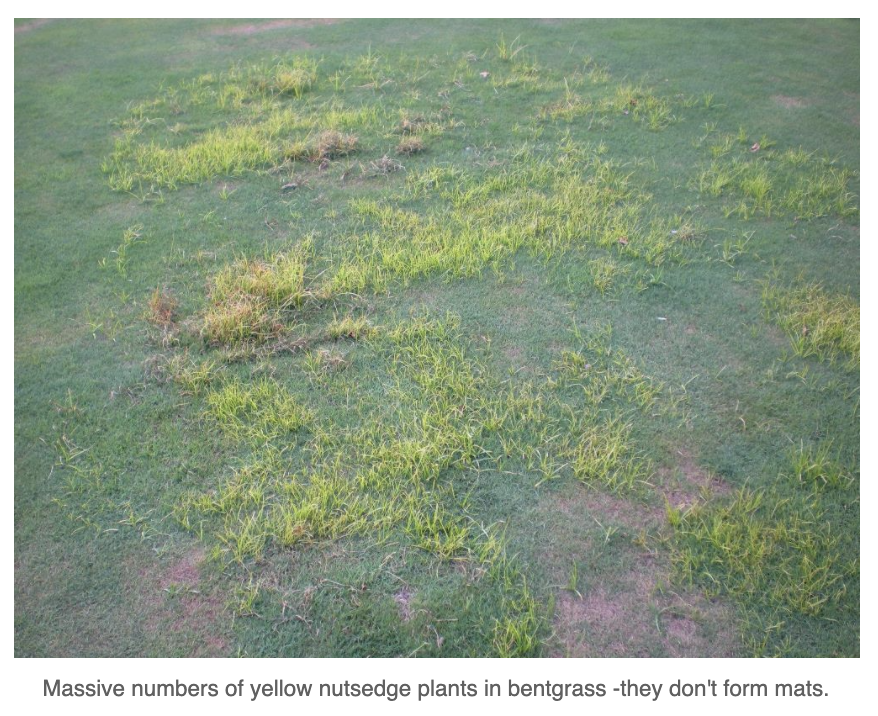
Sedges are neither a grass nor a broadleaf weed. Plants are grass-like perennials that have triangular-shaped leaves. Sedges have shiny, yellow-green, grass-like leaves. Yellow nutsedge develops as solidary plants or in clusters, but mature Kyllinga forms dense, circular mats. Sedges emerge in late spring and throughout summer. Leaves are killed by frosts, but plants survive as seed, and tubers in the case of yellow nutsedge. Sedges mostly are a problem in irrigated turf and wet areas; indeed in older times sedges were called water-grass. Sedges emerge sporadically throughout summer and colonize both sunny and shaded sites, including well-drained slopes.


Yellow nutsedge (Cyperus esculentus) plants can emerge in bare ground seedbeds in early spring at about the same time as crabgrass. In established turf, however, yellow nutsedge emergence normally does not become prevalent until late June and early July. Initially, yellow nutsedge plants appear to be fine-bladed, yellow-green, grass-like leaves. Plants can sprout from underground tubers or emerge from seed. Leaves are yellow to light green, and shiny. As plants mature, they develop slightly fleshy, three-ranked, triangular- shaped (i.e., 3-angled) leaves.
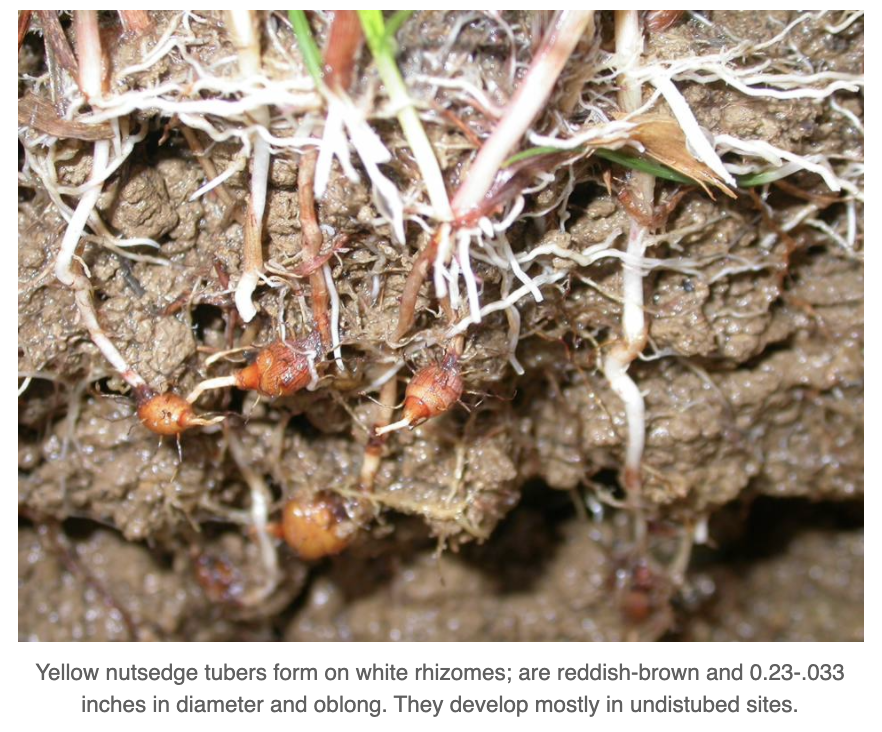
In most maintained turf sites, yellow nutsedge emerges primarily from seed. If plants are allowed to remain uncontrolled, they eventually will produce underground tubes. I once read that tubers can form as early as the 7-leaf stage, but I have never found one except in mulched ornamental beds. In my experience, tubers only form in undisturbed, unmowed and largely abandoned sites. Tubers are onion-like and form on roots and initially are white, but turn brown as they age. Tubers are small, about 0.25-0.33 inches in diameter and most are produced in the upper 3 to 4 inches of soil. Each plant can produce numerous tubers, which may persist for 10 or more years. Where present, tilling soil effectively redistributes tubers and rhizomes, making this weed highly invasive in spring seeding’s.
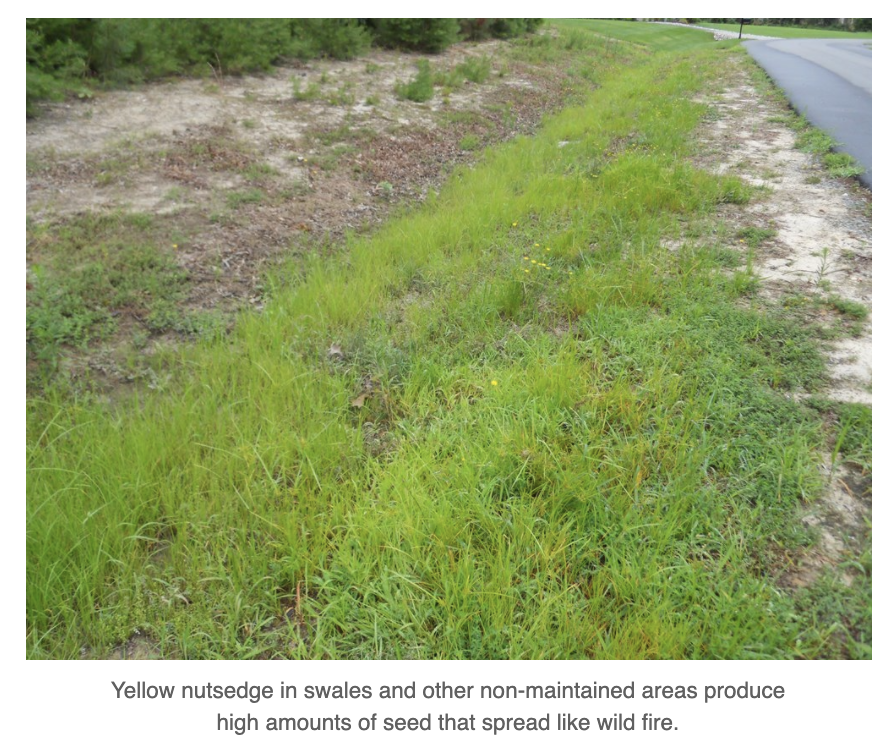
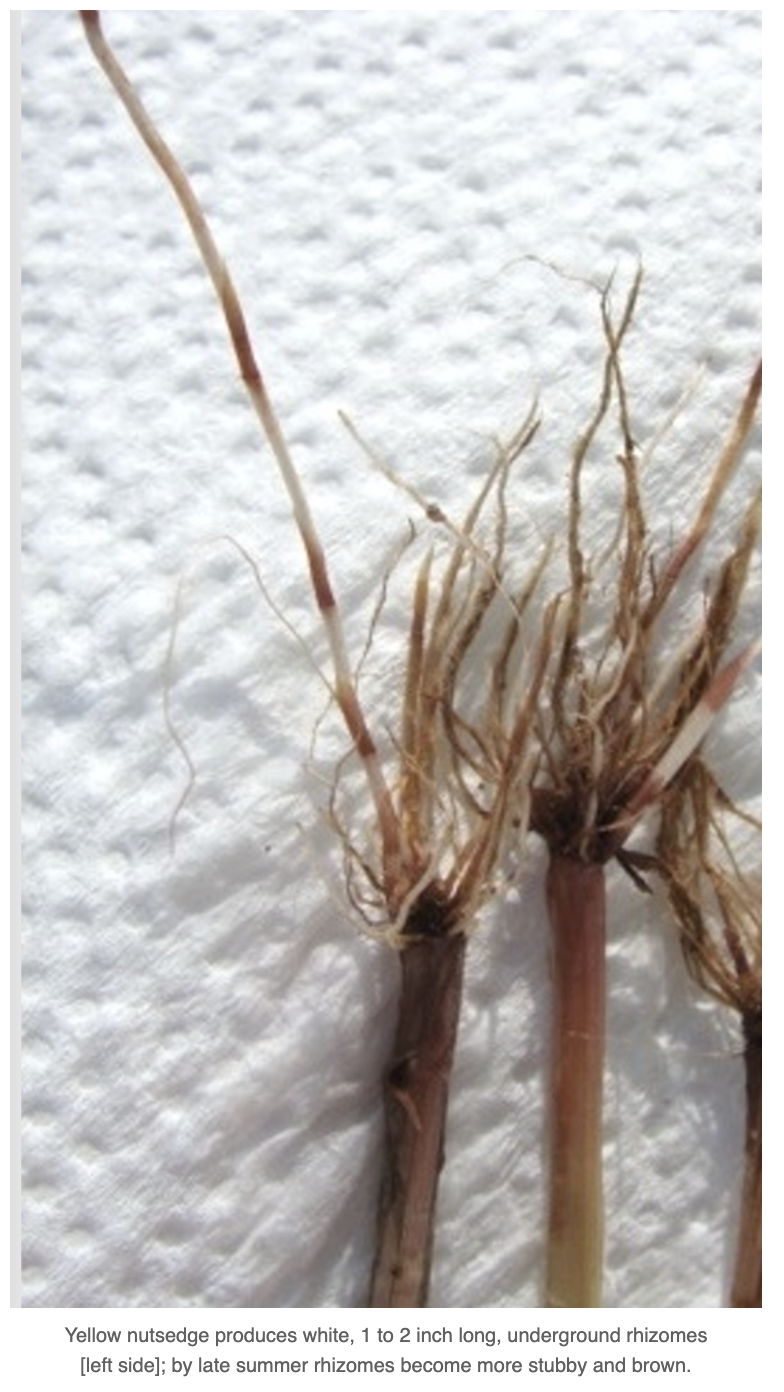
Mature plants also produce underground stems called rhizomes, which look like white fleshy roots. Yellow nutsedge rhizomes are short and wiry (1- 3” long), but plants do not form turf-like mats as in the case of Kyllinga. Seedheads generally do not develop in closely mowed turf. In infrequently mowed low maintenance areas, seedheads form in mid-to-late summer. Massive numbers of seedheads often develop in swales and other generally wet areas where there is little or no mowing. It is from these sites that seeds are produced in masses and eventually redistributed by wind, water and by wildlife (esp. geese). Yellowish-brown flowers develop in globe-like clusters that arise from a common point and grow upwards like ribs or spokes on an upside-down umbrella. Frost kills leaves in the autumn, but plants survive as tubers, but mostly as seed in turfs.


Kyllinga: There are several species of Kyllinga. Green Kyllinga (Kyllinga brevifolia ) produces seedheads throughout summer months, but what I see in our region is mainly false green Kyllinga (Kyllinga gracillima), which produces seedheads in August and September.
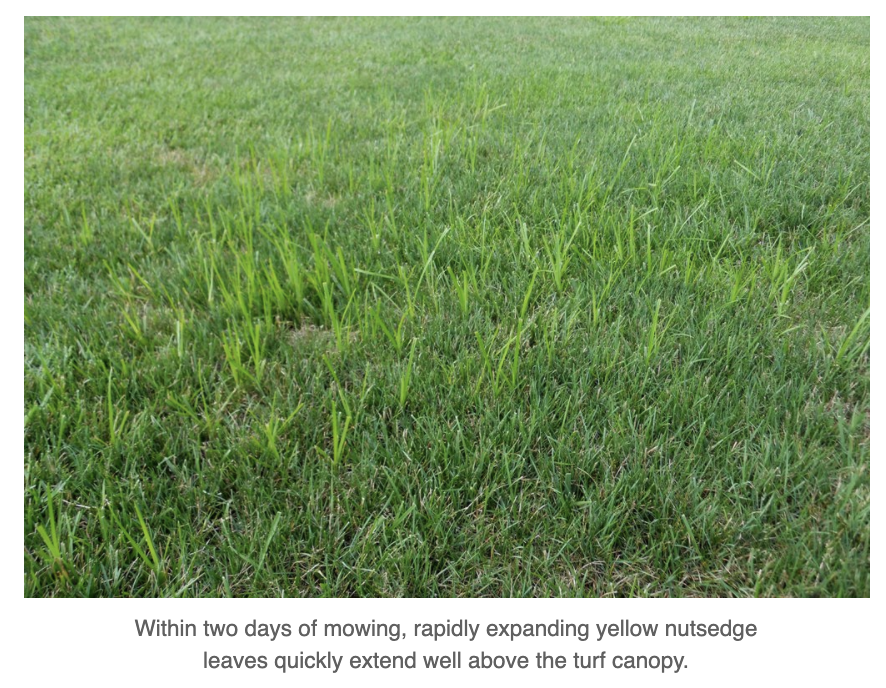
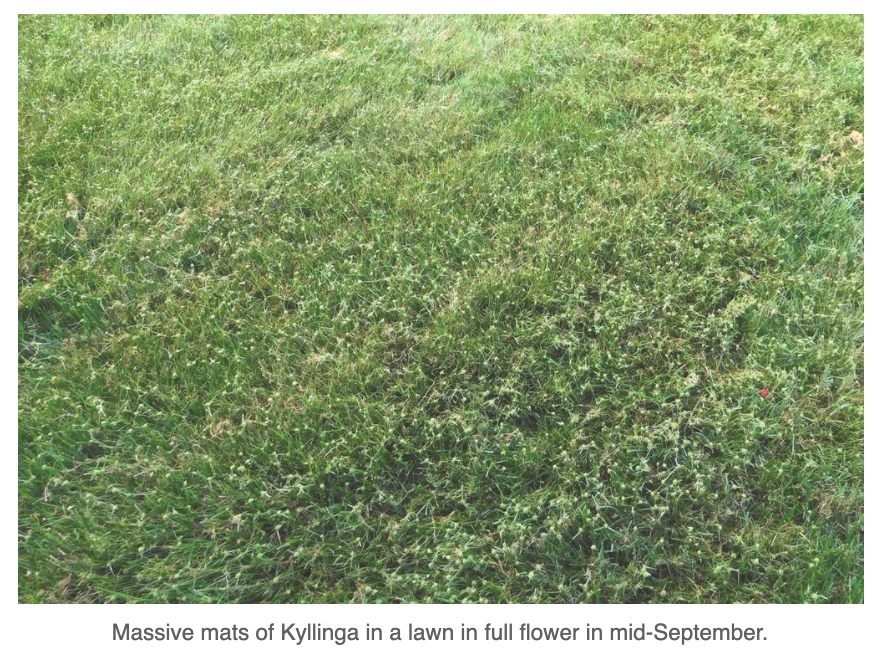
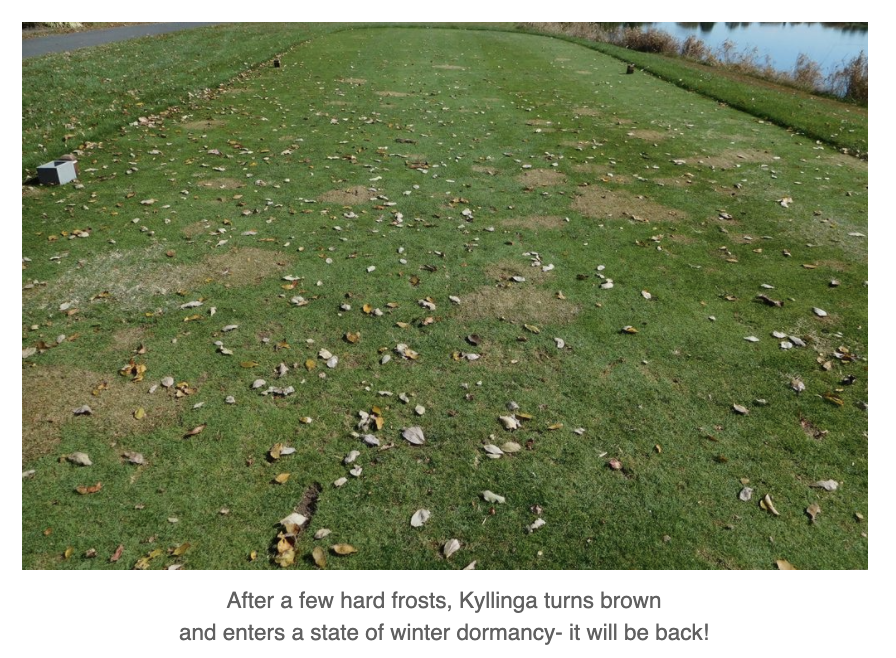
Kyllinga emerges in spring from rhizomes and seed, but it may not become noticeable in lawns and roughs until late summer, when seedheads are produced. As noted below, Kyllinga in lawns and roughs tends to blend-in, since leaves are darker green than yellow nutsedge and grow at the same or slower pace than turf; whereas, yellow nutsedge produces rapidly forming long yellow-green leaves within a day or two of mowing. Kyllinga becomes much more noticeable in close-cut fairways, tees and even greens due it its bright green mats, which contrast greatly in color compared to the turf. Kyllinga produces masses of fleshy and long rhizomes that enable plants to spread rapidly in dense, circular mats. Mats eventually coalesce and form a thick turf-like covers. In late summer, mature Kyllinga mats turn yellow-green. Indeed, thick, dense, yellow mats lining bunker faces and driveways are so uniform in appearance that they look like artificial turf. Its yellow-green mats tolerate extremely hot and dry conditions. Some see Kyllinga mats as a nice cover in the heat of summer. However, when freezing nights arrive in late autumn the mats turn brown and enter winter dormancy; similar to dormant bermudagrass and/ or zoysiagrass.
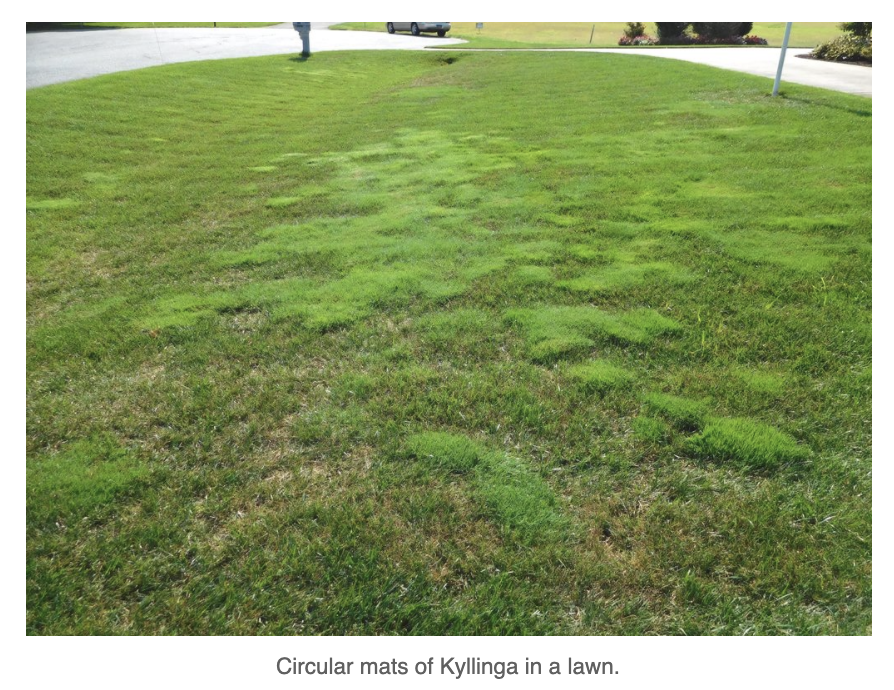
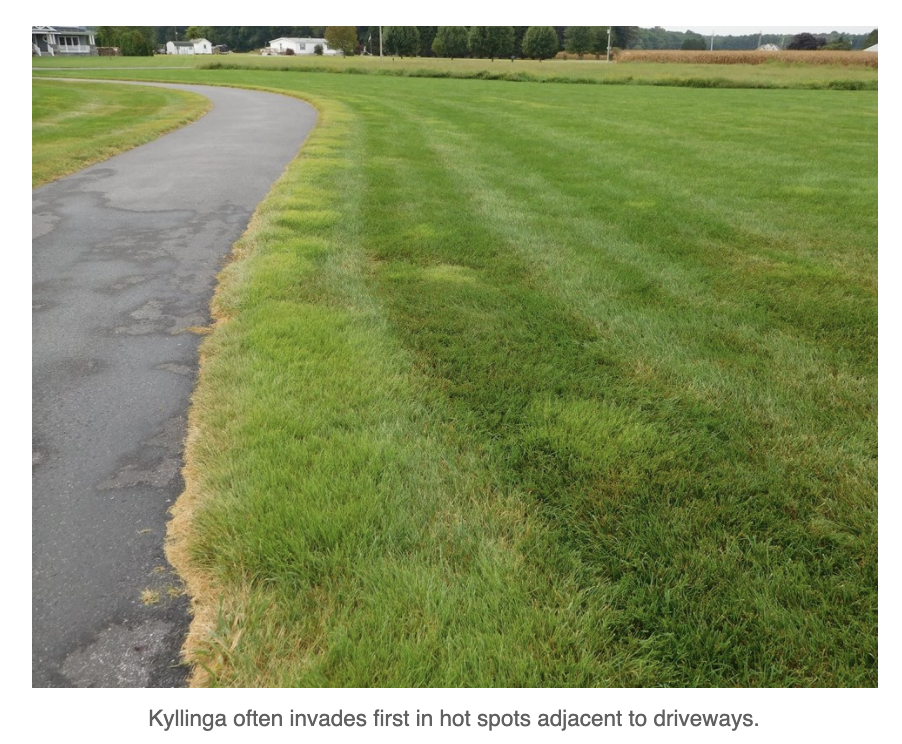
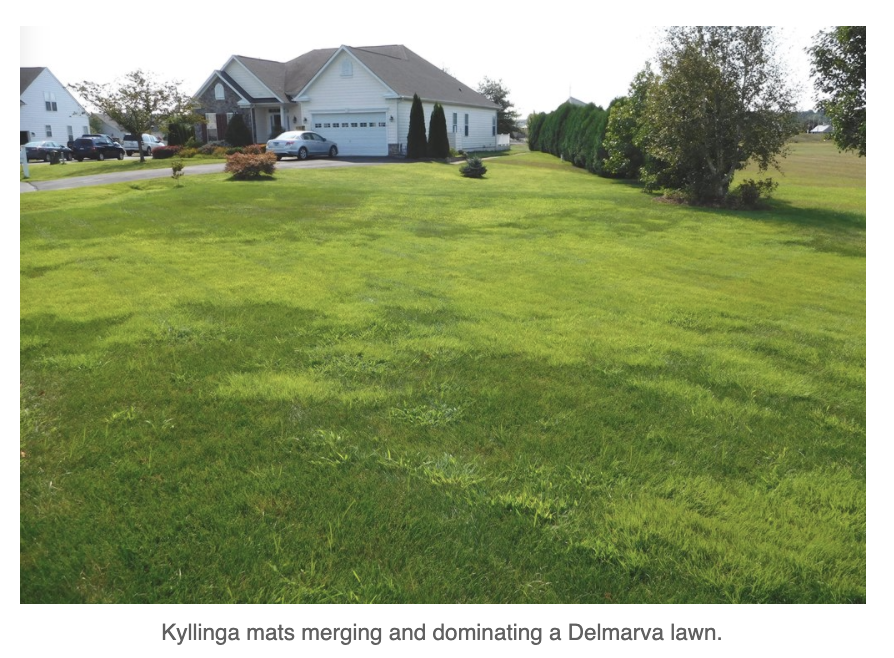
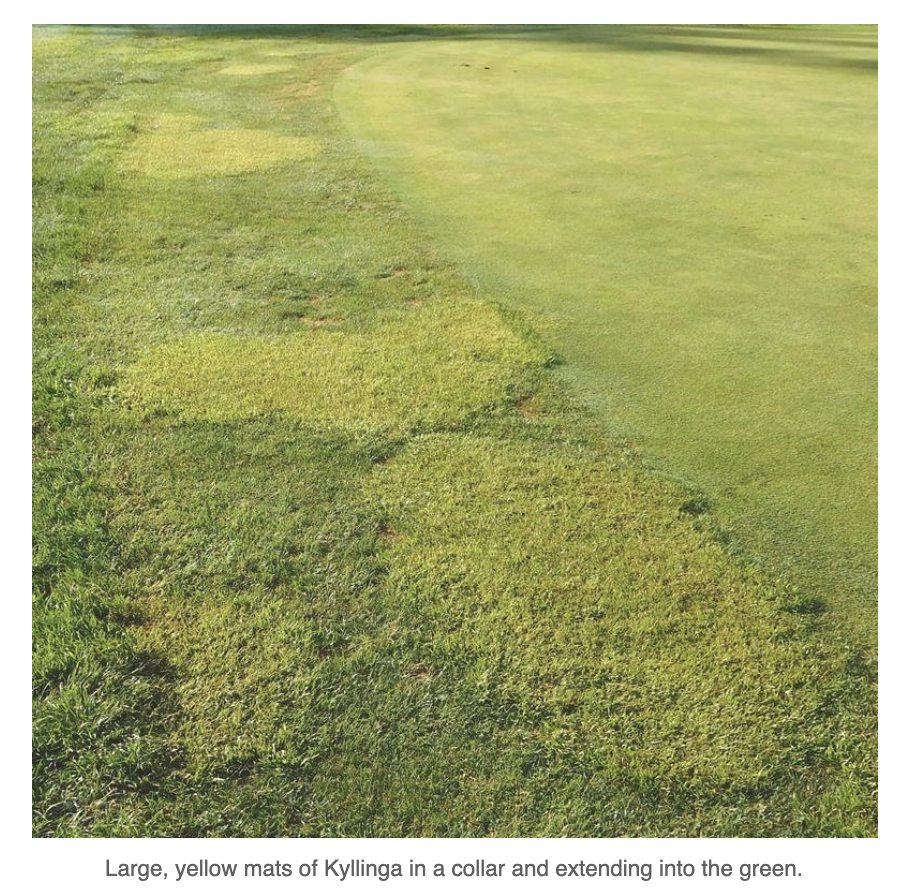
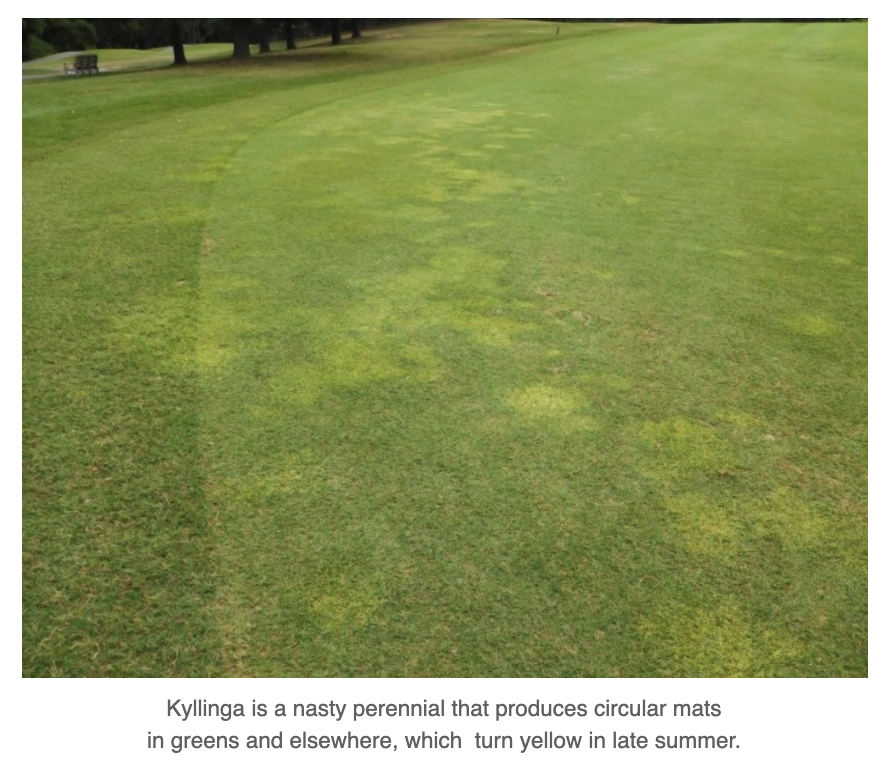
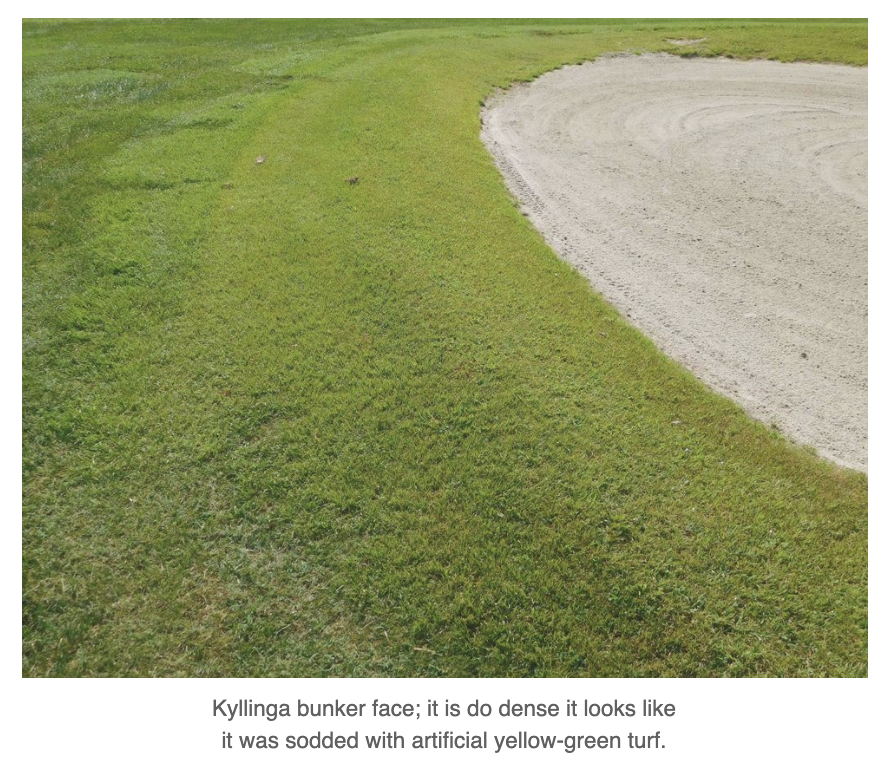
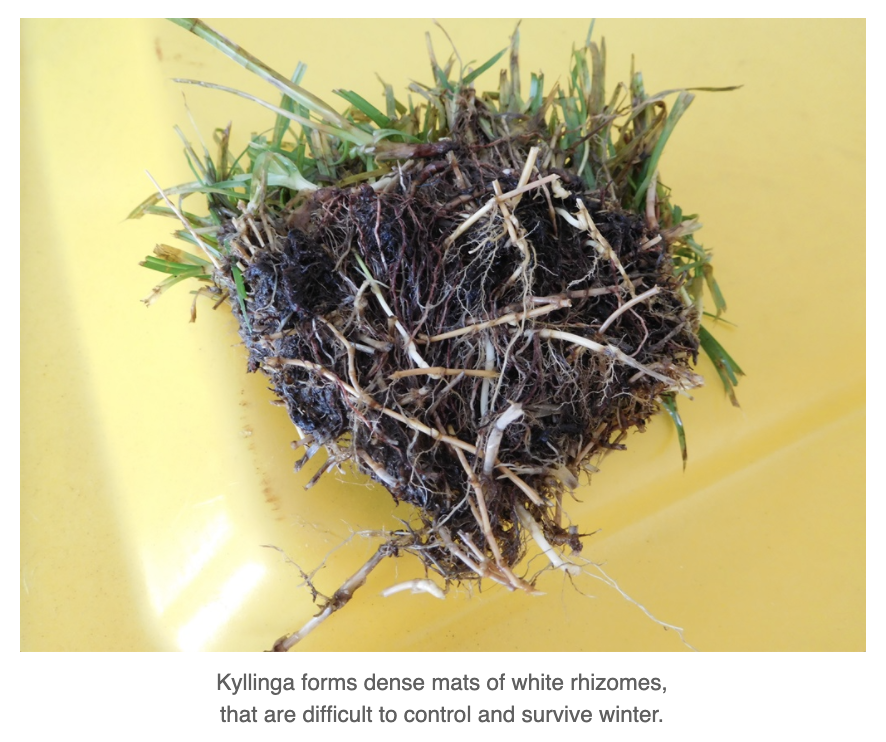
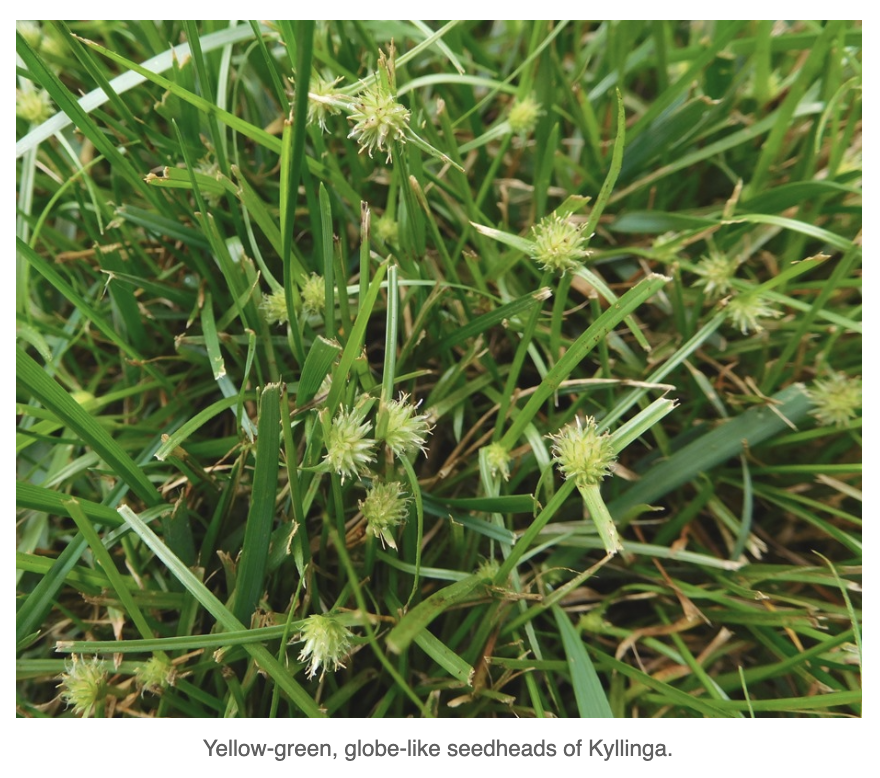
It is important to re-state, that Kyllinga is much sneakier than yellow nutsedge. Yellow nutsedge plants can extend 2-3” in height in lawns or roughs in just a two days after mowing. Conversely, Kyllinga does not grow as rapidly and blends in better. Indeed, many turf mangers don’t recognize a Kyllinga problem in higher cut lawns, roughs and sometimes even surrounds until seedheads become abundant. Kyllinga seedheads develop in globe-like clusters, which initially are yellow-green, and then turn brown. Autumn frosts kill leaves, but Kyllinga plants, and more importantly their massive mats, survive from rhizomes. It is so important to control Kyllinga before massive amounts of seed are produced. Once established, its seed spread like wild fire.
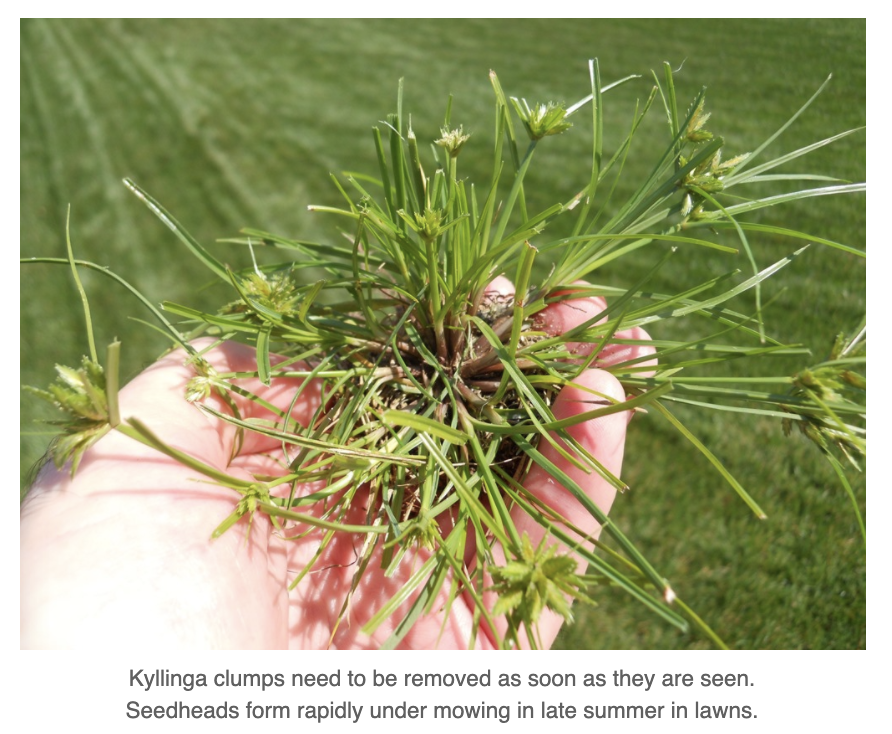
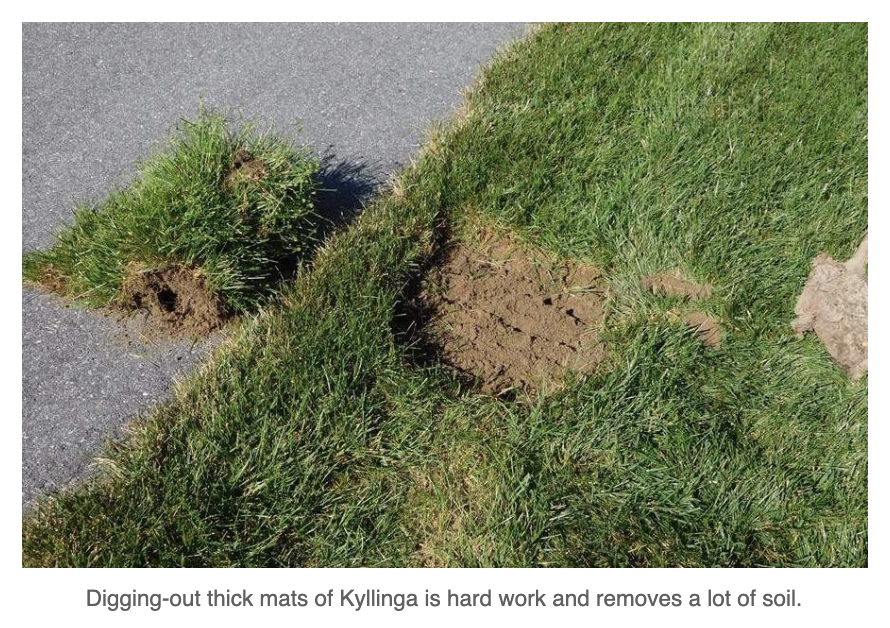
Cultural Control: Improving water drainage and alleviating soil compaction are cultural approaches to reducing the invasiveness of yellow nutsedge and Kyllinga. In reality, once they get a foothold it takes a conscious effort for homeowners to physically remove plants as they become evident. This is easy in the case of yellow nutsedge plants, which are easily detached. Conversely, even young Kyllinga clumps take an effort to physically pull- out of the ground, but it takes a shovel to remove mats.
As noted below, there are three herbicides that effectively control yellow nutsedge and Kyllinga. The problem is (especially in the case of yellow nutsedge) that they will kill emerged plants, but seed emergence is spread-out all summer long. That is, you may eliminate what your see in July, but by early August there will be many more new plants that will have emerged from seed. Emergence continues well past Labor Day.
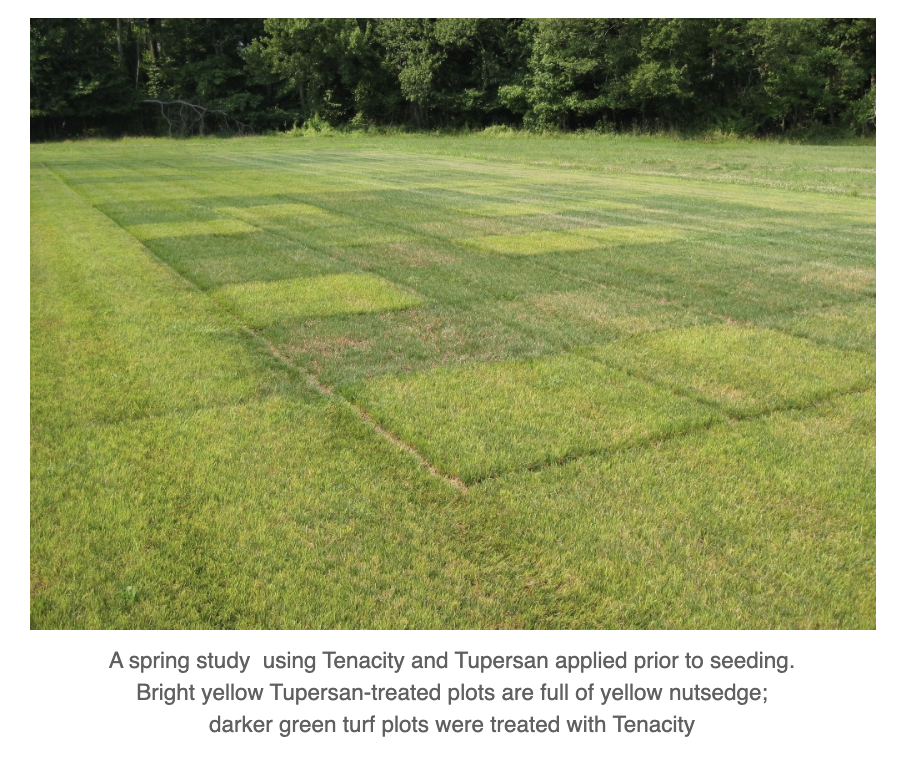
Preemergence Herbicides: Currently, there are no effective preemergence herbicides for either yellow nutsedge or Kyllinga in mature turf. However, in spring seedlings/seedbeds., Tenacity (mesotrione) is highly effective in controlling yellow nutsedge –there is no information if this is true for Kyllinga.
Postemergence Herbicides: Celero (imazosulfuron), Dismiss (sulfentrazone) and Sedgehammer (halosulfuron) are the most effective herbicides for targeting yellow nutsedge and Kyllinga. Sledgehammer may cause some yellowing in bentgrass, but it is slow to react and thus does not produce an immediate effect. A response from Celero and Dismiss normally is seen within a few days of application. As noted above, yellow nutsedge emerges all summer-long and while a single application may do a good job, there are likely to be many more yellow nutsedge plants emerging into late August.
Kyllinga Control on Golf Courses: Kyllinga is especially difficult to control given its extensive network of rhizomes and at least two applications, and often more, are required. Professional’s either swear by or swear at the aforementioned herbicides. Timing is very important in control of Kyllinga. All herbicides have the potential of causing yellowing or some other type of discoloration. In the case of Sledgehammer, it may take up to two or more weeks before yellowing occurs. On golf courses, Kyllinga is best controlled when the first application is made just after mats become apparent in June. A second application is needed 21-25 days later, but some plants often survive via rhizomes.
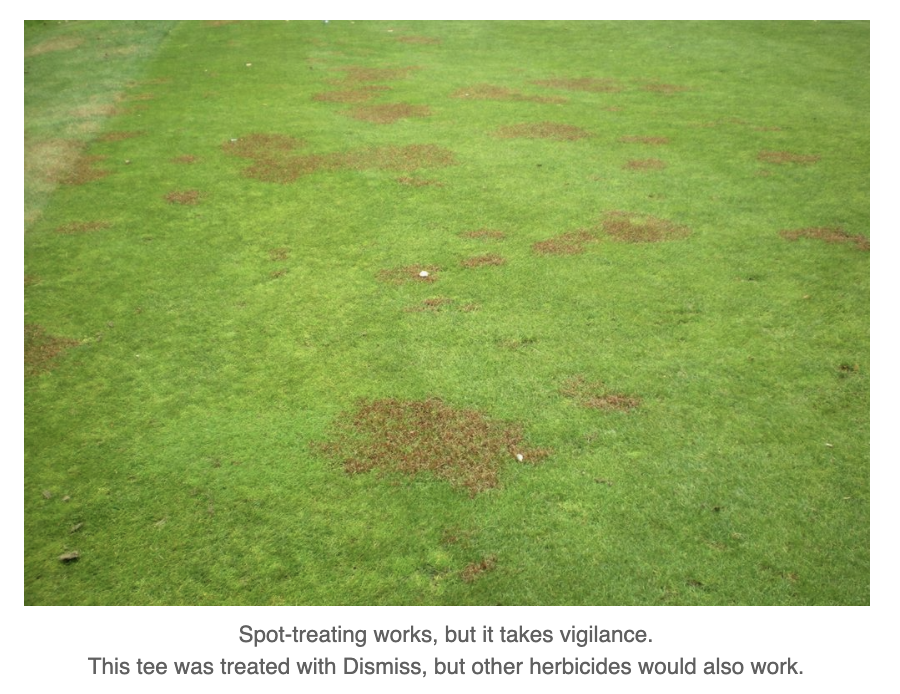
I don’t know of anyone who has been highly successful using any herbicide on greens or approaches. The problem is that under low mowing on greens, and even tight approaches and fairways, there is just not enough leaf surface area of the weed to intercept and take-up herbicidal levels. The most effective strategy for golf courses is a combination of suppression with herbicides, and when there is time and labor available, cut out the plants. Of course winter is the perfect time, but unfortunately Kyllinga turns brown and disappears rapidly following a few frosts. Thus, some method of marking is needed to find and physically remove Kyllinga from greens/approached, collars etc. In fairways, tees and roughs, multiple applications of one of the aforementioned are needed, but I’m not sure any herbicide available today will give complete control of mature Kyllinga mats. It is especially important to aggressively attack Kyllinga in green surrounds and approaches as soon as it is observed; otherwise it will soon invade collars and greens. Kyllinga will be a recurring problem since it is rapidly disseminated by seed and because it is tough to kill once mats develop. It should be noted that late season application(s) of any herbicide that coincides with frosts can damage bentgrass. Once Kyllinga begins to go frost-dormant, herbicides should be avoided.
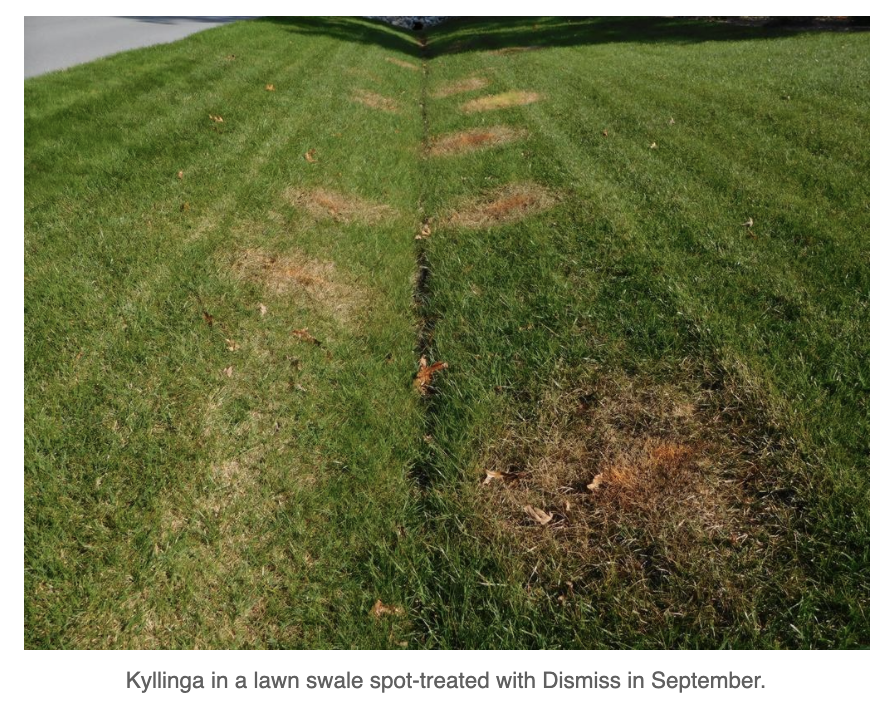
Lawns: If possible, homeowners need to be trained to spot Kyllinga plants as they first appear in clumps (usually early July). Once mats develop, Kyllinga becomes one of the toughest of all lawn weeds. Mats can be physically removed with a shovel, but it is tough work and the excavation will require filling with fresh soil and reseeding or better-sodding. For LCO’s (for economy and logistics), Kyllinga normally is targeted in late summer with spot applications of an herbicide. Good luck, because there will be surviving rhizomes and likely thousands of seed from which the weed will return enforce!
Final Note: Once a large seed bank of yellow nutsedge and/or Kyllinga build, fighting these weeds will be an annual event –like crabgrass, Poa or any other highly invasive and well adapted weed.