
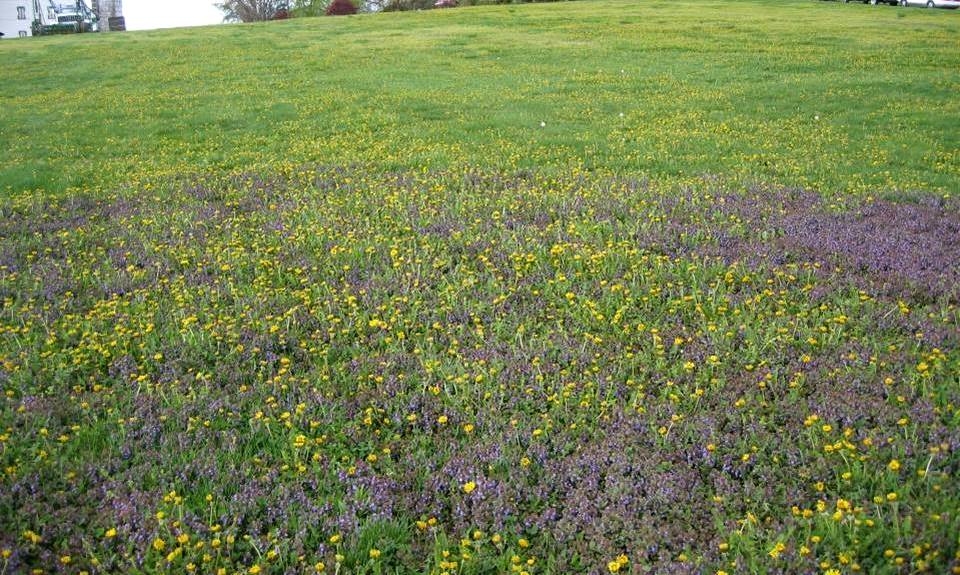
Most turf professionals walk with their heads-down, scouting for the appearance of something usual or out of place. One of the first indicators that it may be time to get the sprayers and mowers out, is the sudden appearance of flowering winter annual broadleaf weeds. Winter annuals germinate mostly between late summer and very early spring; produce flowers and seed ; and die with the advent of warmer and drier days in summer. A few of these species can behave as biennials (e.g., red stem filaree) and sometimes as perennials (e.g. slender speedwell). Biennials take two years to complete their lifecycle; during the first year plants live through winter as clusters of leaves; and eventually flower and produce seeds the second spring of their existence. In our region (i.e., the Philadelphia to Richmond corridor; South Jersey, Delaware and the Eastern shore of Maryland) these weeds largely behave as winter annuals, due in large part, to our often hot and dry summers.
Winter annuals tolerate very low winter temperatures and even long droughty periods during their brief lifetimes. Winter annual broadleaf weeds remain tiny and inconspicuous under turf canopies until the first few warm and sunny days in March. These plants are among the first to feel the effects of increasing daylight and slowly increasing growing degrees, or warming of the soil. Mysteriously, increasing day lengths are detected by winter annuals, despite frigid nights and overcast days that linger in the 30’s and 40’s ºF in February.
Let’s go back in time to get some perspective that humans may not notice, but some plants do. The last day of winter (solstice) occurs when the Earth Poles have achieved maximum tilt away from the sun (in our Northern hemisphere). This is the time when nights are longest and days are shortest, which normally occurs around December 21 –thereafter day lengths begin to increase slowly. The first day of spring (equinox), marks the time when the sun crosses the equator, which generally occurs around March 20. This timing coincides with “Spring Ahead” to daylight savings time, which occurred on March 14, 2021.
Increasing day lengths, despite miserable and overcast days between February to mid-March , provide enough light that helps begin warming of tiny plants, which remain hidden below turf canopies. This subtle heating (despite our furnaces working overtime at night) begin to accumulate in leaves and soil surfaces. Among the first to break-through a brown winter landscape include: red stem filaree; hairy bittercress; common groundsel; henbit / purple-dead-nettle ; slender speedwell; and cudweed. March is the time when winter annuals spring into their colorful glory. Most are competitive in fall seeded stand, while others are merely objectionable or just curiosity plants.
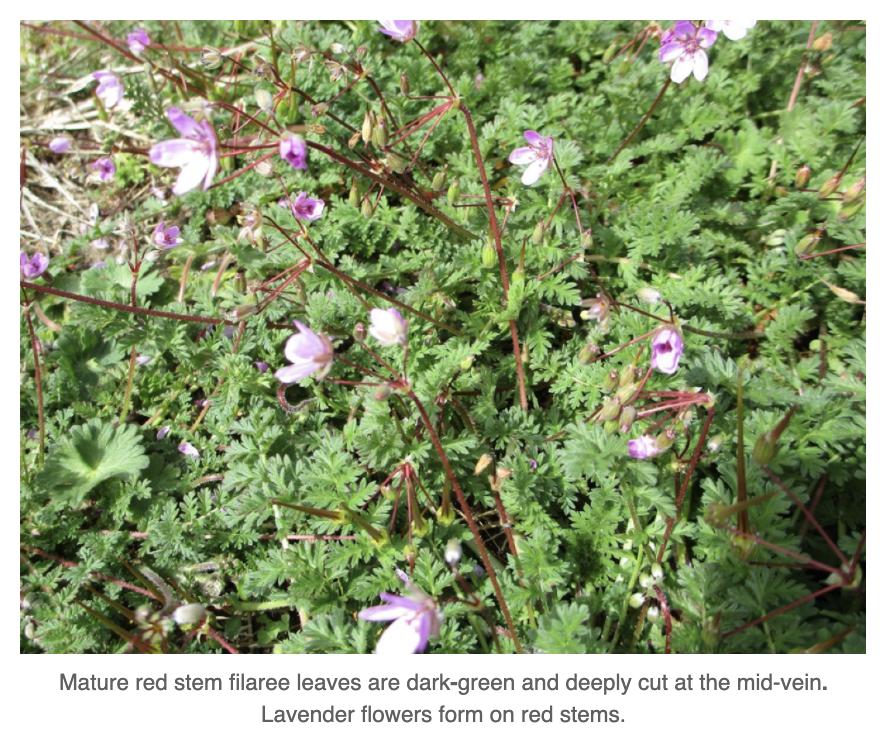
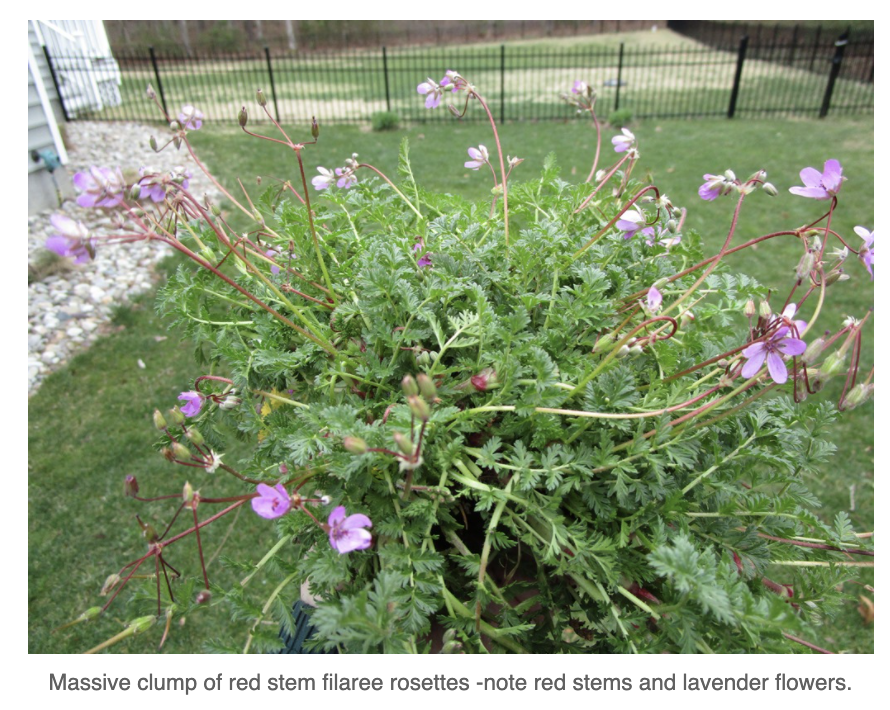
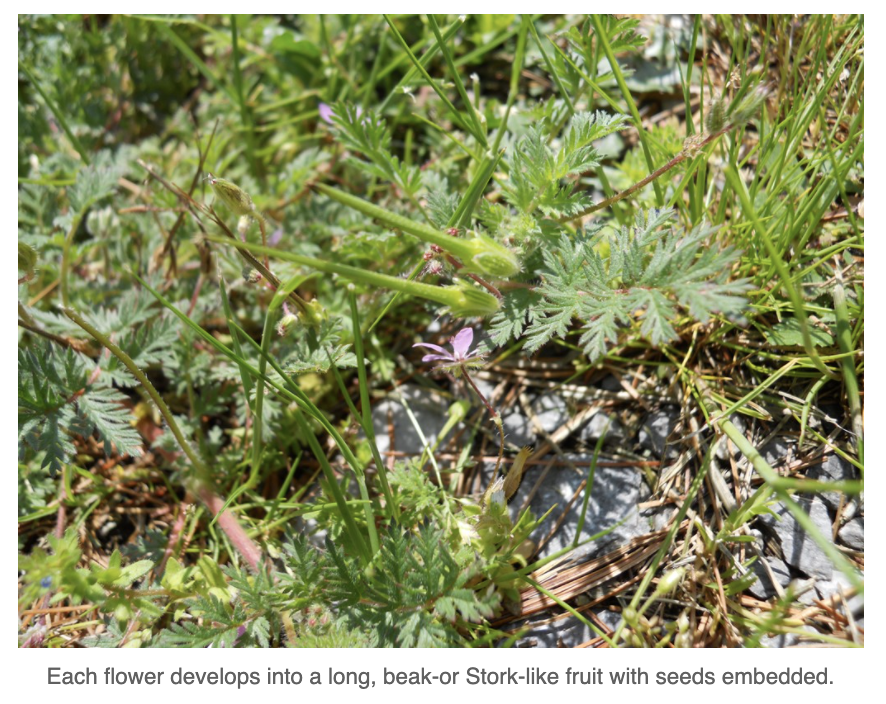
Red-stem filaree (Erodium cicutarium): (aka red-stem stork’s bill) plants can be seen flowering in warm and secluded sites (e.g., mulched beds and adjacent to rusting machinery in a field) during late winter (usually February in our region). Young leaves are compound (i.e., with 2 or more leaflets), deeply cut and dissected into numerous segments. Maturing plants form rosettes of dark-green and hairy leaves. Mature compound leaves are deeply cut to the mid-vein. Stems develop from rosettes (roundish clusters or radiating leaves) and are hairy and fleshy, and can grow 4 to 6 inches or longer. Stems grow low to the ground and usually are green close to the base of rosettes, but become reddish as they elongate. Flowers form in clusters on long (up to 2”), hairy and leafless stalks. Flowers have 5 petals and are pink, purple or lavender. Each flower develops into a long, conspicuous beak-like fruit that mimics a “stork’s bill.” Flowers and fruit persist for only a short period, but rosettes can remain evident until the advent of hot and dry weather.
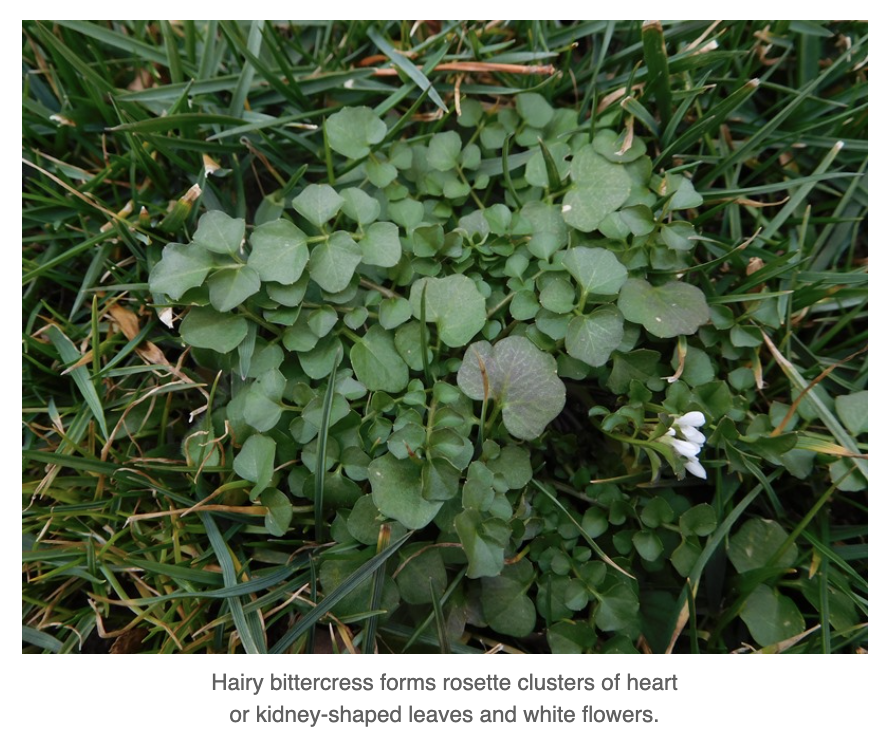
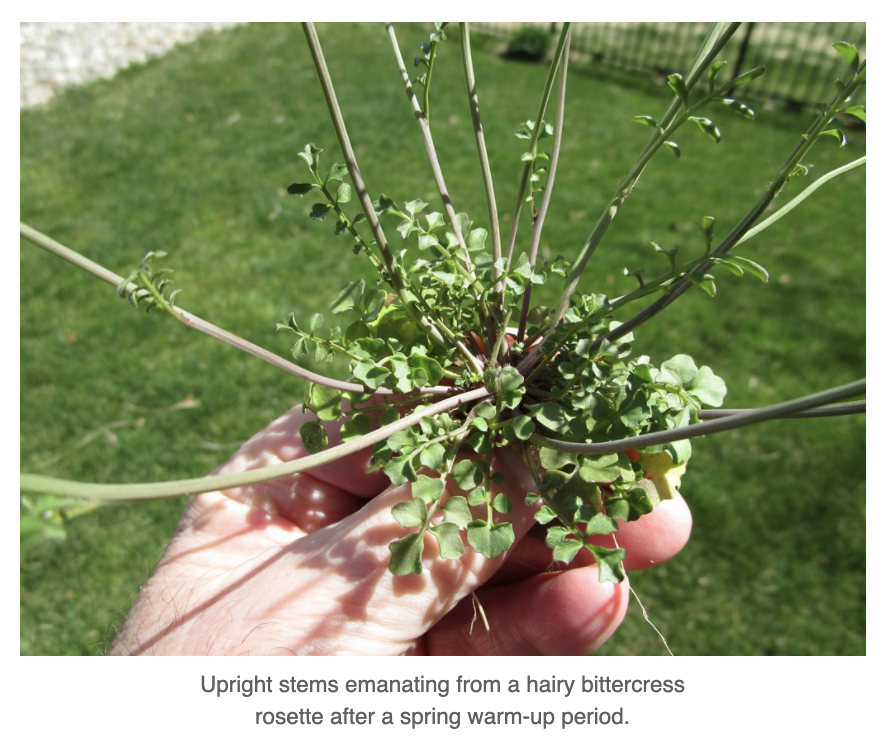
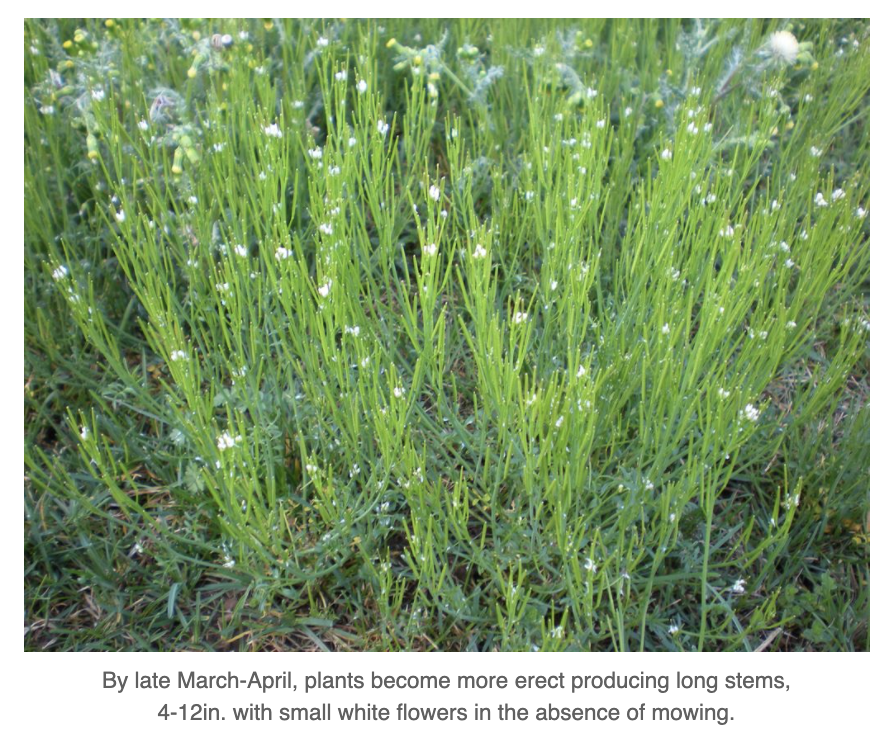
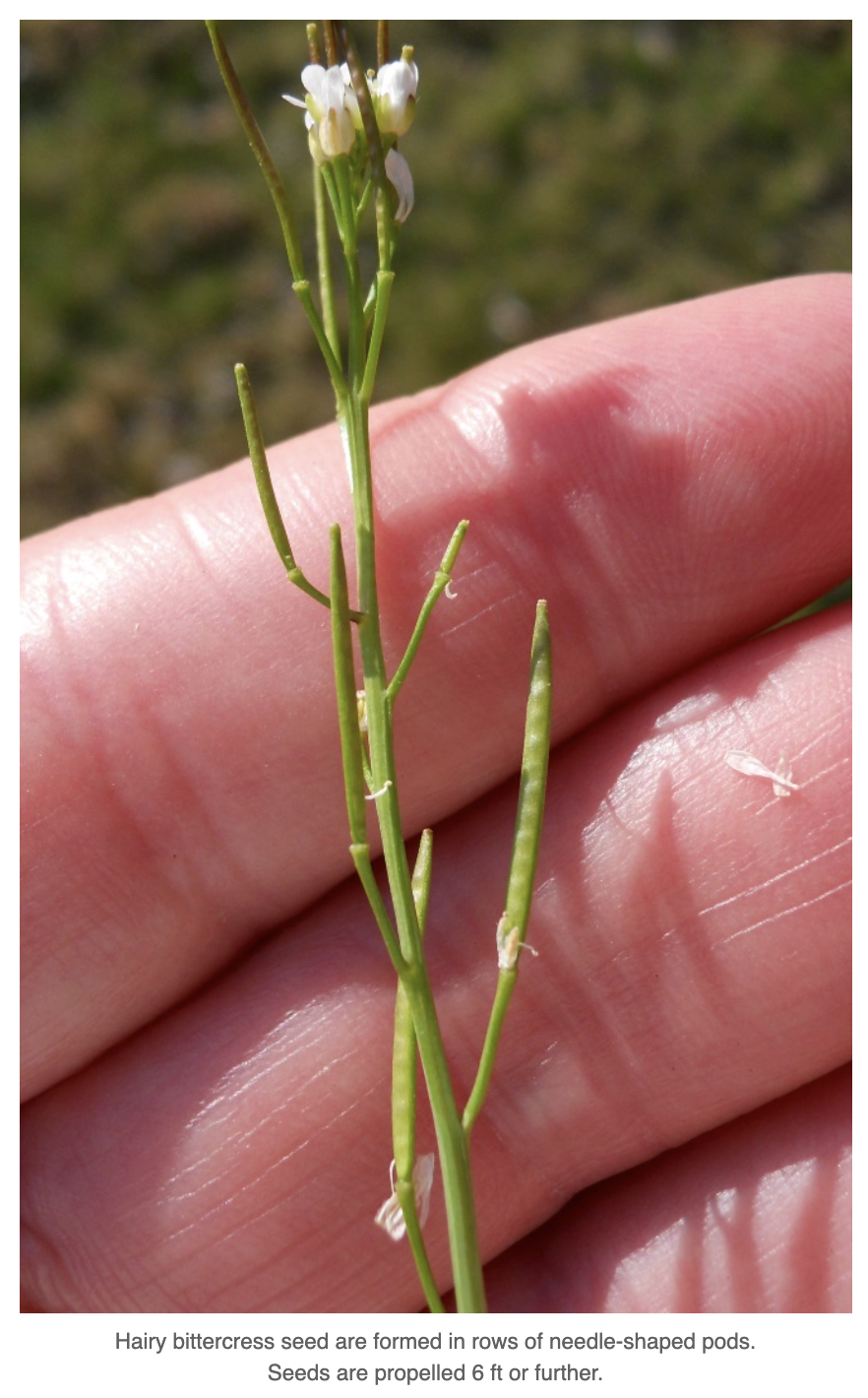
Hairy bittercress (Cardamine hirsuta). In late winter, cluster of tufted dark-green leaves are prominent. Immature hairy bittercress produces small kidney or heart- shaped leaves. Stems are purplish-green and have a square-feel. Mature plants produce basal rosettes with deeply lobed leaves. Leaves are sparsely hairy on upper surfaces and hairs can only be seen with aid of a hand lens. Lower and older stems are more conspicuously hairy. Small, white flowers, with four white petals, form in clusters on the end of stems. Flowers can appear in late February during mild periods on top of 2” to 3” long stems. Normally by March, stems with numerous terminal white flowers, grow to 4” to 12” or higher in the absence of mowing. Seeds are produced in rows in flattened, narrow or needle-shaped pods (0.25 to 0.5” long). Flattened pods, called capsules, form with seed arranged in rows. When mature, seed are explosively propelled from pods over a distance of 6 ft. or greater. This is especially notable when mowing, at which time one can see and feel the seeds flying and pinging. Hairy bittercress stems give turf a shaggy appearance, but plants are not invasive in mature and dense turf. With the advent of warm temperatures, plants naturally senesce and die. Hairy bittercress is a competitive problem in immature stands. Otherwise, their long stems and flowers give lawns, roughs, sports fields and sod fields a shaggy appearance until mowing operations commence.
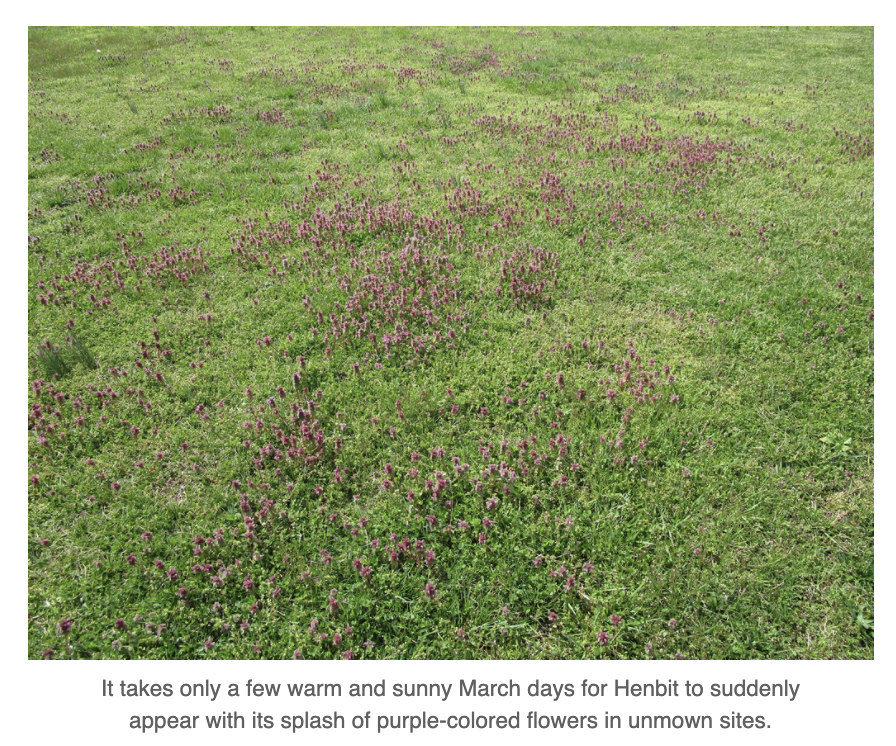
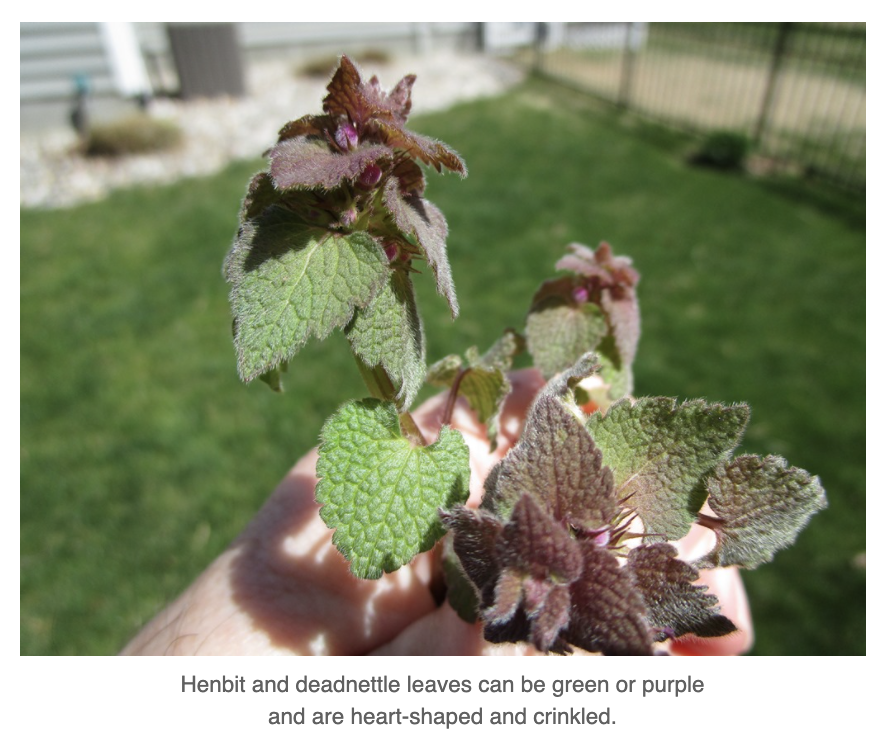
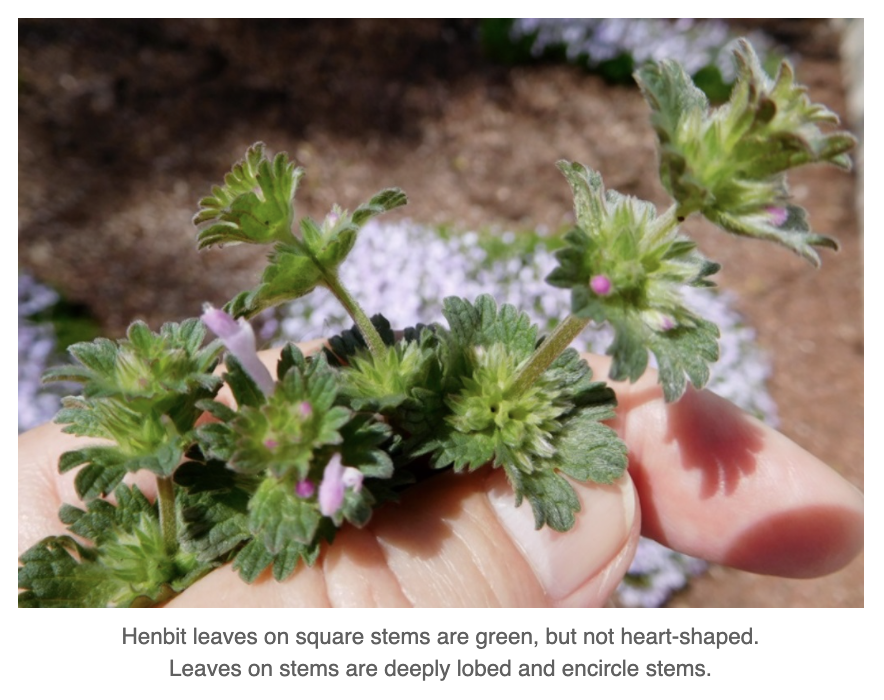
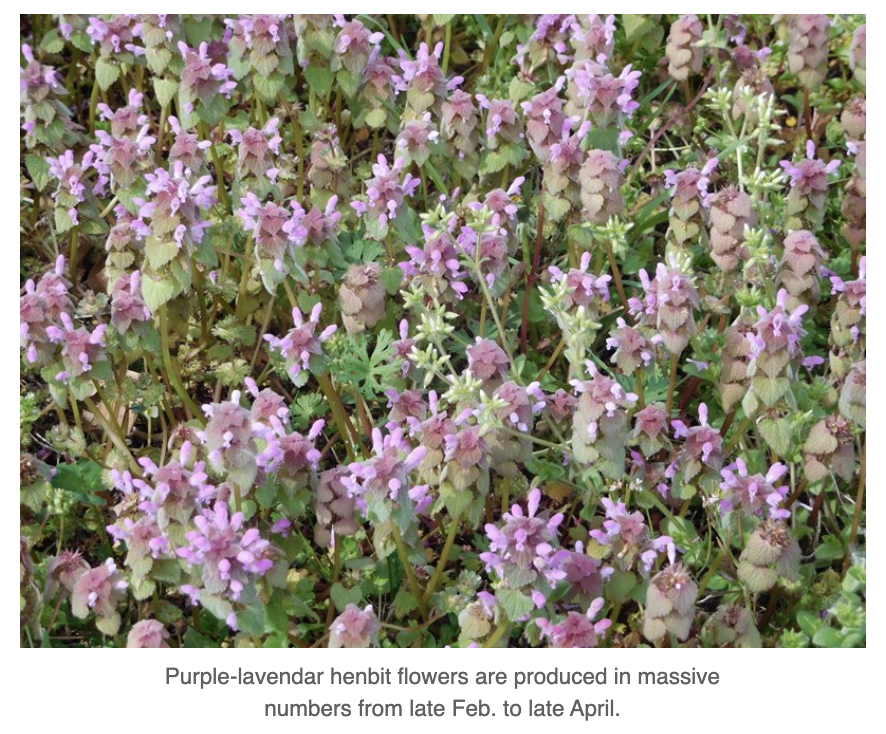
Henbit (Lamium amplexicaule) and purple deadnettle (Lamium purpureum) are nearly identical in appearance. Plants become conspicuous in late February and normally first appear in open agricultural fields; yielding splashes of brilliant lavender swards in March. Leaves grow opposite on main branches, are rounded to heart-shaped, crinkled, and prominently veined on the underside and have teeth or notches. Like all members of the mint family, they produce square stems. Stems are reddish or purple (especially nearer the base) or green, fleshy, and erect. Leaves on stems lose their heart-shape and grow in encircling whorls. Plants have a pungent odor. Flowers are produced in whorls in the axils of upper leaves. Pink, lavender or purple trumpet-shaped flowers appear in late winter and develop throughout spring. Purple deadnettle is different in that upper leaves are conspicuously purple-red and have petioles (i.e., with stalks); whereas, henbit’s upper leaves are sessile (i.e., stalk-less) and can have a green or purple color. Plants senesce rapidly under mowing, but otherwise will die with the advent of warm summer temperatures and survive as seed.
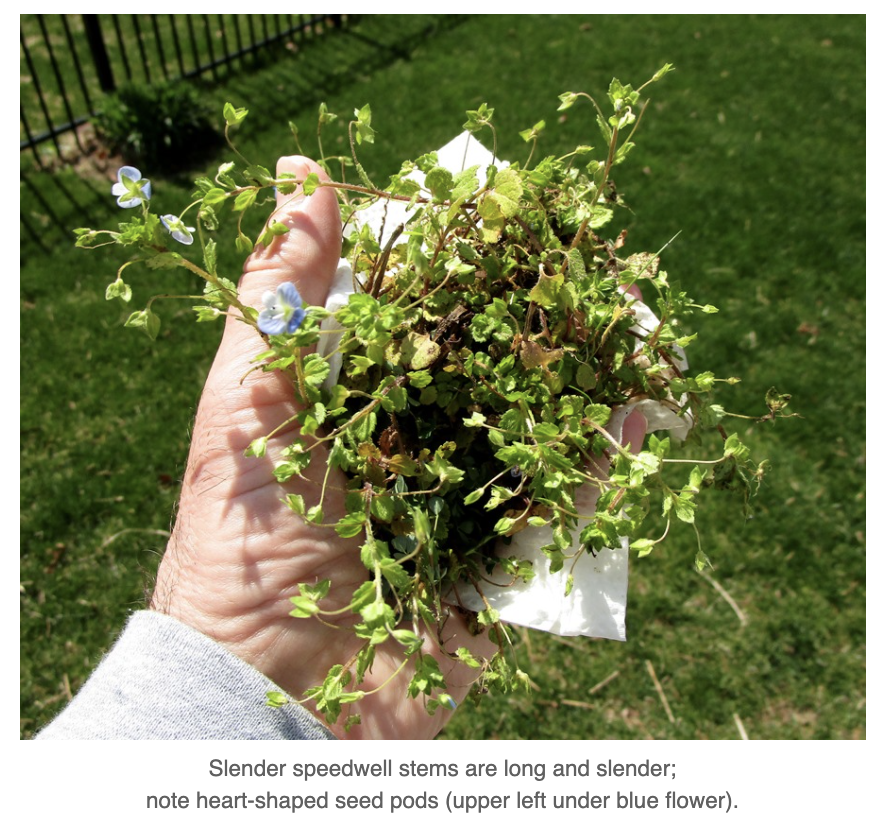
Slender speedwell (Veronica filiformis), also known as creeping speedwell or creeping veronica, produces an abundance of light blue flowers, usually from late March to late April. It grows in sun and shade, but is most dominant in open and sunny locations. Slender speedwell can behave as a perennial in northern regions, but this seldom occurs in our I-95 region. Clusters of leaves become conspicuous in February, but it takes some warm and sunny March weather for an abundance of light-blue flowers to appear. Most people enjoy the light-blue flowers of slender speedwell as a welcome site. Leaves are small, rounded to oblong. Leaf margins are rounded and have slightly toothed notches. Leaves are arranged opposite and lower leaves are larger than upper leaves; on stems, however, leaves are arranged in an alternate pattern. By mid-spring, slender speedwell produces creeping “slender” stems with hairs. Stems may not root at nodes in our region-hence this weed is more likely to senesce like most winter annuals by summer.
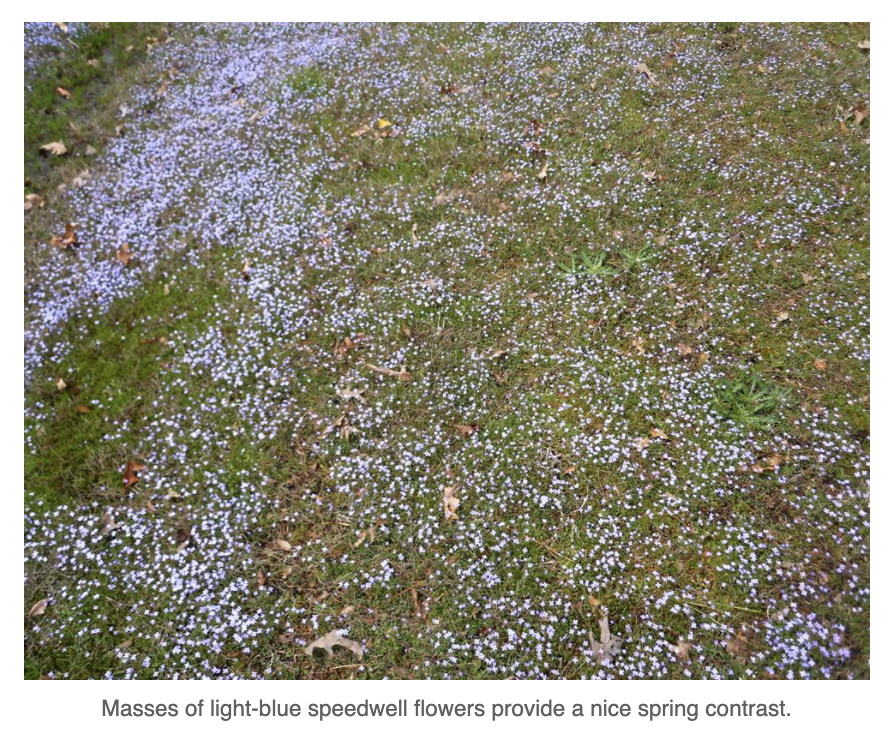

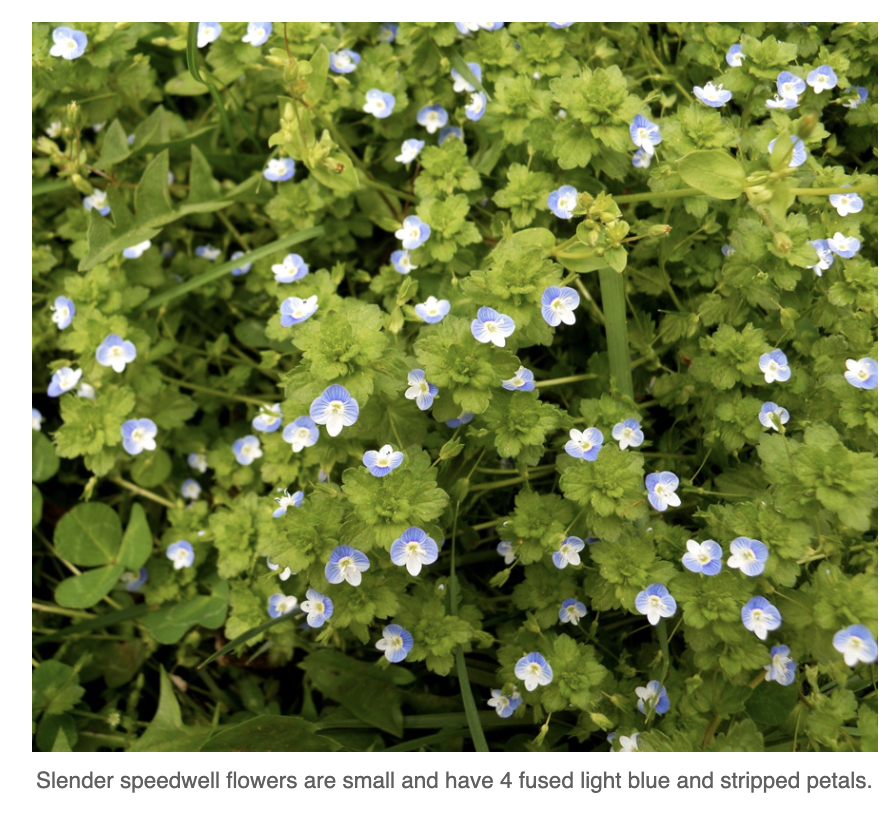
Slender speedwell is very invasive and among the most difficult to control winter annual broadleaf weeds. Mature clusters of slender speedwell plants are low growing stems can result in the development of dense mats of plants (that can be difficult to remove with a pocket knife), which enables slender speedwell to out-compete turf. Solitary plants grow upright in turfs that have not been mowed since the previous autumn. There can be several variations, but generally flowers have four blue or violet and sometimes one white petal. What helps to distinguish slender from other speedwells (e.g., corn speedwell), is that the blue petals are fused (joined) ,rather than distinctly separated from one another. Each petal has alternating white and darker-blue or violet veins. Flowers eventually develop into small inconspicuous, heart-shaped and fuzzy seed pods. With the onset of warmer temperatures in early summer, leaves senesce and die, but plants can survive as stolons (i.e., perennial habitats) and seed.
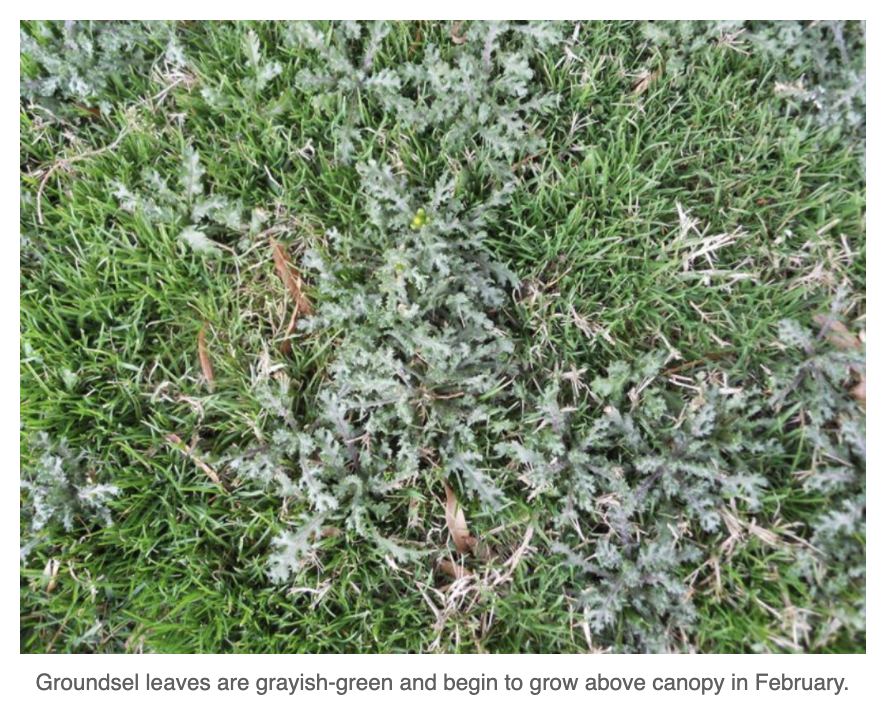
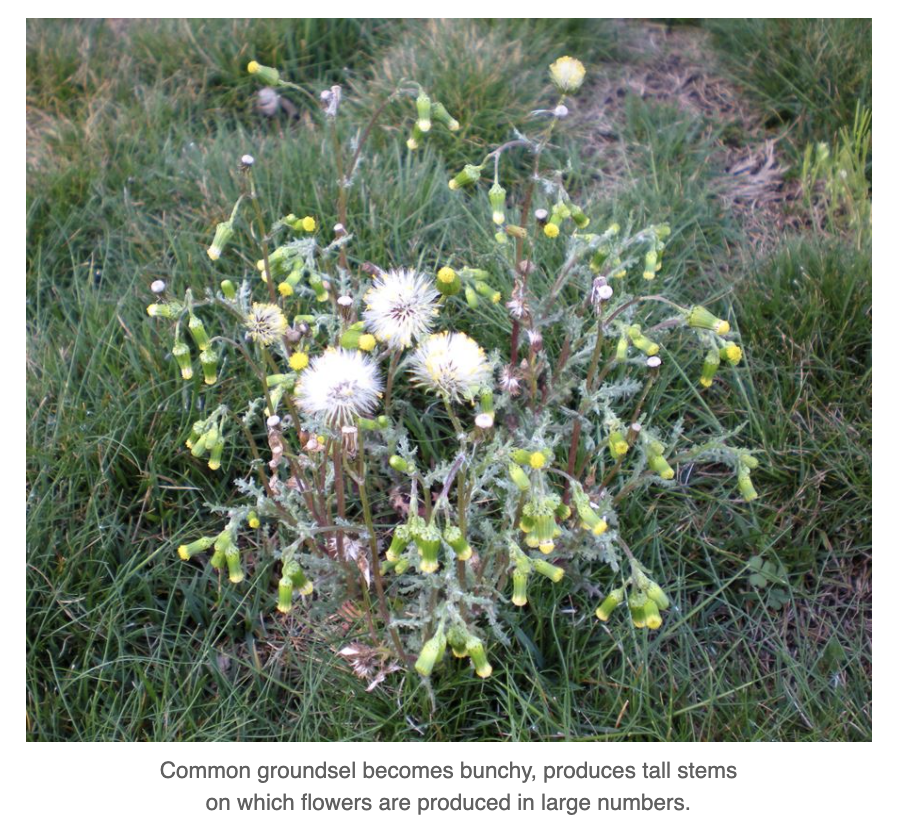
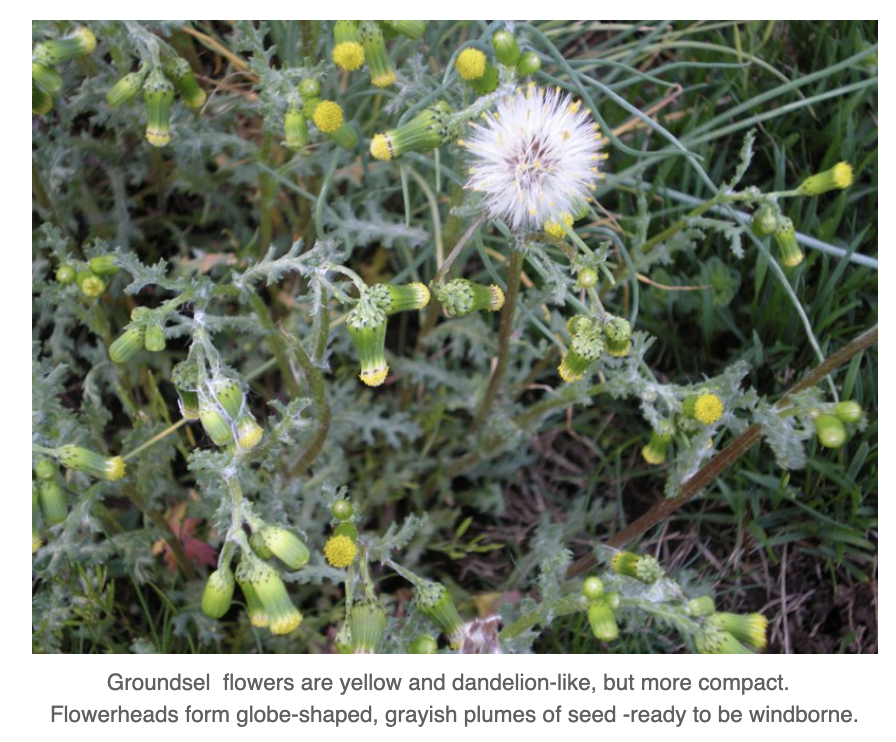
Common groundsel (Senecio vulgaris). Groundsel suddenly becomes noticeable in late winter/ February in mulched beds and secluded areas. It takes just a few sunny and warm spring days to stimulate rapid foliage growth and almost as rapidly the formation of seedheads. Leaves are narrow, hairy, deeply lobed and irregularly toothed. Leaves resemble those of dandelion, but are much smaller, wavy and gray-green in color. Upright stems grow to a height of 4” to 10” or higher, are fleshy, square, and hairy. Yellow, dandelion-like flowers form in clusters in early spring (late February to April ) at the tips of stems. Dandelion flowers are much larger and more conspicuous. Once flowers mature, grayish-white, globe-shaped plumes of seed develop. The yellow flowers and globe plumes of seed are similar to dandelion, but groundsel stems are much more elevated. Plants senesce with the advent of warmer temperatures and soon die.
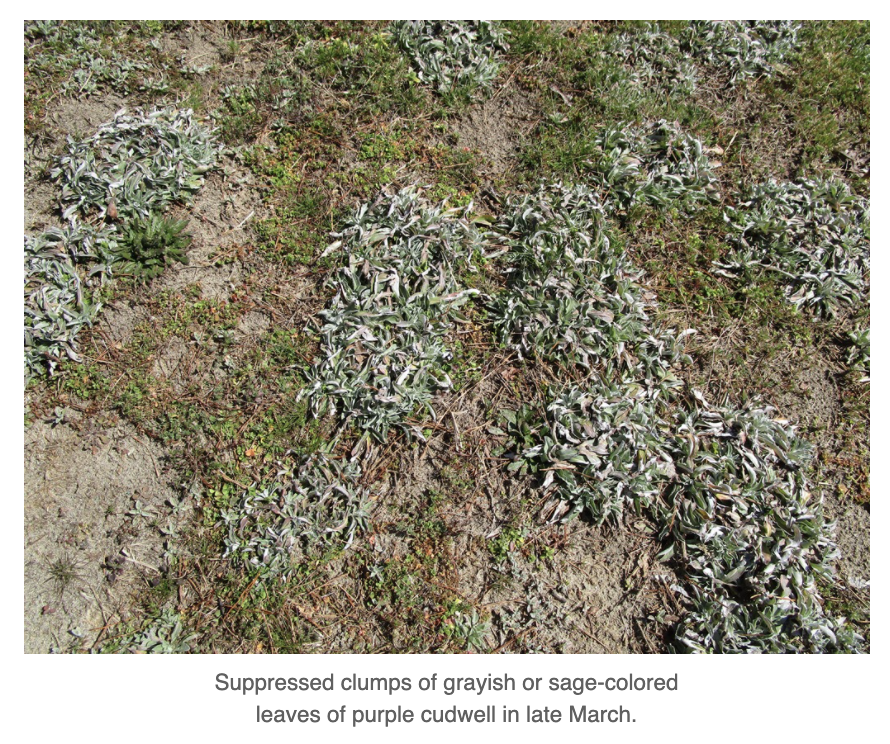
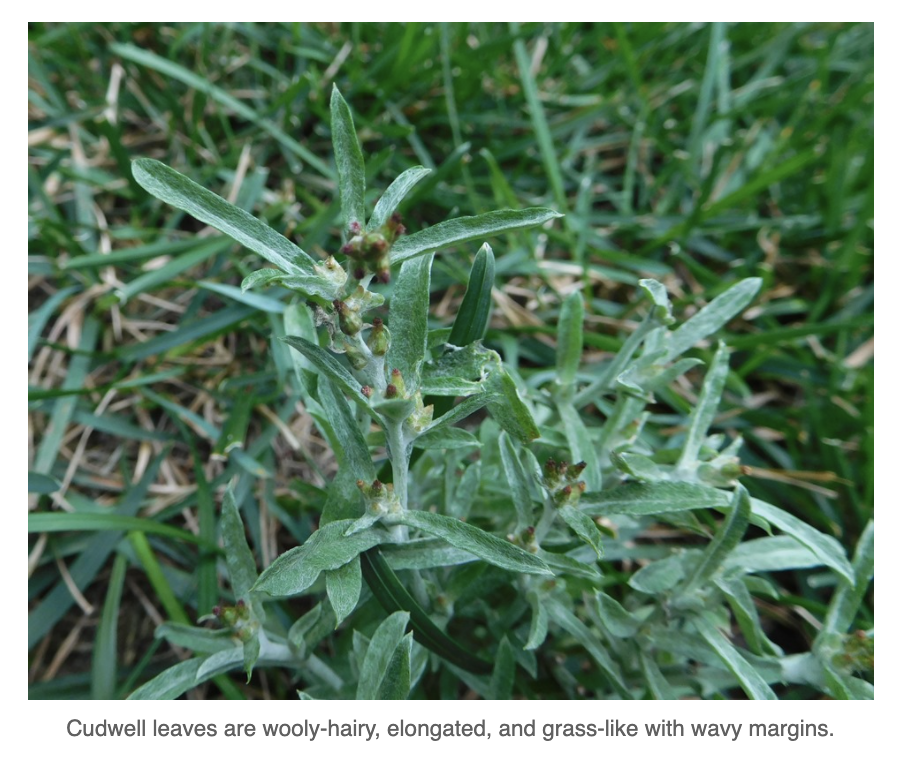
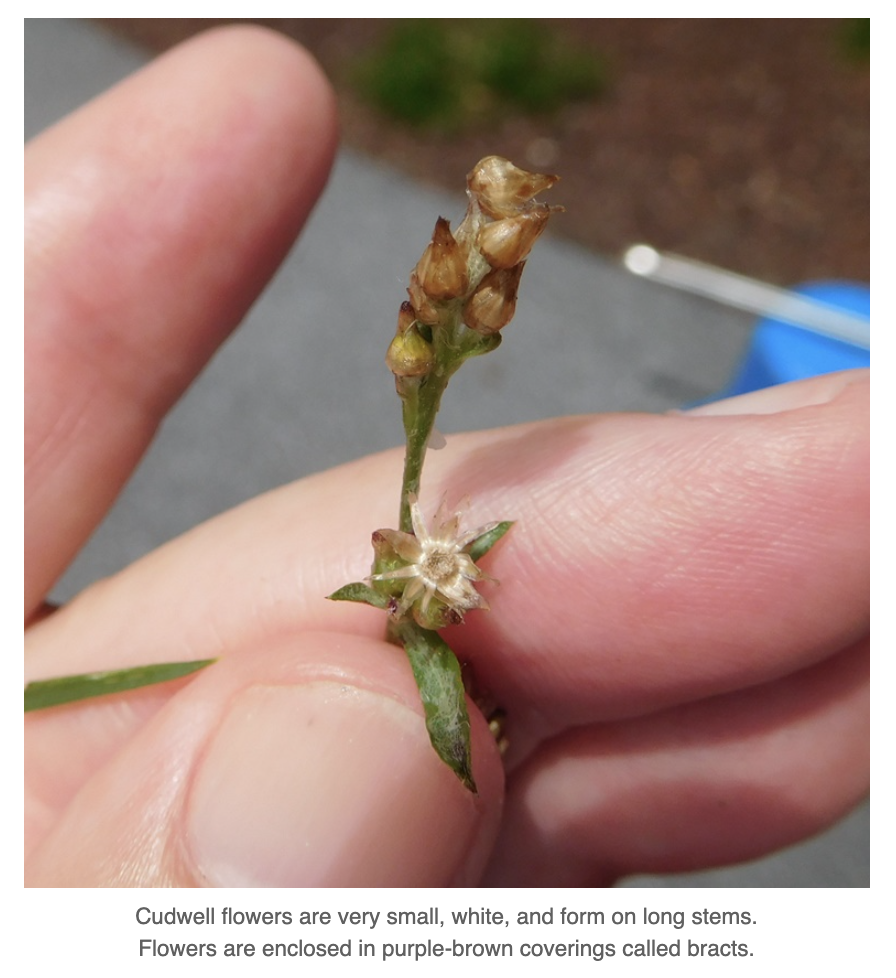
Cudweed (Gnaphalium purpureum), also known as purple cudweed, is most common where fertilizer inputs are low and/or droughty locations and thus turf density is poor. Leaves have a gray-green or sage-like color. Unlike sage, the odor of the foliage is faintly sweet. Leaves, and especially upper stems, appear whitish due to a wooly cover of dense hairs. Basal leaves form a rosette, but as stems elongate leaves develop alternately in a spiraling manner. Leaves are wooly, elongated and grass-like and have wavy margins. Very small, white-tan flowers with numerous petals are formed at the ends of erect stems. Whitish flowers initially are enclosed in pink, purple (hence the name purple cudweed) or brownish covers called bracts. While it eventually succumbs to hot and dry weather, it can be invasive, especially in young or open stands.
Controlling Winter Annual Broadleaf Weeds. Mowing removes stems, flowers and masks the shaggy appearance of these weeds. Their presence in managed turfs, especially lawns, are objectionable since they can be competitive in young or thin stands and because they can persist for long periods. A long tradition has been to apply a 2 or 3 way combination of 2, 4-D, MCPP, dicamba , clopyralid (not for lawn use), fluroxypyr, triclopyr, and others . There are numerous pre-pack mixtures available under a multitude of trade names like: Trimec in the 1960’s and 70’s; CoolPower in the 1990’s; and GameOn in the 2000’s. These combo products are good broad-spectrum materials. All of the aforementioned materials, however, tend to be slow acting in cool-to cold weather and in many cases do not provide acceptable control when applied in the March-April time period. Normally, it takes a significant warm-up of soils to assist these herbicides in their efficacy (usually around Mother’s Day in our region). A Maryland study, however, showed that a mix of 2,4-D, MCPP, dicamba and carfentrazone [Quicksilver] (e.g., Speedzone) to be highly effective in controlling winter annuals when applied during chilly spring weather. Evidentially, the carfentrazone component improves cold-chilly weather efficacy of the aforementioned herbicides. Many of these herbicide mixtures, however, have an objectionable odor, and caution must be taken to avoid drift that can damage ornamentals.
Defendor (florasulam) has been on the market for several years and has become a favorite herbicide among some LCO’s for targeting winter annual and other broadleaf weeds (e.g., dandelion) during chilly weather in March and April. A major appeal is that it is practically odorless. The first effect of Defendor is to suppress weed growth and prevent flowering, which keeps broadleaf weeds out of sight and out of mind for most homeowners. Activity is very slow and it can take numerous weeks for Defendor to eventually eliminate most winter annuals and other contacted broadleaf weeds.
Thanks for reading! For more articles and information, visit the Dr. Pete's Turf Tips Archive.