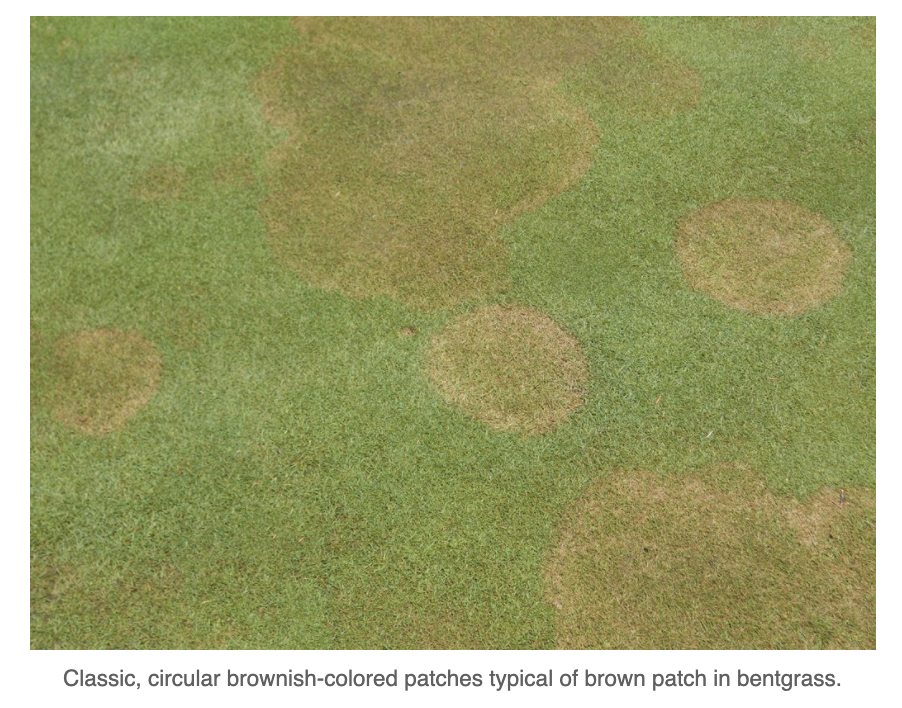
When most folks hear the word “patch” they may think of many possibilities. Some examples include: “briar patch”; “weed patch;” insignia on a military uniform; or the contrasting “piebald” coloring of a pet named patches or a horse called paint. In olden days, moms sewed cloth patches on the knees of worn blue jeans, and gas station mechanics floated tire inter-tubes in tubs of water to find the air leak, which they would fix with a rubber patch. In turf pathology, a patch refers to a visual disease symptom in which affected turf has the appearance of distinctly delimited, circular areas of contrasting discolored or blighted turf. Distinct circular patches in turf (although not always perfect) may range 1” to > 3 ft. in diameter. Circular patches that are only 1-2” in diameter are referred to as spots (e.g., dollar spot and dead spot) -yet they technically are little patches.
Classic “foliar blight” diseases associated with a circular –patch pattern include Typhula blight (aka gray snow mold); Microdochium patch (aka pink snow mold), brown patch, and several others. In the case of “foliar blighting” patch diseases; there will be at some point in time a visual appearance/display of mycelium. Mycelium is the body of a fungus and consists of fine tube-like strands “technically” referred to as mycelia or hyphae. When present in copious amounts, mycelium may appear as cottony masses on foliage. Mycelial growth of different foliar blighters exhibit various colors; ranging from white, gray , black, pink, red, and other variations.
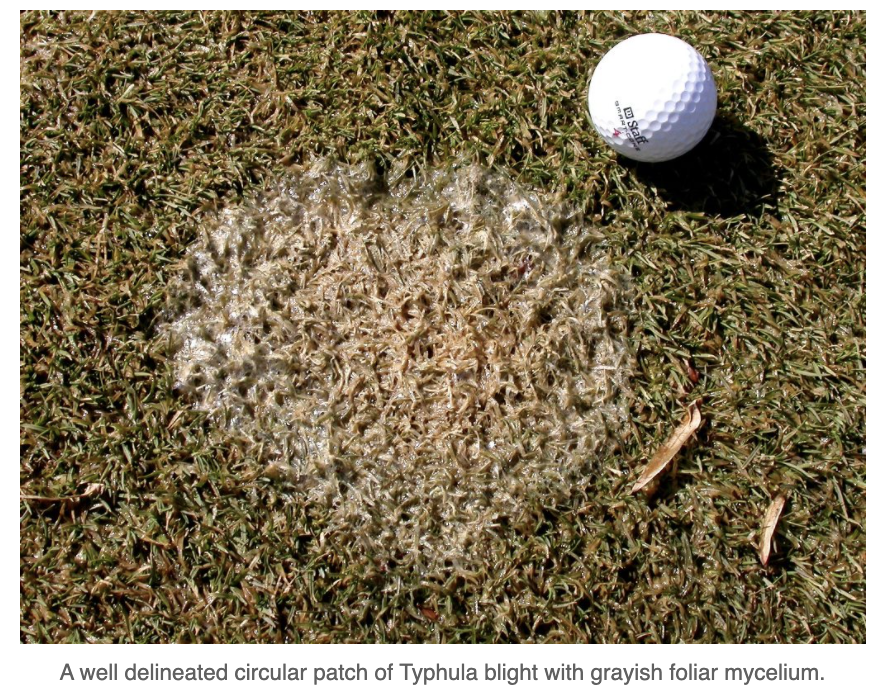
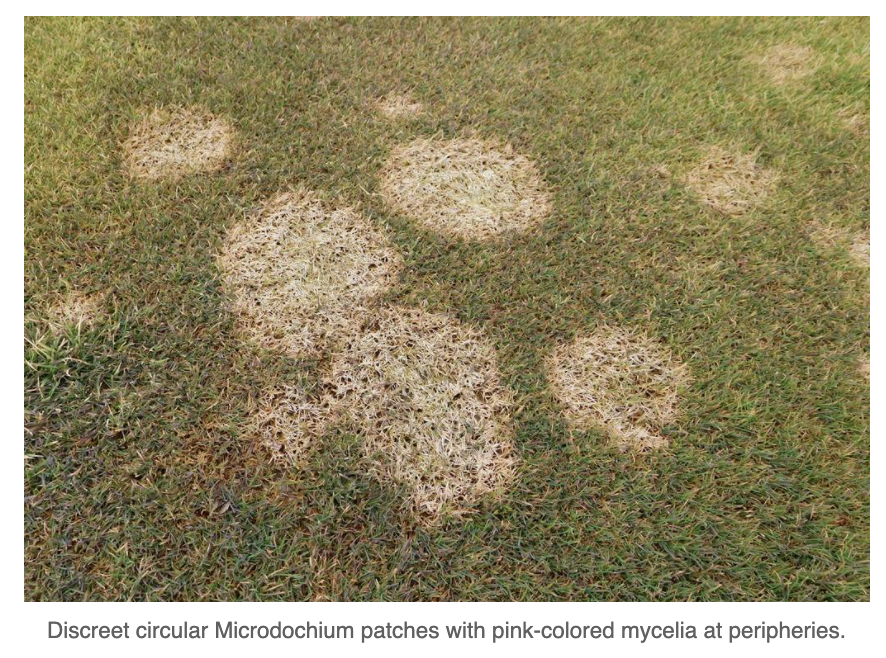
Mycelium can develop from a single spore, but for many pathogens, initial growth begins from fungal fragments lying dormant in dead thatch or in soil organic matter. It is a marvel of how numerous fungi are capable of growing uniformly outward in a radially pattern to produce a circular area of blighted or otherwise diseases and/or discolored turf. Most fungi in nature are inconspicuous (i.e., no visual evidence of mycelium on foliage). Some pathogens inflict damage via spores causing leaf spots (e.g., gray leaf spot) or just a generalized thinning of stands. Some pathogens never produce spores, like the dollar spot pathogen, which is the most ubiquitous turf disease in the world.
Turf Disease Names and Taxonomy: Naming of diseases is based mostly on descriptive symptom(s). Symptoms that fit fairly accurately include fairy ring, brown patch and dollar spot; however, there can be striking variations in size and appearance depending if found in a lawn versus a golf green, etc. The undeniable problem is that fungal pathogens can produce a myriad of different disease symptoms. For example, Pythium blight usually appears initially as bronze-colored spots, but over time they spread and coalesce to cause a generalized blighting, and in rare cases can form rings (called satellite rings). Another big problem is that most diseases produce different symptoms in different environs in different grasses. Some examples include yellow patch (described in Canada) and Waitea patch (described in CA). In the Northeast U.S., however, both diseases seldom form patches, but instead they invariably appear in the form of yellow rings.
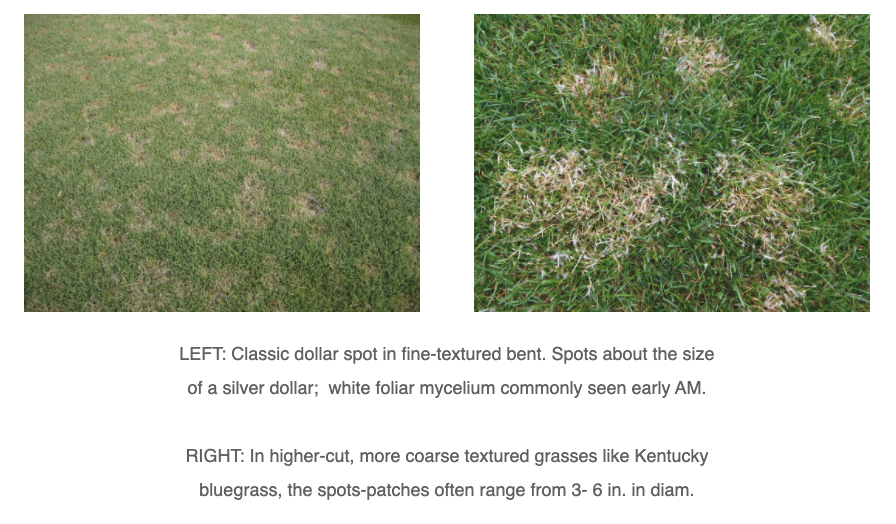
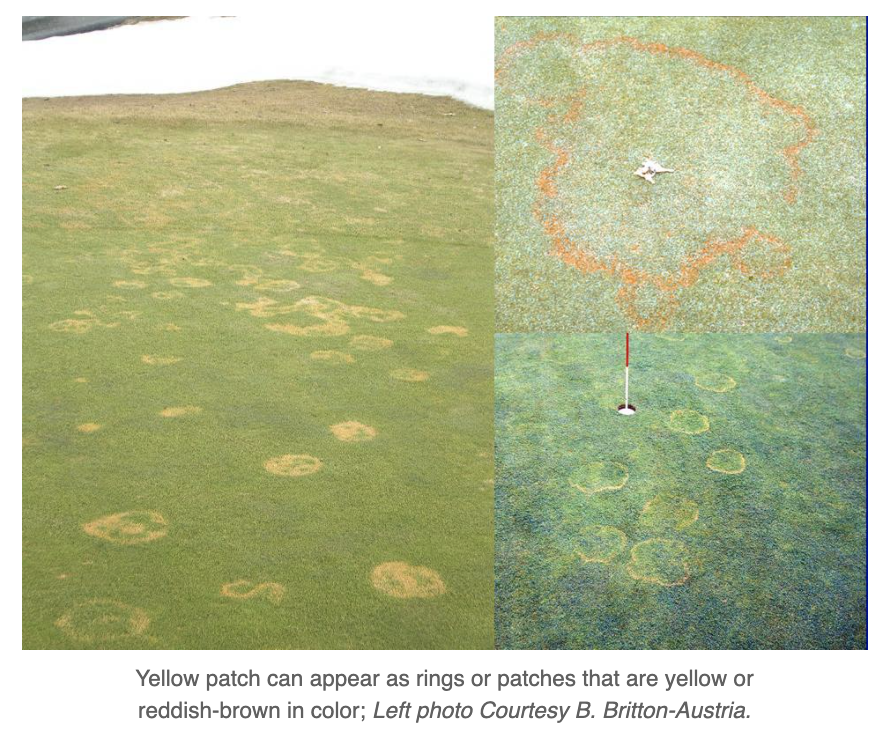
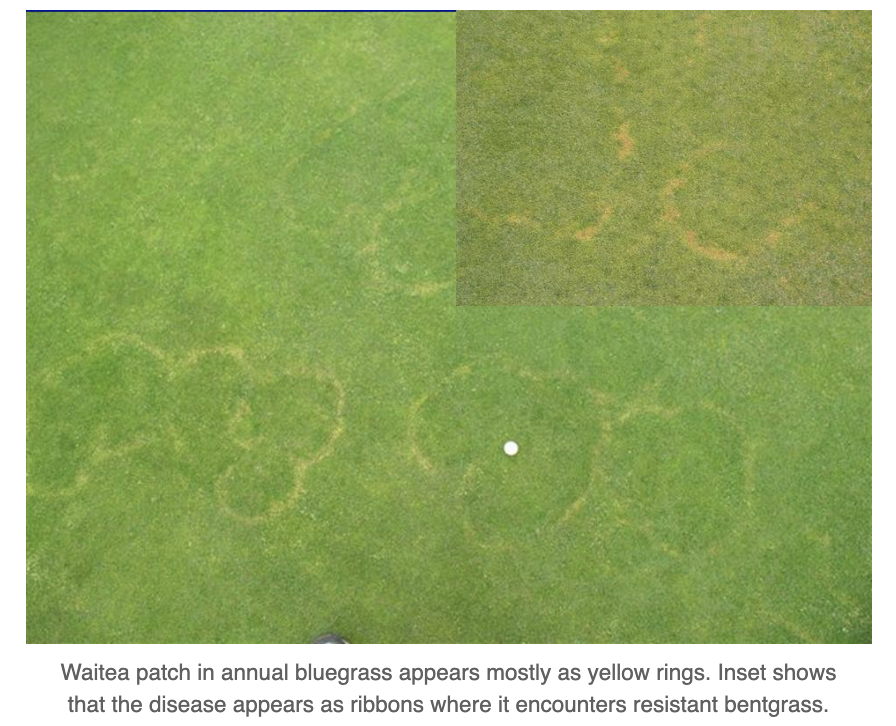
Because individual diseases may produce many different symptoms it seemed logical to assign the Latin “genus” name to the name of the disease. Some examples include Typhula blight, Microdochium patch, and Leptosphaerulina blight. It seemed a more clear approach to solve a lot of problems associated with disease names based on a single symptom. In reality, and as noted above, often there are significant variations of symptoms in different grasses and in different environments. The problem remains- students and professionals alike find Latin names too confusing and/or annoying to remember or pronounce. So we are left with diseases named for symptoms, that may or may not occur, and some with annoying Latin names. To follow is clarification of the term “Patch Diseases.” It was not until the 1980’s that a scientific break-through, and indeed an awakening among turf pathologists, that revealed a unique group of pathogens that attack roots, which collectively are known as “The Patch Diseases.”
THE ROOT PATHOGENS [ DARKLY-PIGMENTED ROOT COLONIZING FUNGI ], WHICH INCITE PATCH DISEASES DEFINED: The discussion above focused mostly on pathogens/diseases that work mostly above ground, beginning their attack in foliage. In 1937, the first turf disease caused by a root pathogen (Ophiobolus graminis) was described in Holland and named Ophiobolus patch. In subsequent years, the name of the pathogen was changed to Gaeumannomyces graminis var. avenae and the disease was re-named take-all patch (Gaeumannomyces patch would have been a tongue-twister). To keep a long story short, there was a “patch” disease called Fusarium blight. It was named and described in the 1960’s, but otherwise was referred to as the SOB (summer obliteration of bluegrasses) disease of Kentucky bluegrass and annual bluegrass (aka The Pittsburgh Plague). Dr. Richard Smiley was hired by Cornel University “to solve the Fusarium blight problem on Long Island, NY.” Smiley found that Fusarium blight was not caused by Fusarium spp., but actually was incited by a darkly-pigmented ectotrophic root infecting [ERI] fungus, that he called Phialophora sp. in 1984. Subsequently, the fungus was studied, clarified and renamed Magnaporthe poae in 1989. Thereafter, the name “summer patch’ was universally accepted. We now recognize take-all, summer patch, spring dead spot, necrotic ring spot, and dead spot as being THE PATCH DISEASES. I will list no more Latin binomials for these pathogens for brevity.
As previously noted, symptoms often vary among diseases. In the case of “The Patch Diseases”, circular patches are not always perfectly circular. Some patches may display frog-eyes a dead ring surrounding or enclosing living turf) or arcs/crescents of dead or dying grass. When there is a mix of 2 or more grass species, blighting may appear generalized since rings/patches will be obscured by the presence of other resistant grass species (e.g., there are no known darkly-pigmented ERI fungi that attack tall fescue or perennial ryegrass).
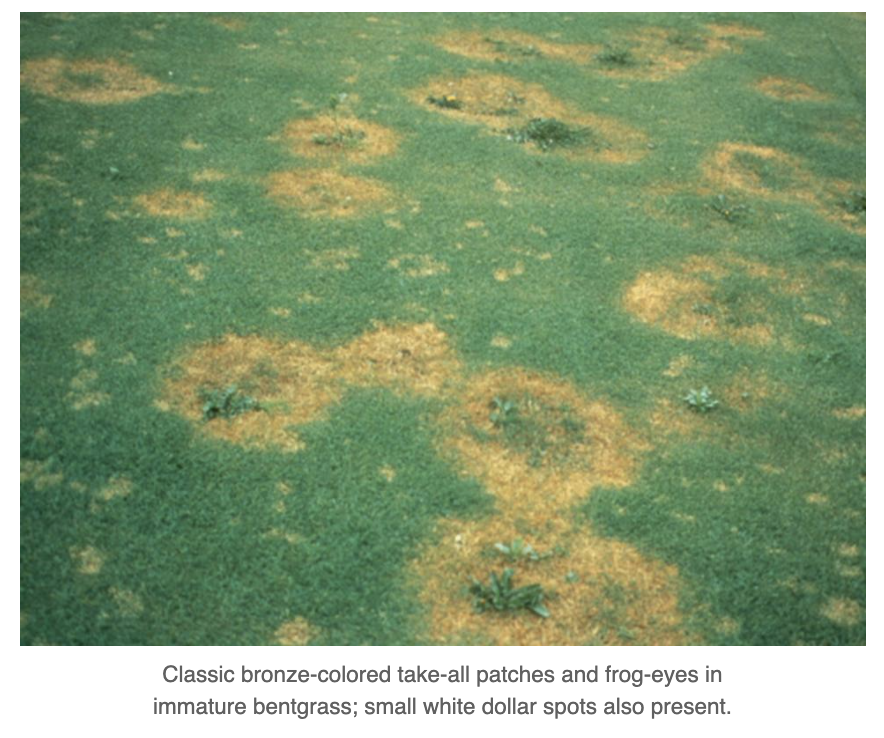
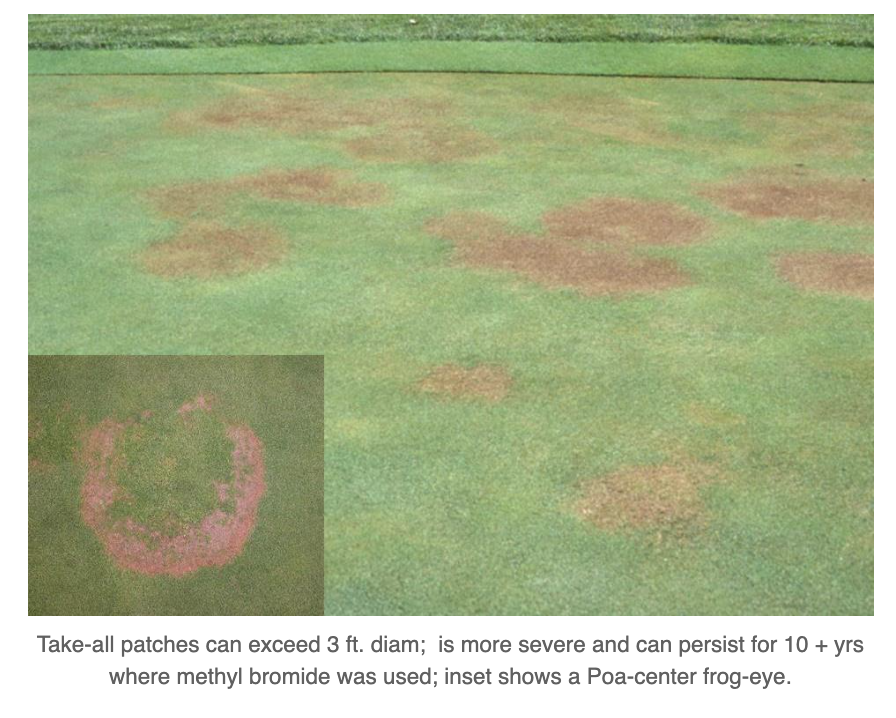
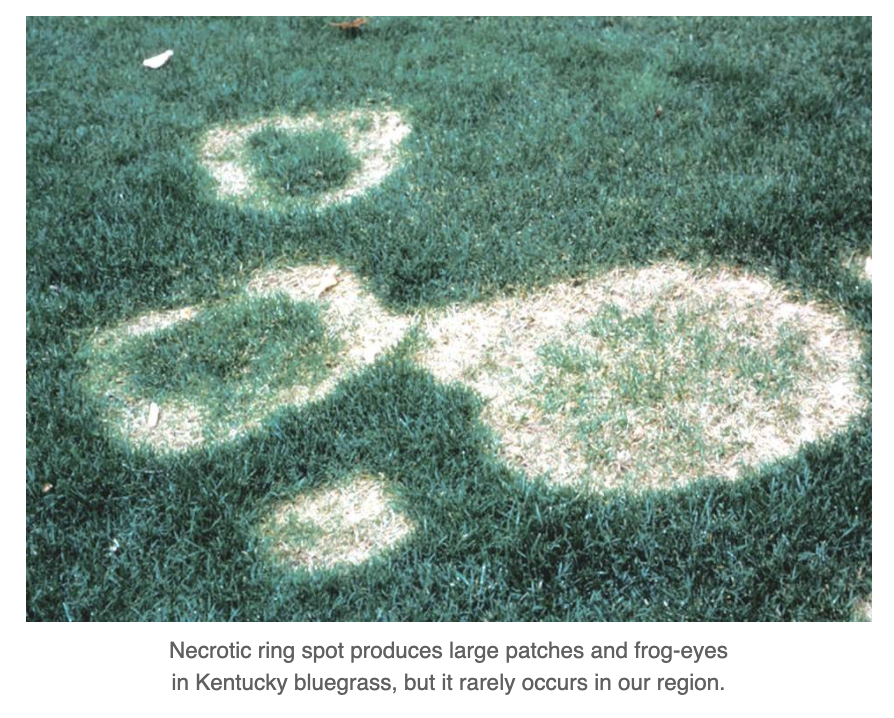
The radial spread in the root-zone is another mysterious marvel. Mycelia move slowly yet inextricably outwards from a root to another root, which soon contacts healthy roots of another plant. It is mind boggling how all this can occur in soil, where there are zillions of other microorganisms present to compete for the same space and nutrients. These diseases tend to be most damaging in young stands. Initial symptoms often include diffuse areas of discolored turf, which may eventually take-on a spot pattern. Over the course of time, and maybe years in the case of take all, spring dead spot and summer patch, the disease explodes and suddenly appears in many circular patches of discolored (often yellow, reddish or bronze-colored) and dying/dead turf ranging from 1 to> 3 ft. in diameter. In some cases a “frog-eye” symptom appears. Frog-eyes exhibit living turf within the confines of a dead ring. Many times, living turf within patch disease rings is colonized by a different, resistant species. For example, in some of the photos to follow, you will see perennial ryegrass and tall fescue within the confines of a dead ring caused by the summer patch fungus in annual bluegrass or Kentucky bluegrass; respectively. Oddly yet rarely, one may find annual bluegrass colonizing the middle of a dead take-all patch, to produce the frog-eye.
Sensible Summary for What You Need To Know About Darkly-Pigmented Ectotrophic Root-Incited “Patch Diseases” and Their Host Grasses in the Mid-Atlantic:
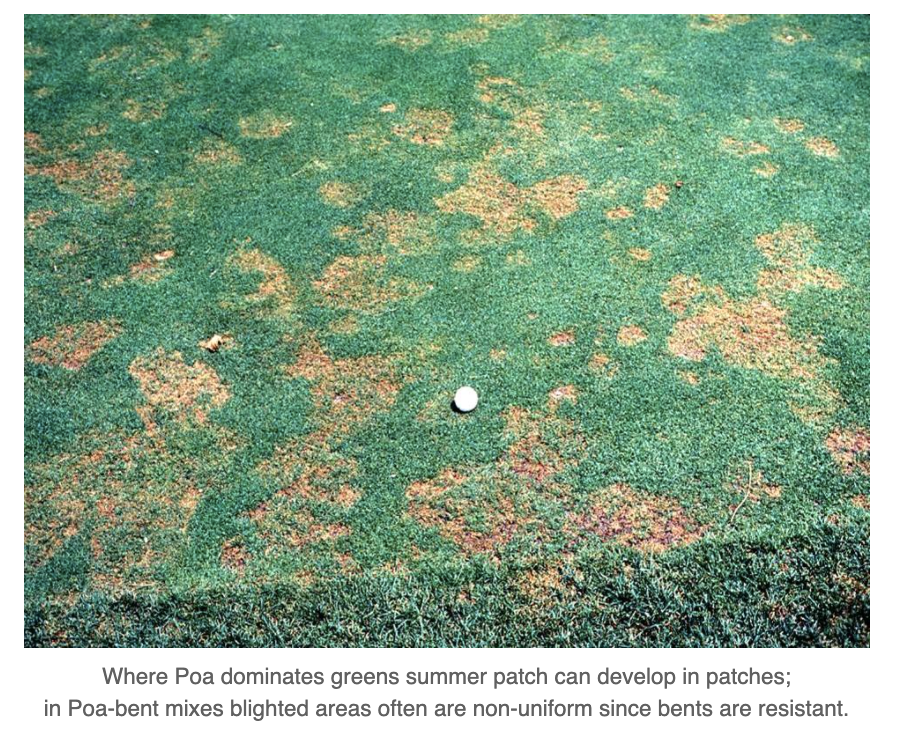
Summer patch remains a common and highly destructive disease of Kentucky bluegrass and sometimes annual bluegrass.
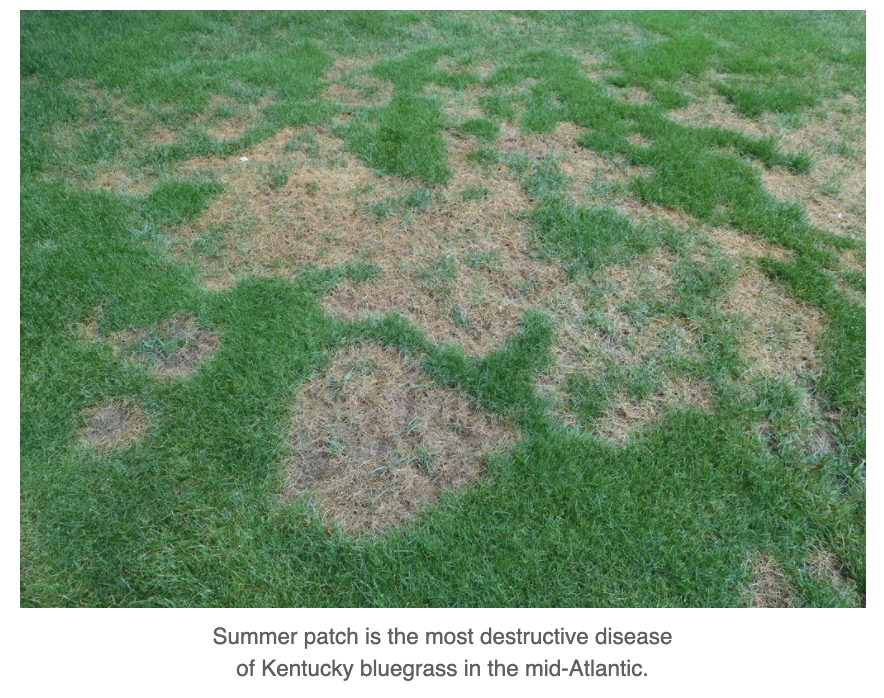
Summer patch in annual bluegrass grown on greens has become less common due to the advent and common usage of highly effective QoI- strobilurin fungicides (e.g., Heritage, Insignia, Fame, others) on golf courses.

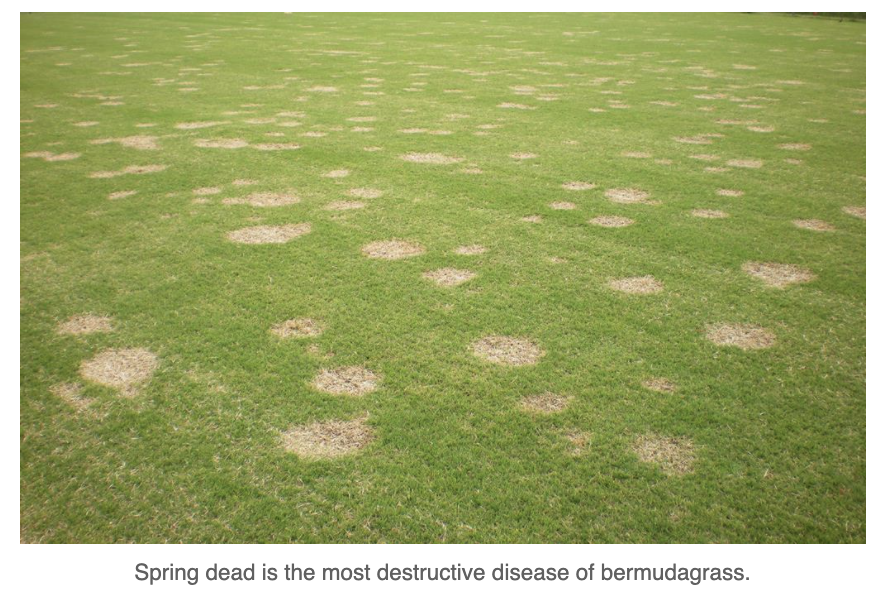
Spring dead spot remains the most common and destructive disease of bermudagrass grown on golf courses.
Take-all is mostly a problem in bentgrass grown on greens in new constructions, and when it occurs, it may persist for 2-5 years. Thereafter, take-all declines in intensity and ceases to be highly damaging. Rarely, it can recur on older golf courses (especially in the UK) during extraordinary wet years.
Take-all is much more chronic and damaging in older greens renovated using the fumigant methyl bromide; in this scenario, take-all can be persistent and remain a highly destructive problem for 10 or more years.
Dead spot exclusively is a disease of newly constructed bentgrass and bermudagrass greens, or where methyl bromide was used to renovate older greens. Regardless, dead spot seldom persists for more than 2-3 years. In rare cases up to 6 years.
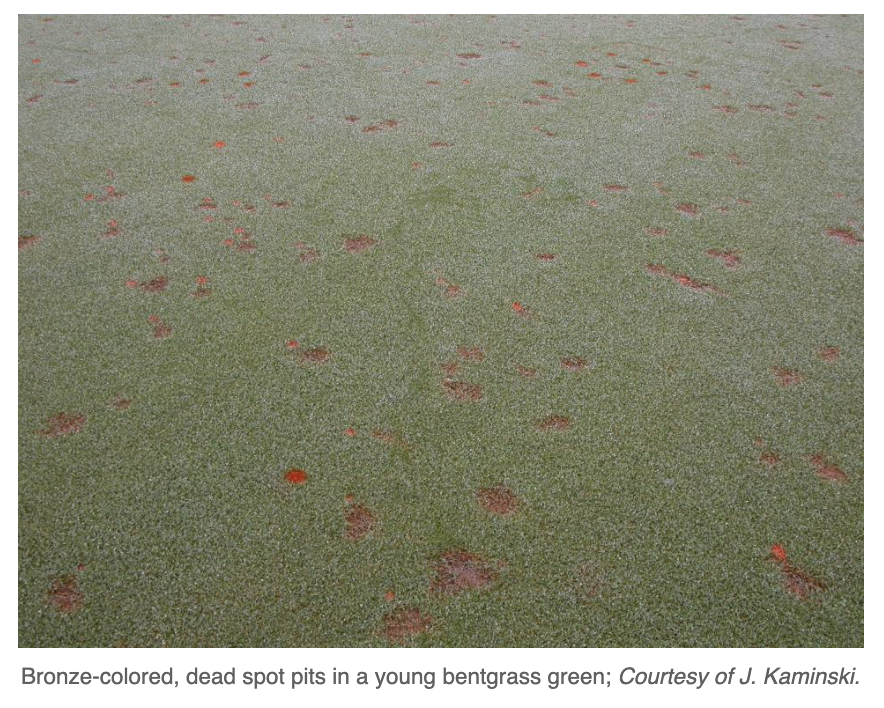
Dead spot is an outlier in that its darkly-pigmented hyphae mostly colonizes and infects stolons. Over time, the pathogen infects roots, stems and even above ground plant parts. Symptoms appears in bronze-colored spots or pits 2-3” in diameter. Patches seldom exceed 4-6” in diameter.
Necrotic ring spot is an obscure/rare disease of Kentucky bluegrass and creeping red fescue in our region, and mostly is found in more northern, mid-western environs and the Rocky Mountain States.
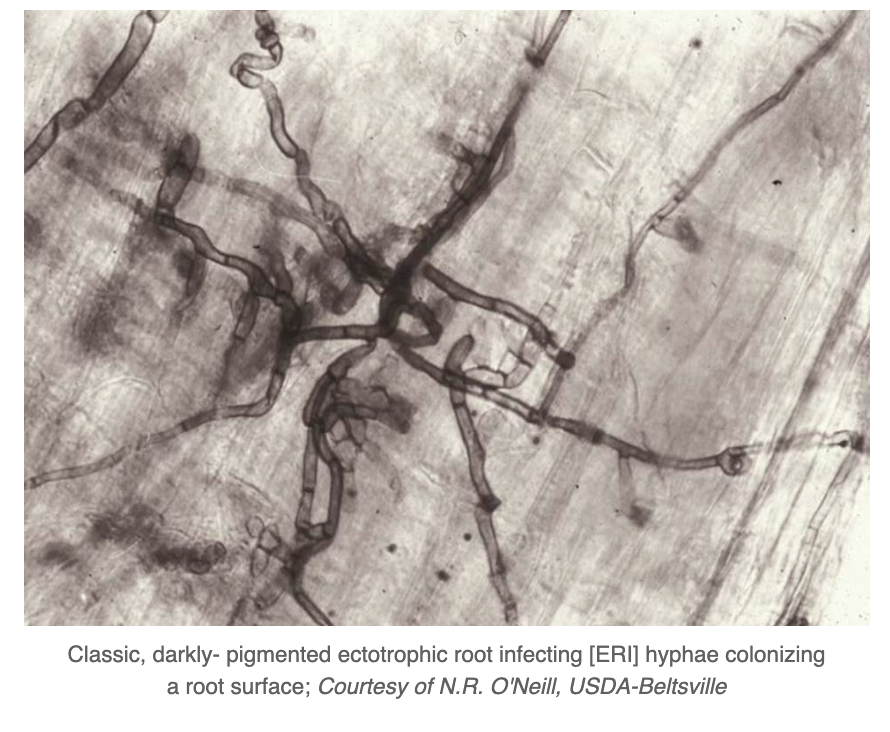
The fungal body of these root pathogens (i.e., mycelia, hyphae, other structures) are darkly-pigment (usually brown, gray or black), which initially grow from dead organic matter soil (where they lay dormant) to colonize root surfaces [i.e., ectotrophic]. These pathogens employ chemical and physical methods to penetrate and infect roots. Most of the infection action occurs on roots/stolons and eventually these pathogens move into stem bases. There is no visual mycelium or leaf spots of any kind. Generally, the first indicator of a root problem is tip die-back of leaves and discoloration in foliage. In the case of take-all, an early indicator is an absence of dew in circular-patch areas in early AM in greens. This is due to penetration and subsequent damage to root systems, which cannot effectively move water or nutrients to above ground leaves.
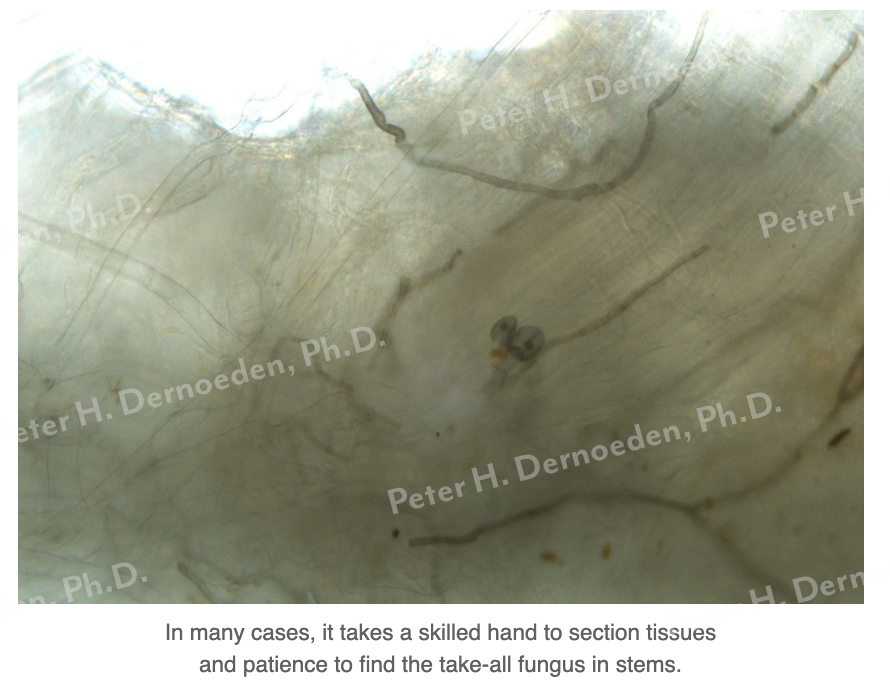
These pathogens often are tough to diagnose, especially if the diagnostician has no photographs of field symptoms. In the lab, roots are washed, sorted and otherwise prepared (boiled and stained), and viewed with aid of a microscope. What is so frustrating is that there may be only small, almost imperceptible fragments of fungal parts (e.g., hyphae, mycelia, and other structures) present on roots. In this case, it takes a steady hand to cut ultra-fine slices of stem-base tissues in an attempt to find any evidence of their presence in crowns (i.e., very tiny bundles of cells from which shoots, roots and seedheads will begin to grow). I cannot tell you how many times I have taken samples from obviously infected plant roots and crowns; and searched and searched until I could finally convince myself (maybe) of the diagnosis.
Diagnosis of the darkly-pigmented root infecting pathogens only is partially simplified by the fact that each of these diseases/pathogens usually reveals diagnostic field symptoms in specific turf species and at specific times of year. For example, summer patch exclusively is a disease of Kentucky and annual bluegrass and appears during the heat of summer; spring dead spot is exclusively found in bermudagrass and appears at spring –green-up; and dead spot is mostly a disease of bentgrass and bermudagrass greens and appears in summer. Definitive molecular testing remains unavailable to even University plant disease diagnostic labs. Thus, diagnosticians rely on symptoms, turf species affected and weather conditions prevailing at the time of symptom appearance. Always send photos of field symptoms to help diagnosticians.