
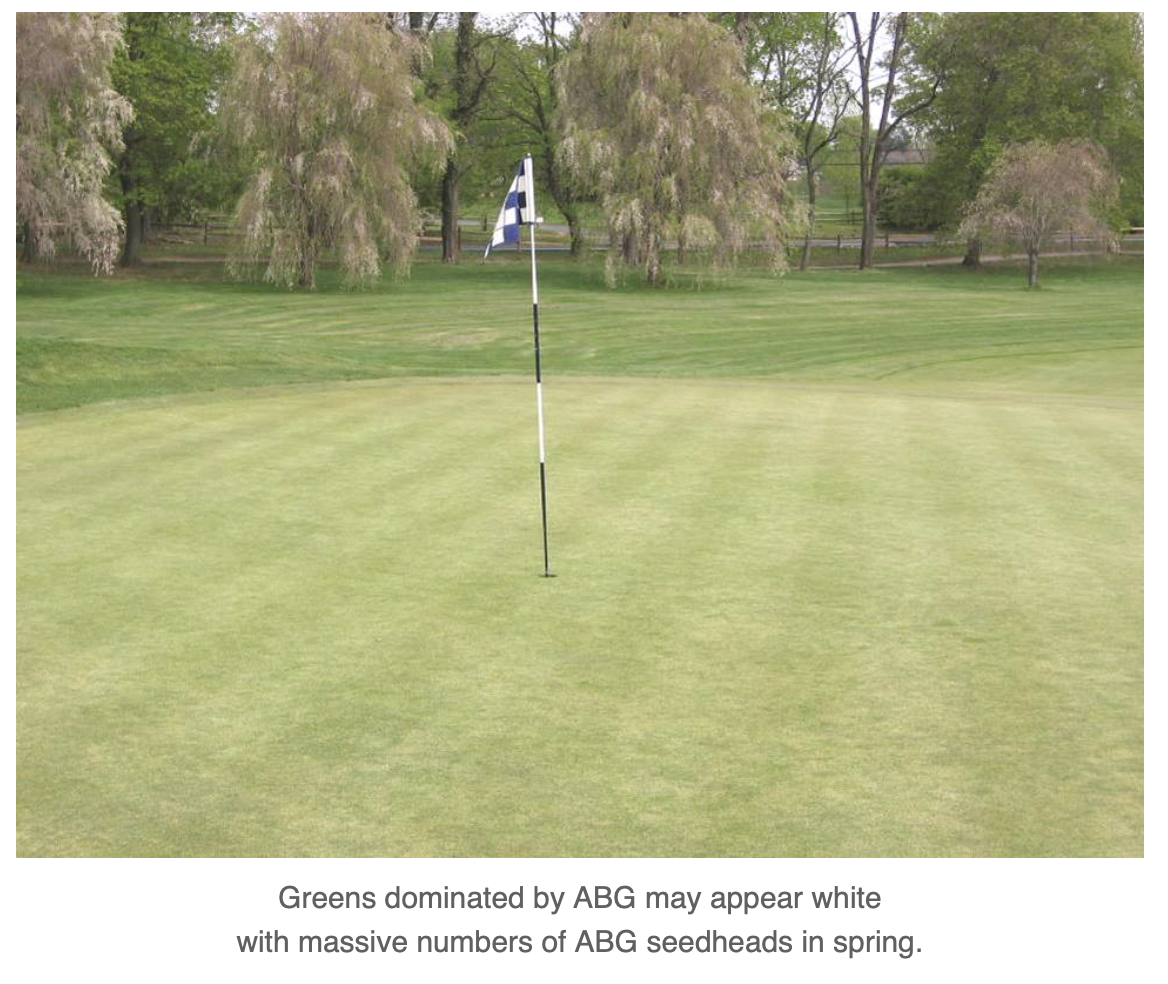
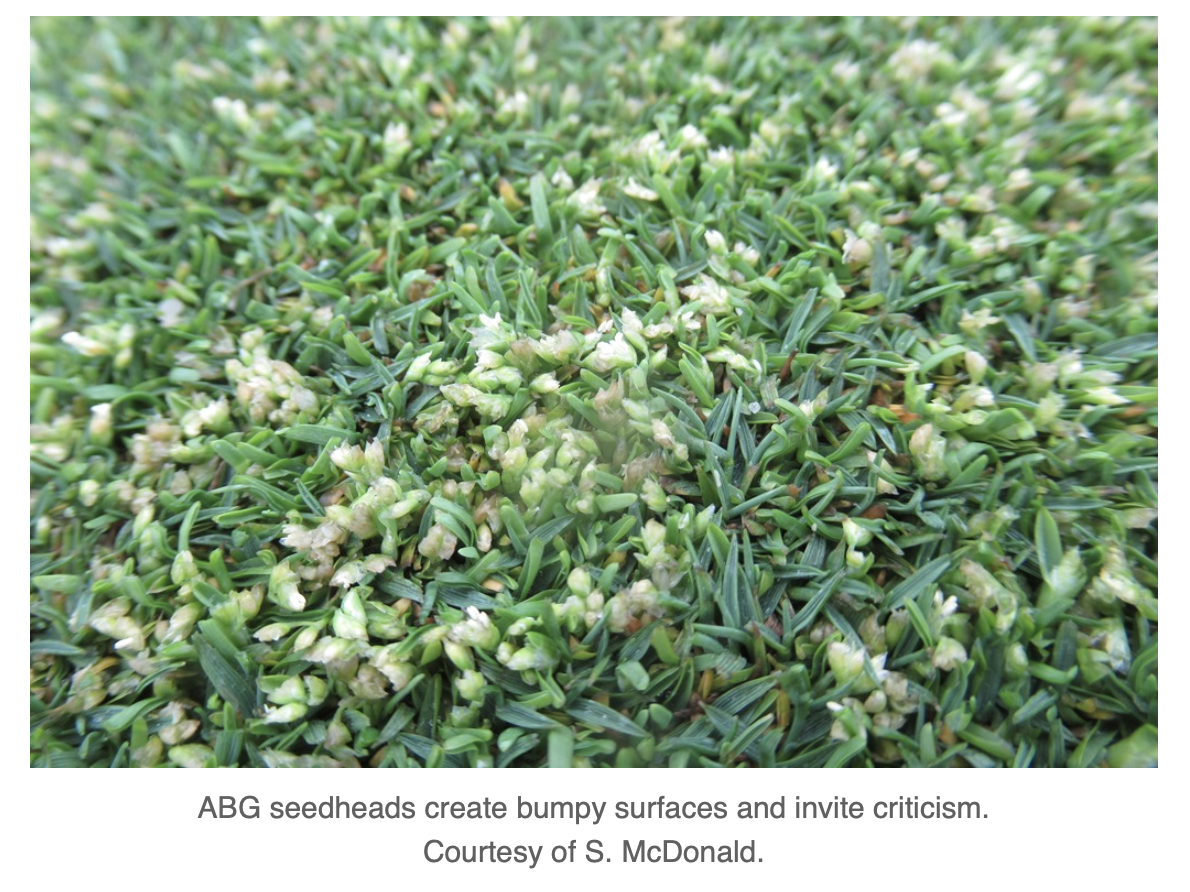
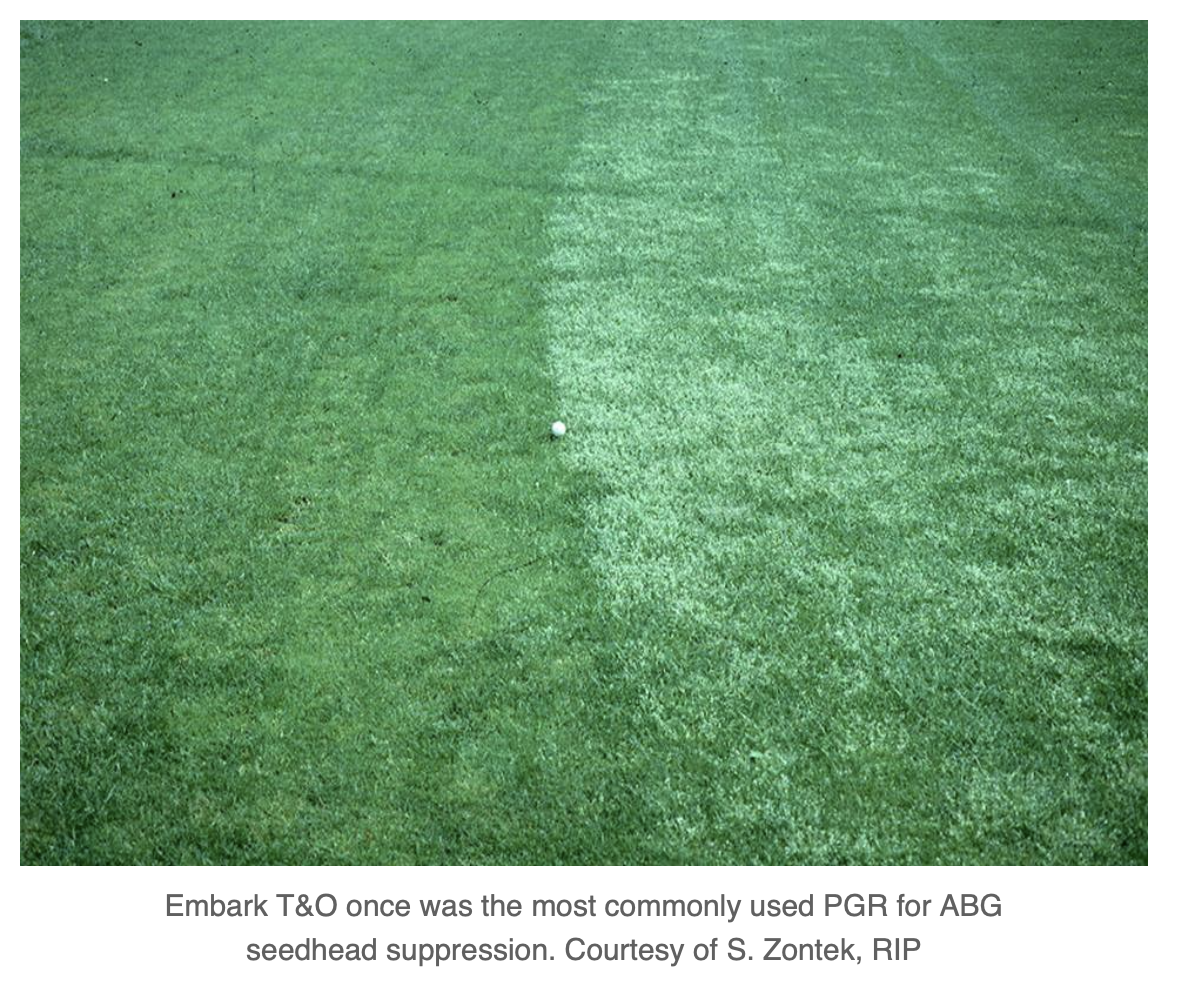
Annual bluegrass (ABG) seedheads create bumpy putting surfaces in the spring and detract from uniformity. ABG seedheads often are recognized by golfers and can be a subject of criticism. Vertical-cutting removes many seedheads, and slightly lowering mowing height may help mask their appearance. Many superintendents attempt to chemically control these seedheads, but success often is elusive. Embark T&O (mefluidide) once was the primary PGR used to suppress ABG seedheads. Embark has fallen by the way-side and no longer is being manufactured, although existing stocks are legal to purchase. Proxy remains the preeminent PGR for targeting ABG seedheads. Achieving effective seedhead suppression can be difficult and timing is everything. The two traditional methods used to time a PGR for ABG seedhead suppression were to scout for the “boot stage” of seedhead development, and/or use a growing degree day model (GDD).
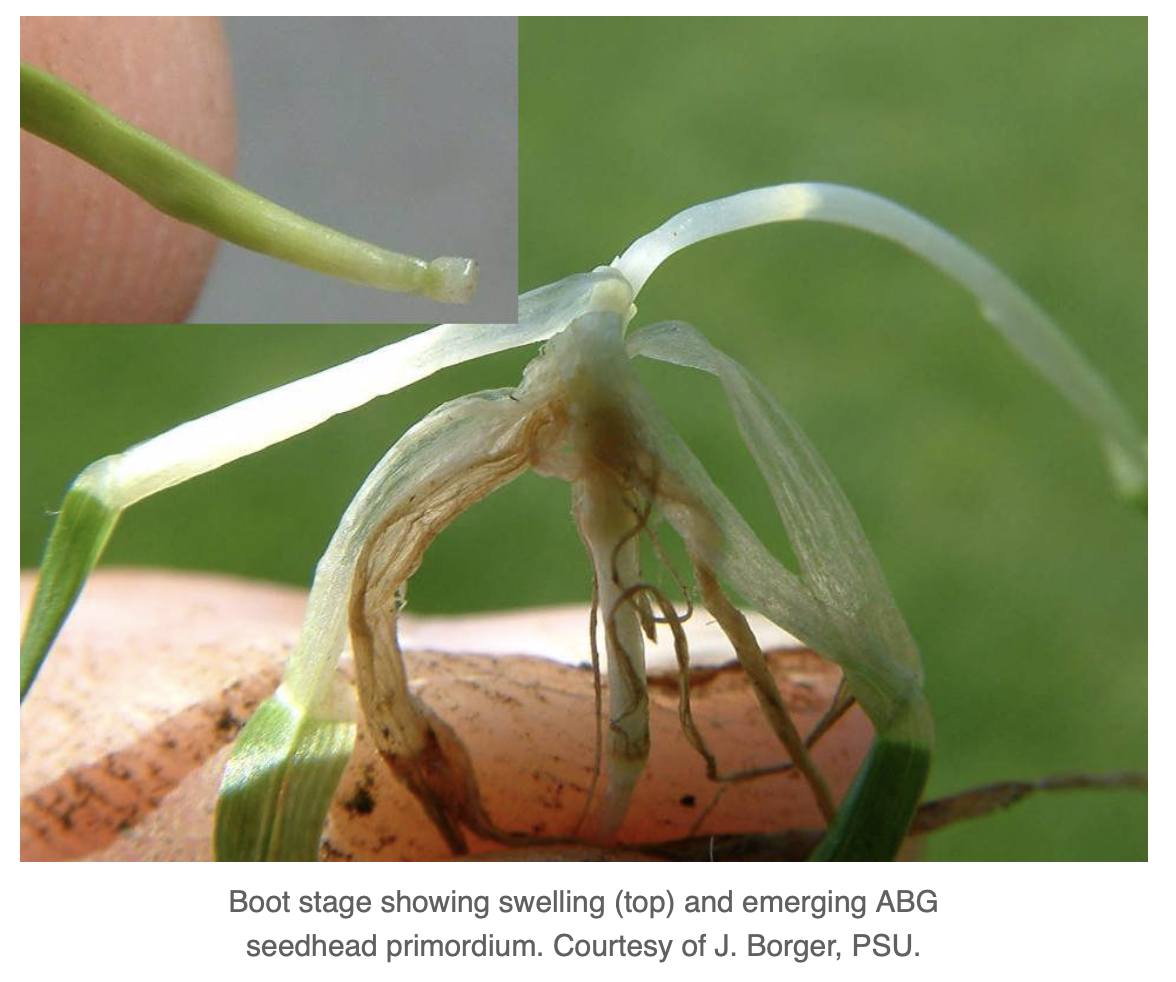
The boot stage is scouted by examining stem bases located at the soil surface and look-feel for swelling. The swelling or bulging indicates stem elongation has begun as the apical meristem (i.e., main growing point of each tiller) is differentiating and transforming into an inflorescence (i.e., seedhead). Scouting for the “boot stage” is a challenge mostly because plants produce seedheads in widely varying environments (shade vs. sun; north vs. south exposures, slopes; presence or absence of trees, etc.) at different times and because few managers have the time to scout different terrains. Furthermore, most don’t know “the feel” of the swelling. Experienced superintendents find known “hot spots” to scout, giving them a time-line appreciation for what may be developing in the most vulnerable or problematic areas of the golf course.
Understanding Growing Degree-Day (GDD) Models: GDD models are great tools for monitoring the development of plants, insects and sometimes even pathogens. The concept is simple, GDD measure the accumulation of heat, which is the most important environmental factor impacting growth and development of plants and other organisms. There are many other environmental influences that confuse and confound these models. For example, slopes, swales, light/dark exposures, the presence/absence of trees, soil root-zone water status, water features and many other factors have a large impact on accuracy. There are 3 important inputs in all GGD models including base temperature (btemp; usually shown as Tb); the start date or biofix date; and a simple calculation based on the average high and low temperatures over a 24 hr period. There are flaws all along the way, beginning with guess estimates on arriving at a base temperature and start/biofix date as described below. These and other factors often render use of GDD models as weak predictors, yet they remain a valuable scouting tool. Don’t be discouraged, since GDD information is available for your location via PGR manufactures and other turfgrass websites.
Base temperature (btemp) is an estimation based on experience, observation and rough data. Establishing a btemp is arrived at empirically (i.e., a guess-estimate). Base temperature is an estimated average daily temperature that signals the initiation of a target biological process, such as ABG seedhead formation, seed germination, flowering, when a pathogen begins to grow or start the infection process, and even stages in insect metamorphosis. In many research publications, a typical btemp used is 50 F, since most plant and insect biological processes dramatically slow down at or below that temperature. Similarly, the start date also is estimated.
For example, if you generally see the first ABG seedheads in hot spots the first week of April, then given time for processes to slowly develop, a good estimate of a start date may be around March 1 or even earlier.
GDD found in University Extension Newsletters often use a start date of January 1. It is convenient and mostly used to quantify the accumulation of heat from month to month, which can be of value to farmers and other growers, but are not applicable for estimating the timing of a PGR for the purposes of controlling ABG seedheads.
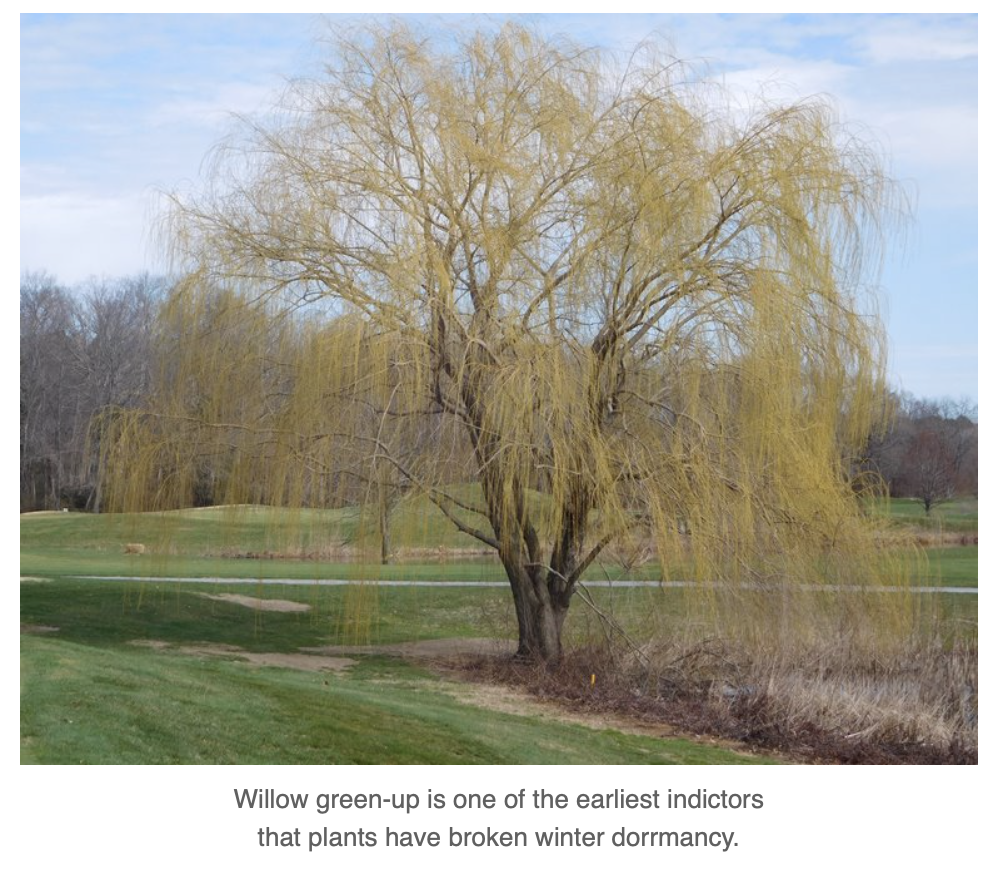
An Example: Let’s say a scientist looking at all the data and information available decides the base temperature (btemp=Tb) for ABG seedhead formation (e.g. swelling indicating the “boot stage is underway) is 50F (Tb50). Again, using a guess estimate of when the btemp becomes relevant also relies on establishing a start or biofix date. Start dates are based on regions. A start date in VA likely will different from DE, MD, PA, etc. I have, however, found the first hint of greening willow buds can be a useful growth indicator and may serve as a good GDD start time. Research articles and on-line GDD websites should also be helpful. For the example outlined below, we choose a start date of March 1 to begin counting GDD’s
Once the btemp and start dates are established, the GDD calculation is simple –but only if you have an accurate weather/temperature station data –another big problem. GDD models rely on nearby weather stations to provide maximum (max.) daily and minimum (min.) daily air temperatures (not soil-another major weakness). Much more accuracy is obtained by researchers who use averaged temperatures summed over 15 minute measurements. Measurements for daily maximum temperature are recorded and averaged every 15 minutes between 6AM and 6 PM , and the daily minimum temperatures are averaged from 6:01 PM and 5:59AM. Averaging based on 15 minute temperature measurements over a 24 hr period greatly minimizes the impact of fast and sharp temperature fluctuations, especially during late winter and late autumn.
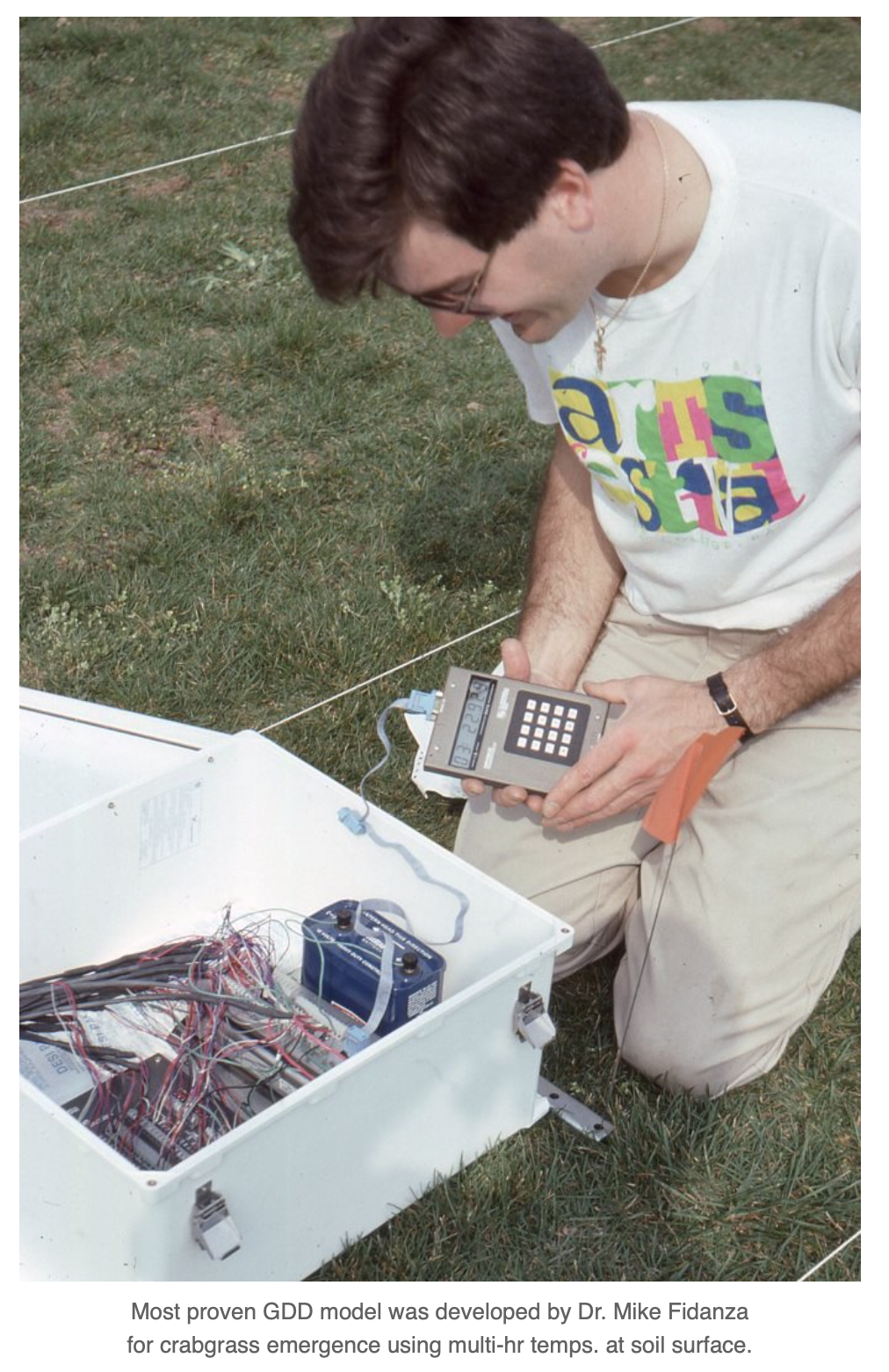
In this example, we will use a btemp of 50F and a start date of March 1. The daily max. and daily min. temperatures are added together and then divided by 2 to get an overall average. For example, if the daily high (max.) is 60F and the daily low (min.) is 38F, the sum is 98, and when divided by 2 the average is = 49F. The average daily temperature minus the btemp equals the number of GDD. For example, on March 1 if the average 24 hr temperature is 55F and the base temp is 50F the daily GDD is calculated as 55 minus 50, which equals +5. On March 2, if the average temperature is 45 and the base temp is 50F the result is -5, the actual GDD recorded is 0; this is because a daily GDD of less than 0 is simply counted as 0. Hence, the running total of cumulative GDD remains +5. On March 3, the 3rd day from the start date, a large warm-up begins and the average temperature is 65F minus the btemps of 50F for a total of 15 daily GDD. Hence, the cumulative GDD for those three days (i.e., 5 +0 +15) sums to 20. And, so it goes, and GDD’s begin adding up faster and faster as temperatures increase in spring.
Annual Bluegrass Suppression With Proxy: As noted above, Proxy remains the primary PGR used to control ABG seedheads. The Proxy label on how to use the product for ABG seedhead suppression is vague. This is a necessary, because there are way too many variables in too many regions in the US in which a GDD model would fit all users. Research conducted by Dr. Shawn Askew at Virginia Tech (regionhttps://www.golfdom.com/a-new-key-to-poa-annua-seedhead-suppression/. ) published in Golfdom (August 2016) indicates that the initial Proxy application should begin before winter ; around November-December period. Repeated testing showed that Proxy applied alone before winter (i.e., Nov.-Dec.) provided for very high levels of consistent ABG seedhead suppression in spring.
We now, however, are well beyond that timing in 2021. As indicated in his Goldom article, a January-February Proxy application alone was more effective suppressing ABG seedheads versus a spring Proxy application. Dr. Askew describes GDD-based timings, with a start date in March. As noted above, there may be other useful web-bases resources in your region for estimating GDD’s.
According to the Askew article, the initial application of Proxy is made alone (i.e., in the Jan.-Feb. period) and then based on a local GDD model, make two more applications on roughly a 21 day interval using a mix of Proxy + Primo MAXX . You also may wish to contact your sales representative, and/or other agronomists to assist you on how best to time and apply Proxy and Proxy + Primo in your area. The TIME to act is NOW.
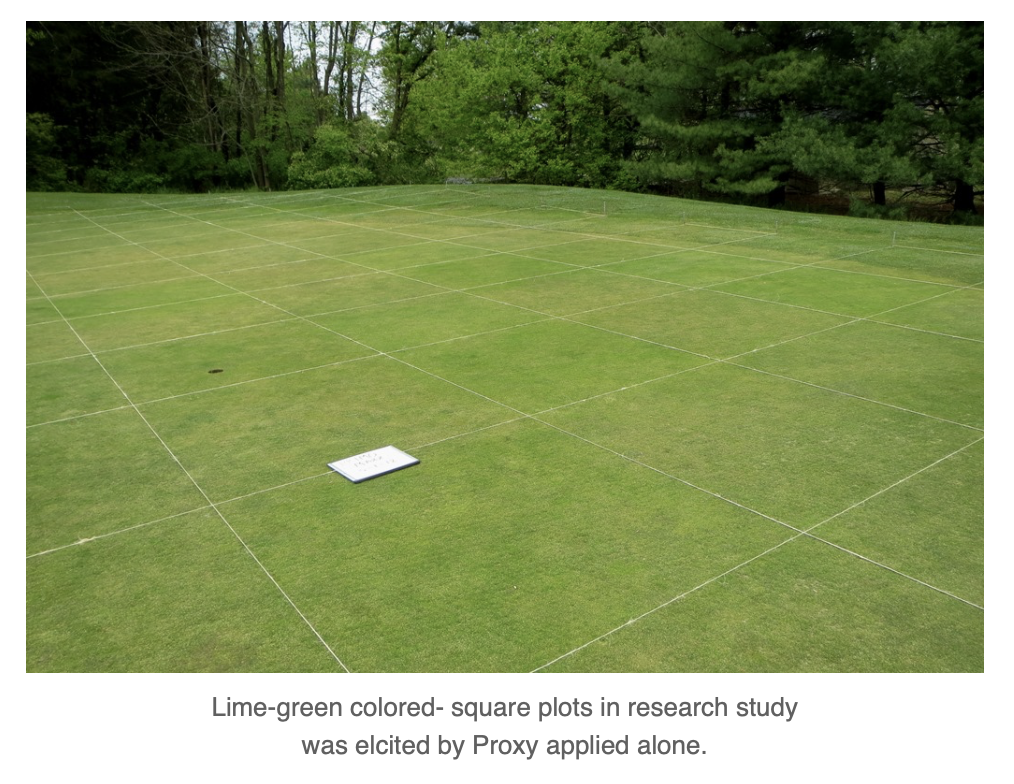
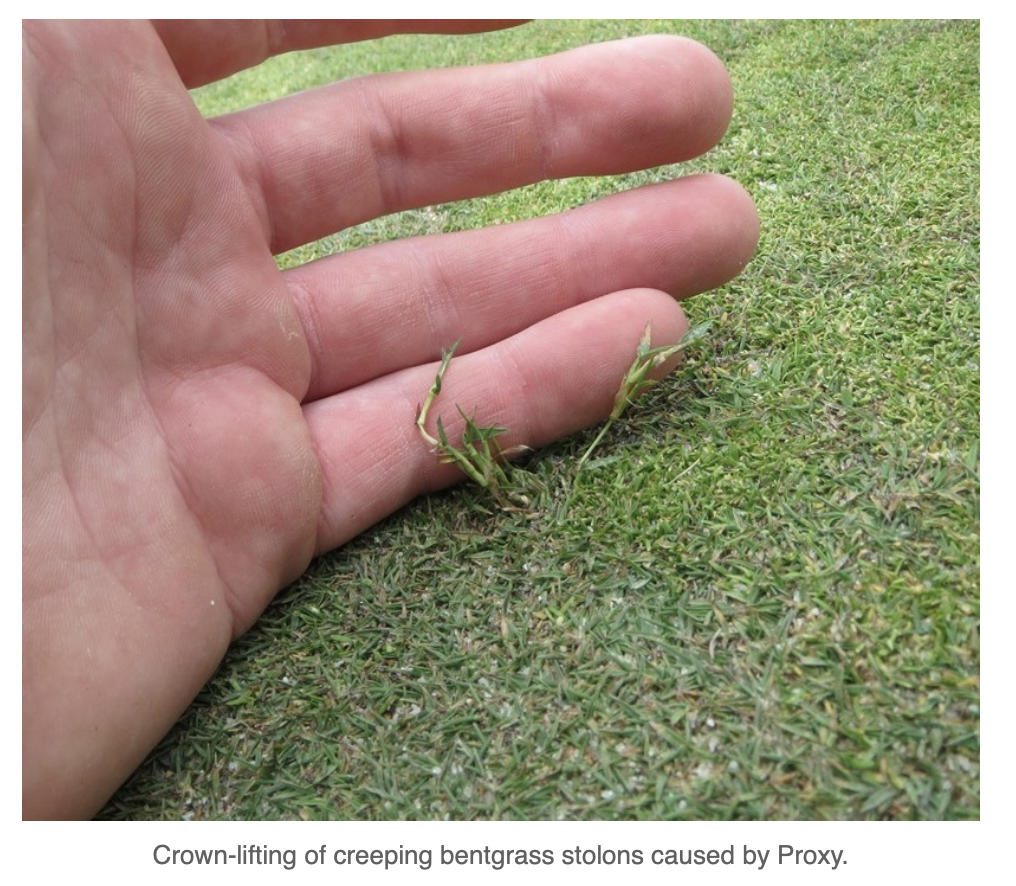
Proxy-alone elicits a lime-green color in creeping bentgrass and can predispose creeping bentgrass to stem or “stolon lifting.” Stolon lifting gives greens a shaggy look, but more importantly , “lifting” can predispose greens to scalping. In my own research studies, I found that mixing Proxy + Primo MAXX helps to mask the Proxy-induced lime-green color as well as minimizes the potential of scalping due to crown lifting.
High rates of some wetting agents alone also reduce or delay ABG seedhead emergence, but are not consistent. Early spring applications (e.g., early April+ early May about 21-days apart) of Banner MAXX (propiconazole) in the Philadelphia – Washington DC corridor also may reduce ABG seedhead production. Part III will address use of Cutless and Trimmit to suppress ABG invasiveness in creeping bentgrass, and other benefits and drawbacks.
I thank Mike Fidanza, Ph.D., and Steve McDonald, MSc. for their time, insights and always dependable assistance in preparing this and other Turf Tips Articles.