
The 2019-2020 winter did not happen. We had an “open” snow and ice -free winter. Our coldest nights staggered between mid-December and throughout most of January. Most February days were above average in temperature, but sprinkled in were several days when air temperatures were below average. Long periods of overcast weather brought little measurable rainfall. Most areas did not get sufficient rain to re-charge ponds, an indicator that the drought beginning in summer 2019 has not abated.
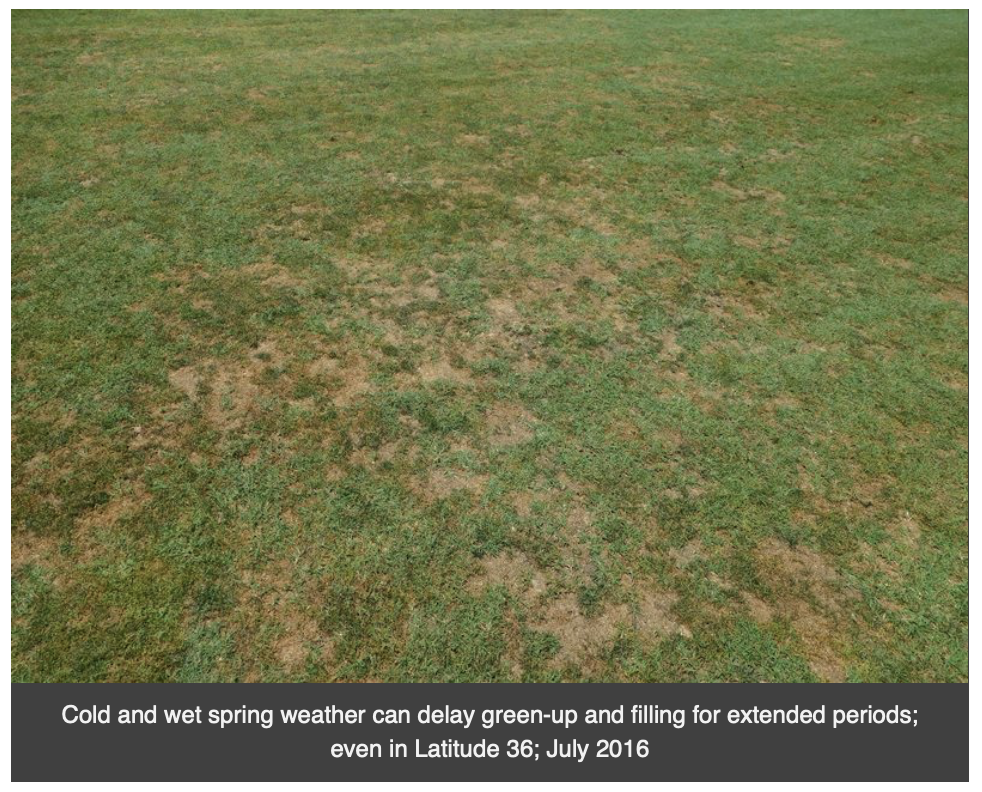
Washington DC long has been considered the northern most region where one can consider growing bermudagrass. This has not stopped many superintendents in trying to push use of this species more northward. Cultivars like Midway, Midiron, Tufcote and Vamont were among the first cultivars of bermudagrass to push the limits of adaptation in the 1980’s and 1990’s. In the early 2000’s, Patriot and others were embraced in the Baltimore region and the Delmarva Peninsula. The advent of a more cold tolerant cultivar called ‘Latitude 36’, has extended bermudagrass bounds into southeastern Pennsylvania. However, the threat of winter-kill or very cold spring weather that can cause long delaysin bermudagrass green-up and filling-in have remained commonplace issues, even for Latitude 36.

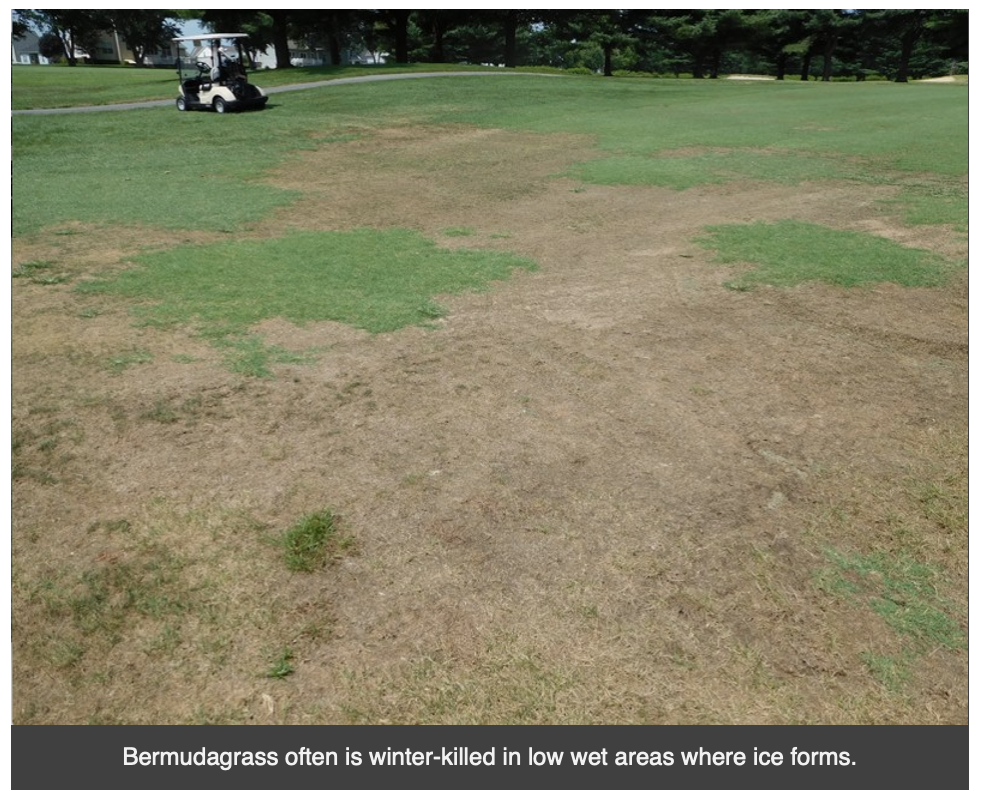
The two greatest limiting environmentalfactors on bermudagrass survival include winter damage and shade. Winter damage can be sub- categorized to include : direct low temperature injury; frozen, water-logged soils and/or ice cover; and desiccation. Low temperature damage occurs when air/soil temperatures drop rapidly to below 23oF or gradually to below 10oF. In our region, it would take several weeks of night temperatures below 20oF to cause direct-winter damage. Excessively wet soils that freeze, especially where ice forms in water puddles, is the most common form of winterkill in the mid-Atlantic. Any combination of freezing and thawing soils and ice cover, causes ice crystal formation inside stem cells (i.e., crowns, stolons and rhizomes), which destroys cell walls and contents. The presence of ice is the “double whammy” causing death due to oxygen depletion (anoxia). Finally, areas subject to frequent winds, in combination with cold and very dry soil conditions ,can cause tissue desiccation (i.e., water is physiologically pulled out of tissues and plants wither). In the mid-Atlantic, desiccation only occurs in sloped, south facing slopes in winter where there is no snow cover in combination with wind and soil drought. Bermudagrass desiccation is far more common in colder, semi-arid regions of the Southwest U.S.
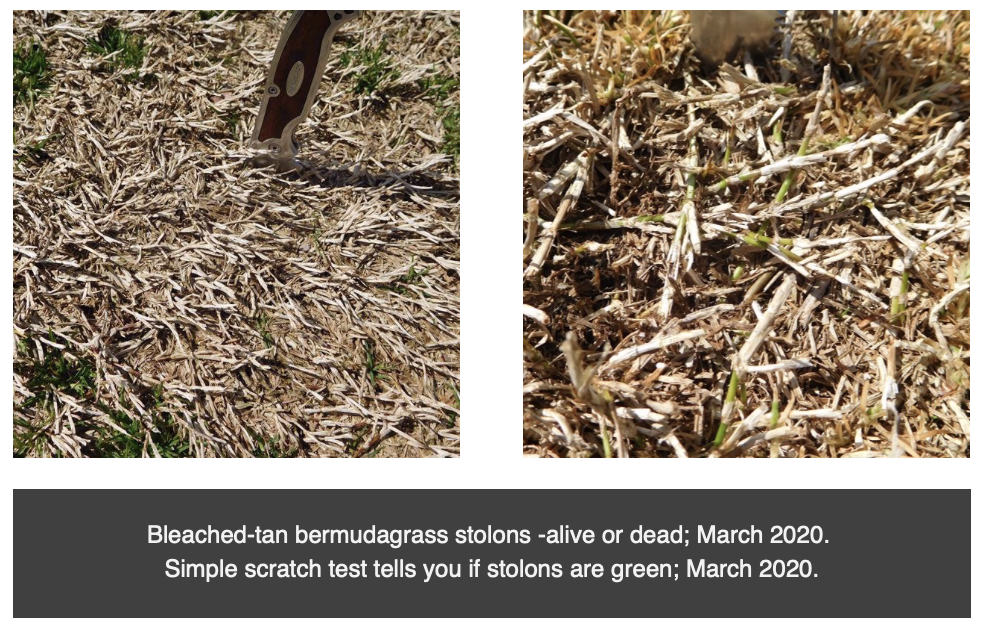
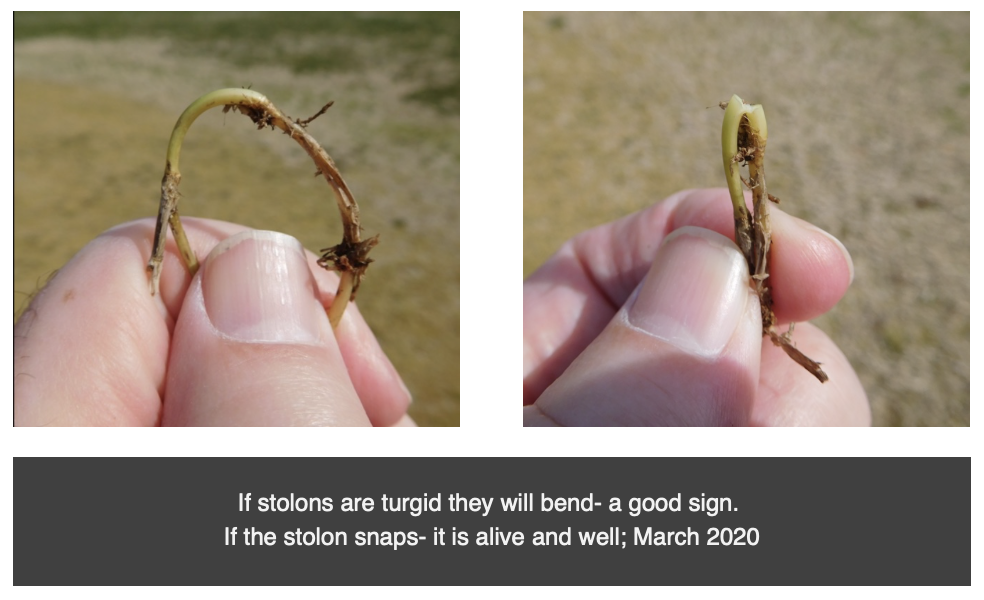
Longer March day lengths combined with above average air temperatures suddenly broke dormancy of several “spring” indicator plants like yellow forsythia flowers, willow limbs greening and some blooming fruit trees. If you manage bermudagrass, and have taken time to scratch around, you probably have found greening stolons. There is a simple test to determine if your bermudagrass is aliveand well after winter. Even if you see some greening of stolons, it is important to do a quick check, since some stolons may be green, but otherwise water-soaked (mushy like cooked veggies) and thus not likely to survive. Simply bend the stolon, and if it snaps, it is alive and well.
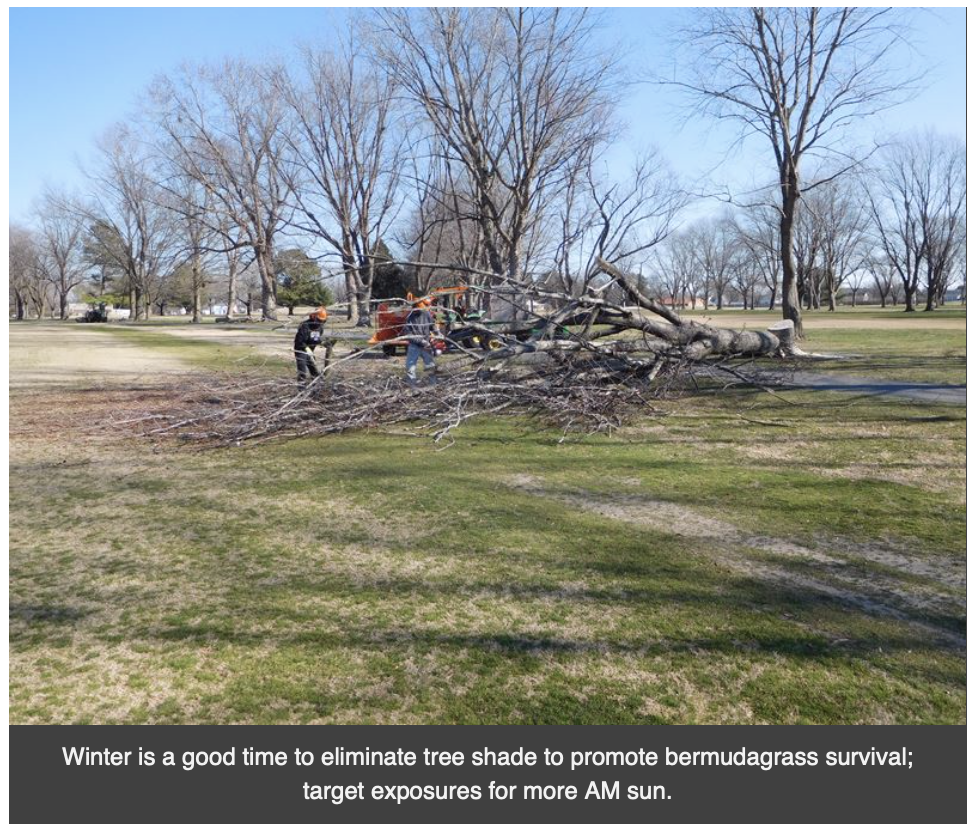
Bermudagrass and zoysiagrass (i.e., warm-season grasses) are especially equipped with the ability to grow (i.e., produce sugars via photosynthesis) during periods of heat and bright sunlight in summer. Shade, short days(fall to early spring) and otherwise low light intensity situations present significant growth limiting factors for bermudagrass, even for sports fields in stadiums. Bermudagrass grows best when sunlight duration exceeds 12 hours per day. In particular, morning sun provides the best quality light because clouds and haze often increase later in the day. As day lengths shorten in the fall, bermudagrass growth declines in proportion; stolons elongate and bermudagrass begins to lose density.
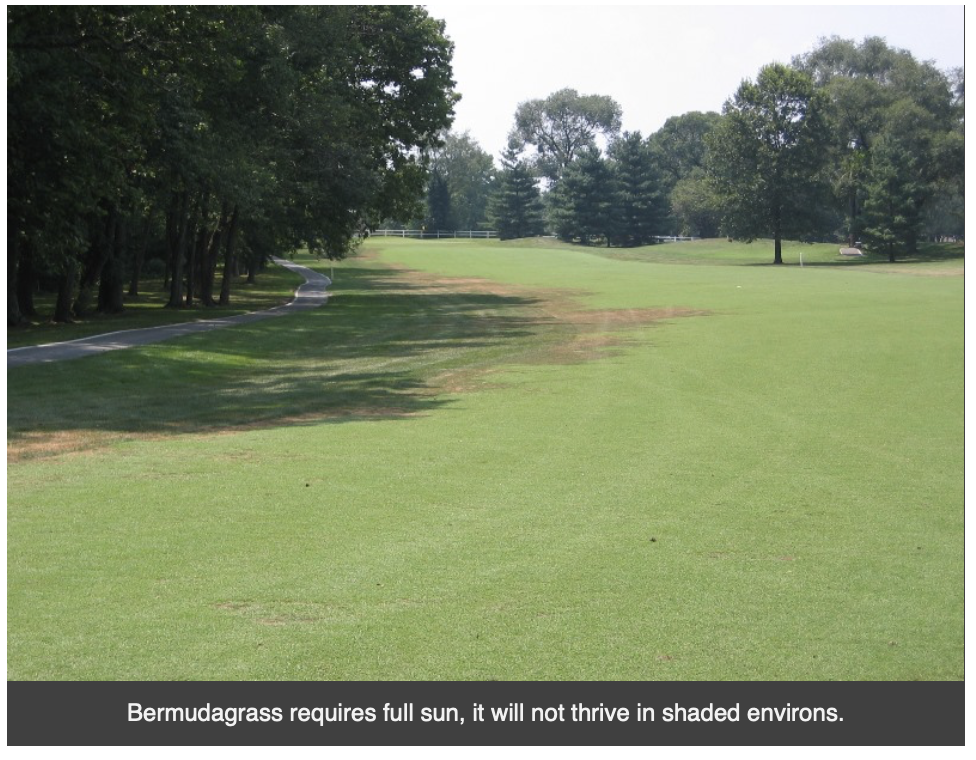
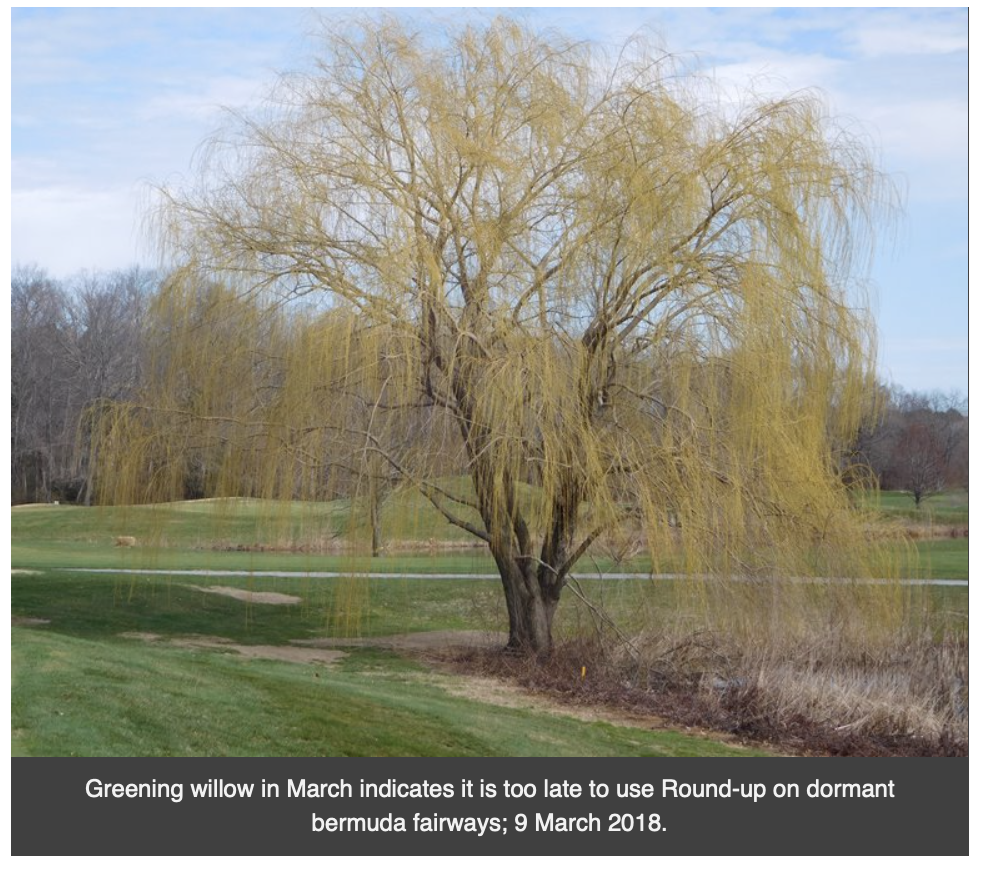
The third leading cause of poor bermudagrass recovery is weed completion. Bermudagrass requires 100 days without weed competition between spring green-up and August to fully attain optimum density before declining daylight naturally slows its grown. Hence, it is important to eliminate any competing weeds as soon as possible in the spring. The most common herbicides used to eliminate perennials (like perennial ryegrass) and winter annual weeds (especially annual bluegrass or Poa) in dormant bermudagrassfairways are glyphosate (Round-up, others ) and diquat (Reward, others). Both are non-selective and thus must be used before bermudagrass breaks dormancy. The greening limbs of willow, which have been apparent in southern areas of our region for over 2 weeks, have sent the signal that it is too late to use glyphosate on seemingly dormant bermudagrass fairways. Glyphosate can only be safely applied in February (in most years to ensure safety), and even then, it should be applied in less than 25 gal. water/acre to limit movement of the herbicide downward around stems. Diquat is a fast-acting contact (i.e., only kills green tissuescontacted), and is a good choice if you only are trying to kill Poa and other winter annuals in dormant bermudagrass fairways. It is safe to use on dormant bermudagrass, but the recent warm weather has now made it too riskyto use in many locales.
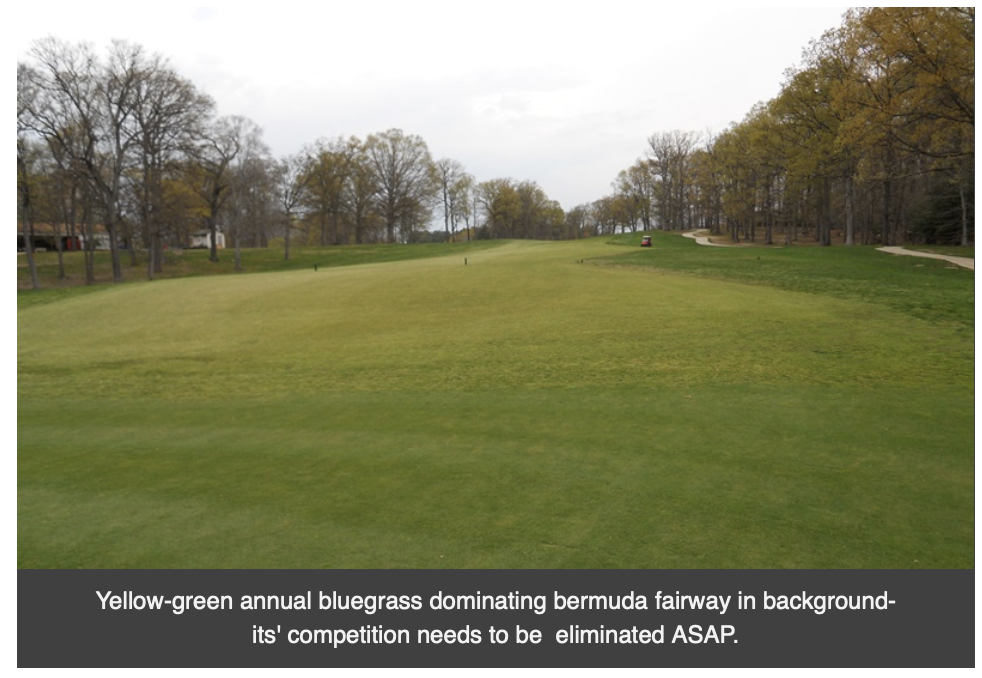
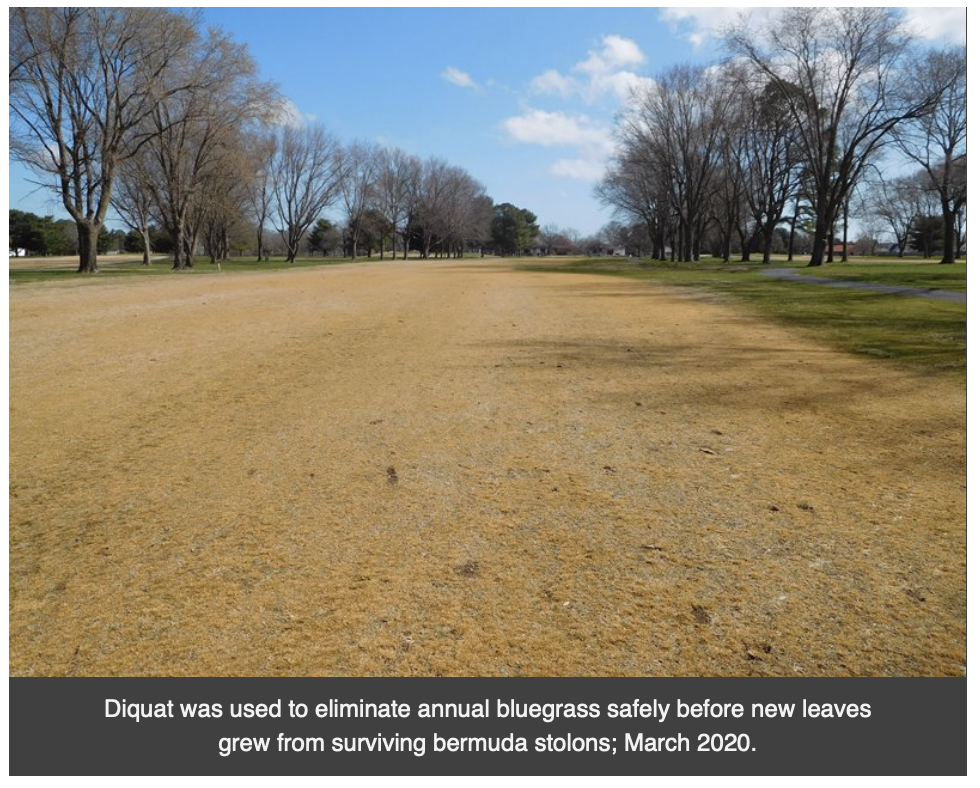
Since stolons are now greening in southern areas of our region, it is best at this point in time, to consider a less risky, selective herbicide. This is especially true if fairways have a dense cover of overseeded annual or perennial ryegrass. Common selective bermudagrass herbicides include Kerb (pronamide), Revolver (foramsulfron) and Manor (sulfosulfuron). All of the aforementioned have the ability to track or movein surface water drainage patterns to kill nearby cool-season grasses. Kerb, however, is the most mobile of the aforementioned and should only be used with extreme cautionif desirable cool-season grasses are growing nearby. While these herbicides could delay green-up; there are greater benefits to be had by removing highly competitive overseeded grasses from bermudagrass in spring.
Frequent applications of water soluble nitrogen (N) fertilizers like of ammonium sulfate, ammonium phosphate, urea, and others are best used to stimulate growth, but do not apply N too early. Coated urea’s and other slow nitrogen fertilizers are great later in summer to maintain uniform growth and green color. Only begin a water soluble N program after the leaves of bermudagrass appear and when there is a uniform green tingeacross fairways. The big “potential” problem is that we are not out of the woods on cold temperature threats at this point. Indeed, stimulating bermudagrass growth at this point would be counter-productive in the event we experience several frosty nights, or worse, freezing soil conditions and/or ice.
Once past your last probable frost date (usually sometime in May), you can begin to use more liberal amounts of water soluble N. I’m a resolved believer in using ammonium sulfate to stimulate bermudagrass cover. This involves applying 0.5 to 0.75 lb. N/1000 ft2every 14 to 21 days from green-up until maximum green cover has been achieved. While research evidence is weak, it appear that using N and potassium (K) in a 1N:1K ratio further helps promote recovery and improve the summer hardiness of bermudagrass. Ammonium sulfate works fast to stimulate leaf growth and provide a pleasing greening-effect. On the down-side, ammonium sulfate has a very high burn potential and can severely damage cool-season grasses during warm periods, especially creeping bentgrass. Use urea (there also are many other safe organic and liquid forms of N+K) as your primary N-source where there is a risk of spreading fertilizer pellets onto bentgrass during warm and humid summer periods.
Thanks for reading! For more articles and information, visit the Dr. Pete's Turf Tips Archive.