Most turf nerds, like myself, are baffled and amazed by the incredible strength and endurance of relatively small animal pests, which create mounds of excavated soil in lawns and golf turfs. Major mounding pests include moles (sometimes shrews and voles), as well as cicada killer wasps and ants. All members of critter/insect turf mounders are extremely difficult to control or otherwise deter from their disruptive activities.
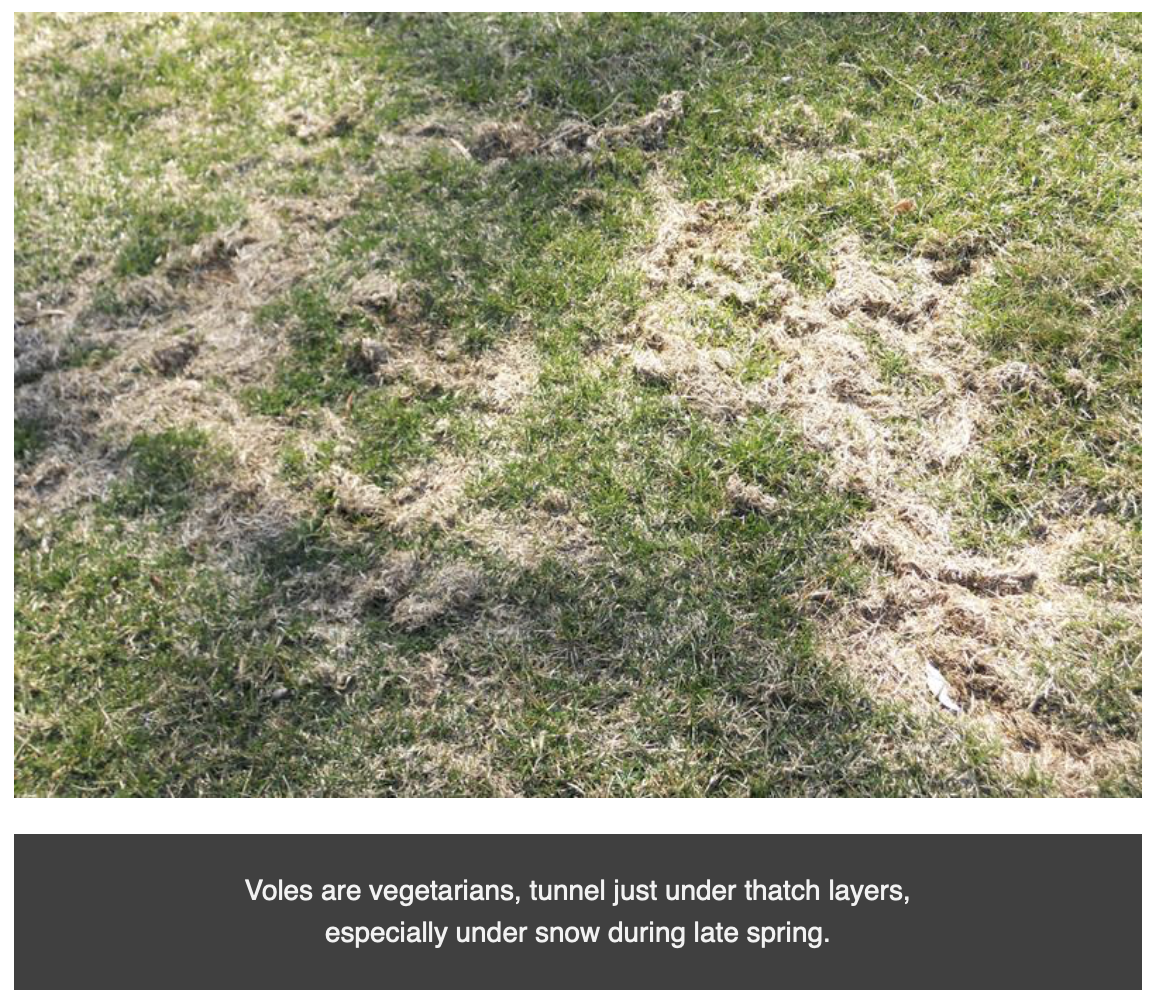
Three aggressive tunneling and mounding critters include moles, voles and shrews. Voles live in grassy areas where they construct networks of surface and underground runways (about 1-2” wide), which may be accompanied by large numbers of exit holes (≈1-2” in diam.). Voles are vegetation’s and eat mostly roots, weeds (e.g., plantains, clovers and others) as well as bulbs and bark.Voles look like field mice and are gray or reddish-brown and 4-7” long, including the tail (which is short). They do not hibernate and can be active under snow during spring melts in both greens and lawns. In turf, vole activities are mostly noted in spring after snow recedes. They tunnel close to turf surfaces under snow, creating ribbons of dead grass by feeding on roots and dormant grass. Shrews are small, about 3-4” long, mouse-like with a long pointed snout and small eyes. They eat ants, small snakes and mice as well as insects above ground and in tunnels excavated by moles. They do not create surface mounds.
Among these critters, molesare by far the most common. They are most active in spring and fall when soils are cool and moist. They avoid tunneling in compacted and/or very dry soils. Moles mate once in spring and offspring’s move away from one another, and become solidary operators. Although solitary , there can be 3 or more moles working independently in the same lawn, and often in the front and back of the same lawn. When this occurs, there can be extensive tunneling, with numerous holes and torn-up turf. Moles are carnivores (i.e., don’t like salads) and feed mainly on earthworms, insects (esp. grubs) and other invertebrates. Moles have claws and shovel-like forefeet, which enable them to tunnel and mound aggressively in lawns and other turfs including golf greens. Moles lack external eyes and ears, are furry, 6 – 8” long, and live almost exclusively underground.
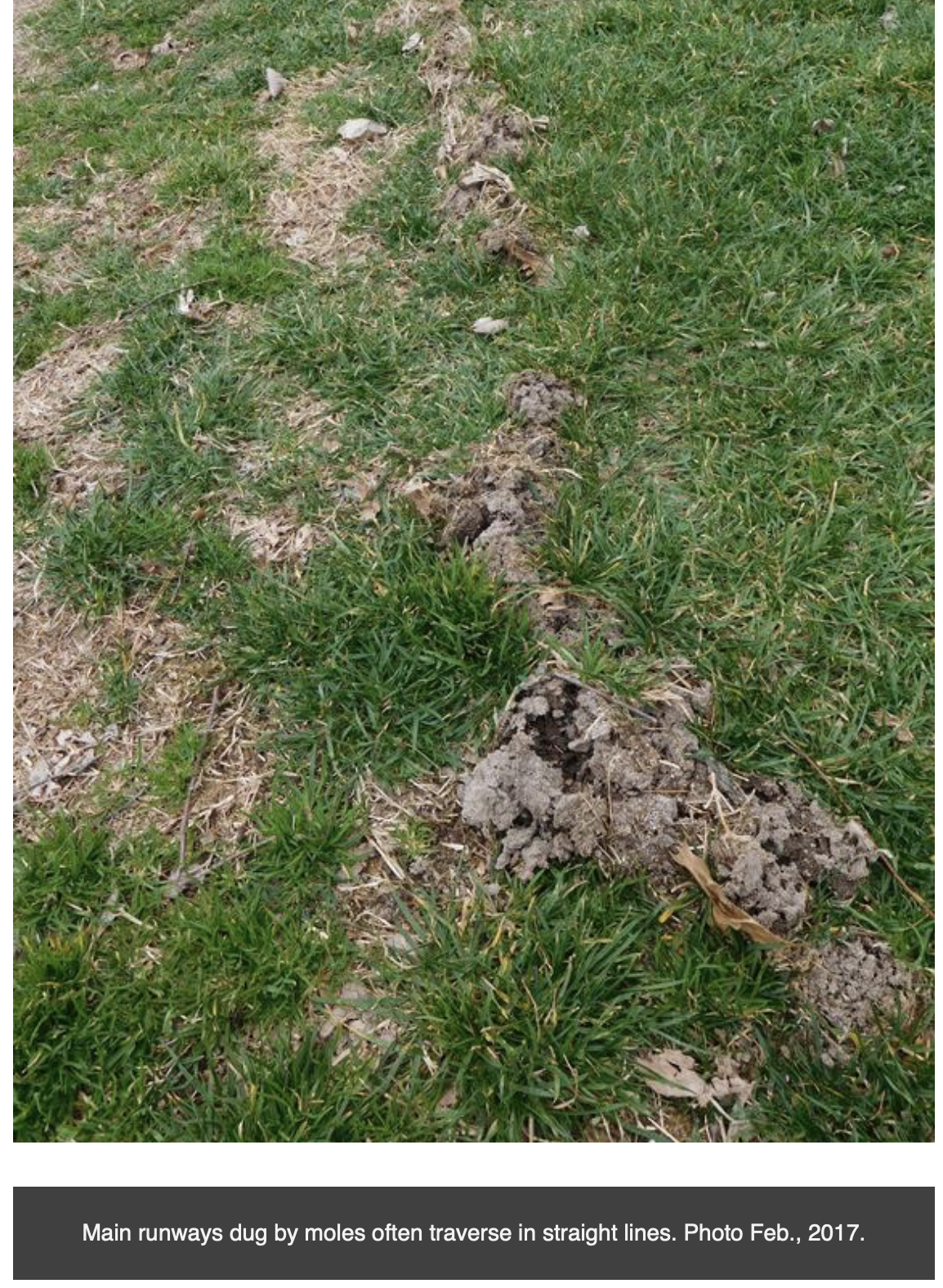
Moles work surface tunnels almost exclusively at night; their movements during daylight hours are rarely observed. Moles are most abundant in lawns adjacent to wooded areas. Moles construct extensive surface and underground tunnels. Surface runways appear as ridges through turf areas; surface runways normally are used as daily travel lines. In less dense turfs, ridges appear as fresh excavated soil. Main runways run a straight line course for 30 feet or longer. To confirm an active main tunnel runways, tramp down ridges at several locations and check to see if they have been repaired in a day or two. I’ve collapsed many surface tunnels, in hope they would stay down, only to find them raised again the very next day.
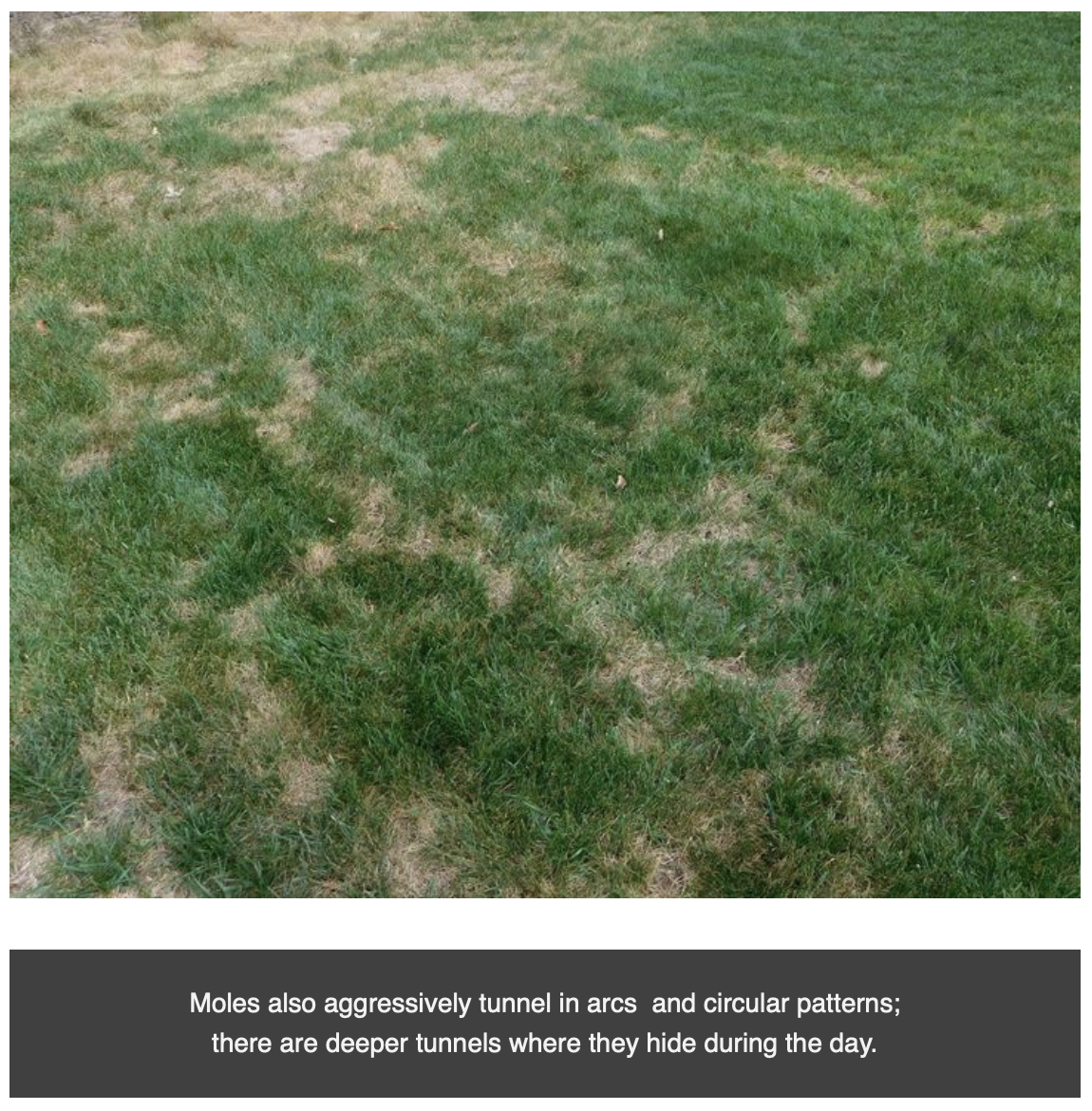
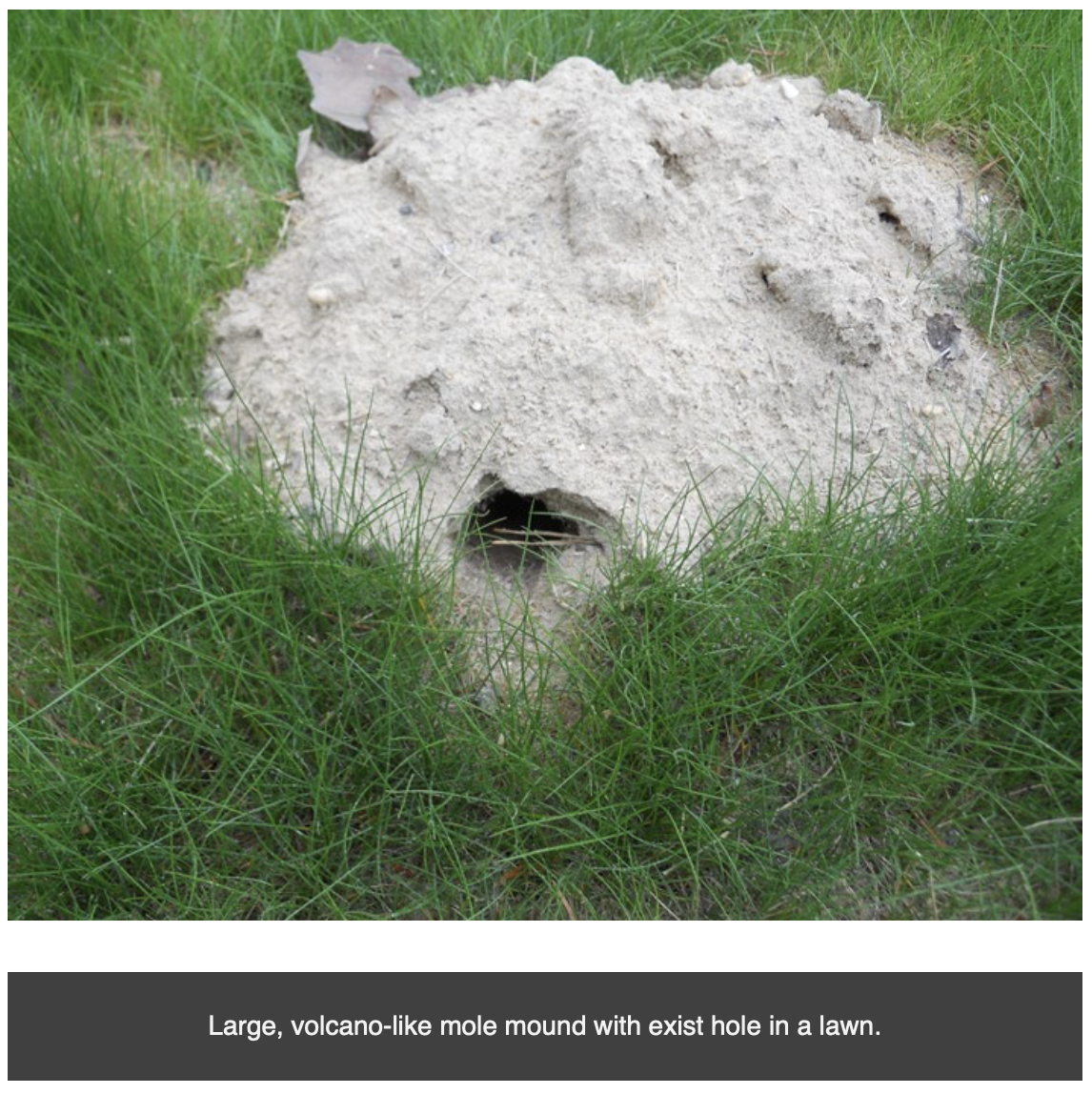
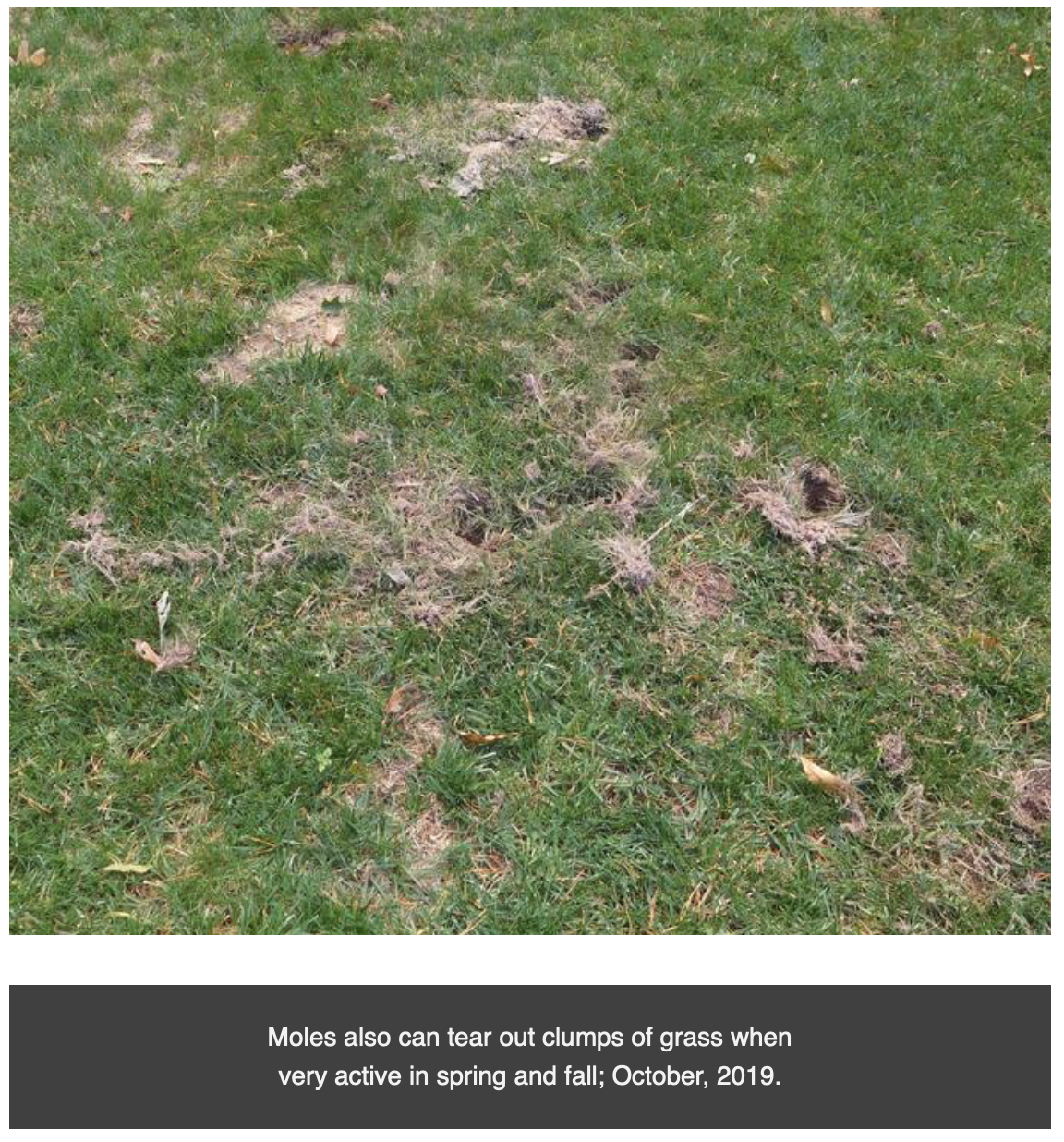
Sometimes, moles settle in a relatively small area (< 100 sq.ft) churning away in arcs and circular patterns leaving large (2” or large) exit holes. Sometimes they surface to tear-out clumps of turf. Such activity can be so damaging that affected areas need to be raked often to remove debris and redistribute soil into holes. In these sites, soil underfoot feels roiled or tilled and needs to be tamped to protect mowers. Some types of massive disturbances may involve predators like snakes, owls and fox. Occasionally, moles produce large volcano-like soil mounds over 8” diam. at the base, with an exit hole in the top or side.
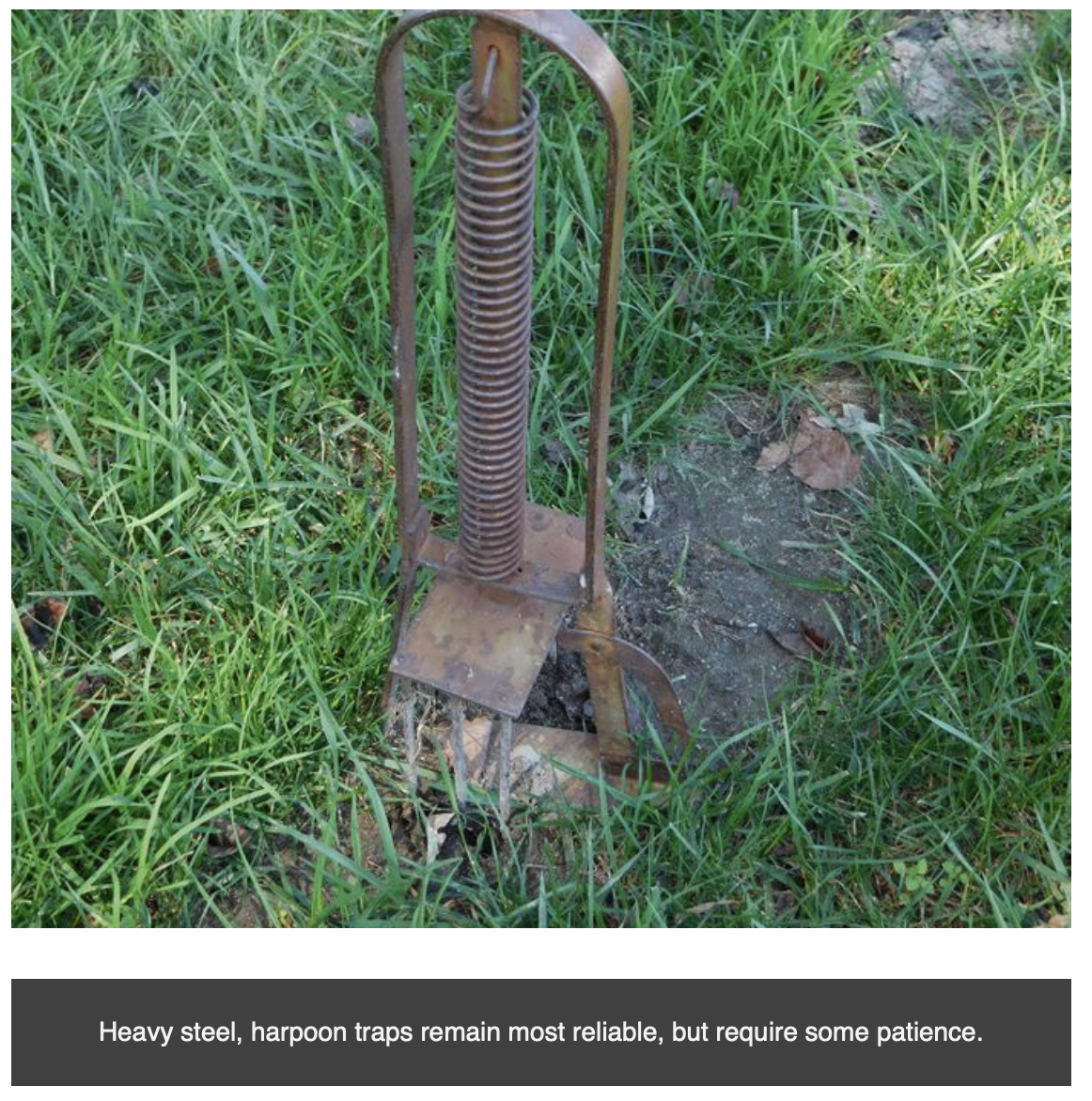
Moles are aggressive digging machines, which infuriate lawn owners and turf professionals as well. As far as I know, there are no reliable ways to deter or control moles in turf. Some urban legends of mole control have included inserting into holes and tunnels things like gum, razor blades, broken glass, rose branches, human hair, sheep dip, bleach, diesel, lye, flooding, exhaust carbon monoxide fumes, and baited mouse traps. One highly misleading recommendation is to apply an insecticide to control grubs (e.g., larvae of chafers and Japanese beetles). While moles enjoy eating grubs, they are not deterred by grub-killing insecticides because their main food source is earthworms. The most reliable method of mole control to date is use of harpoon/plunger traps. Common deterrents include 100% castor bean oil, Cheyanne pepper and others. As far as I can determine, 100% castor (check label –many products only contain 10% castor oil) alone provides mostly poor results. There is no information on using castor bean oil in combination with Cheyenne pepper, but a friend swears by the combo.
Harpoon/plunger traps, use sharp spikes that skewer moles as they run along active surface tunnels. Trap use requires a lot of patience, and work only if moles are using an active surface runway. This requires tamping down tunnels and returning every day or two to see if surface tunnels have been raised. Once an active surface runway has been identified, the trap is set, and the tunnels are tamped down. Harpoon traps are still considered the best means of mole control. However, newer light weight steel and plastic traps are erratic.
Poison baits of the past have not worked since moles are mostly interested in eating worms and bugs and avoid baits. I recently learned of a product “poison worms.” (seeVictorPests.com.). Unlike other baits, these artificial worms evidentially are palatable/ tasty to moles. Poison worms are colorless, about 3” long and contain a neurotoxin (bromethalin). The LABEL clearly states that they must be handled with gloves and that they are hazardous to pets, children and wildlife. Basically, you need to find a hole, place a worn inside and cover with soil. It helps to insert about five worms in a small area where there are numerous raised tunnels and exit holes. Information about baits and deterrents is mostly anecdotal – so “pay your money and take your chances.”
While use of deterrents and baits are erratic, moles eventually will move away in their own good time – presumably when their food supply has been exhausted. One thing is certain, and that is their tunneling and mounding activities quickly stop with the advent of frosts and cold soils, which send them deeper into soil to hibernate.
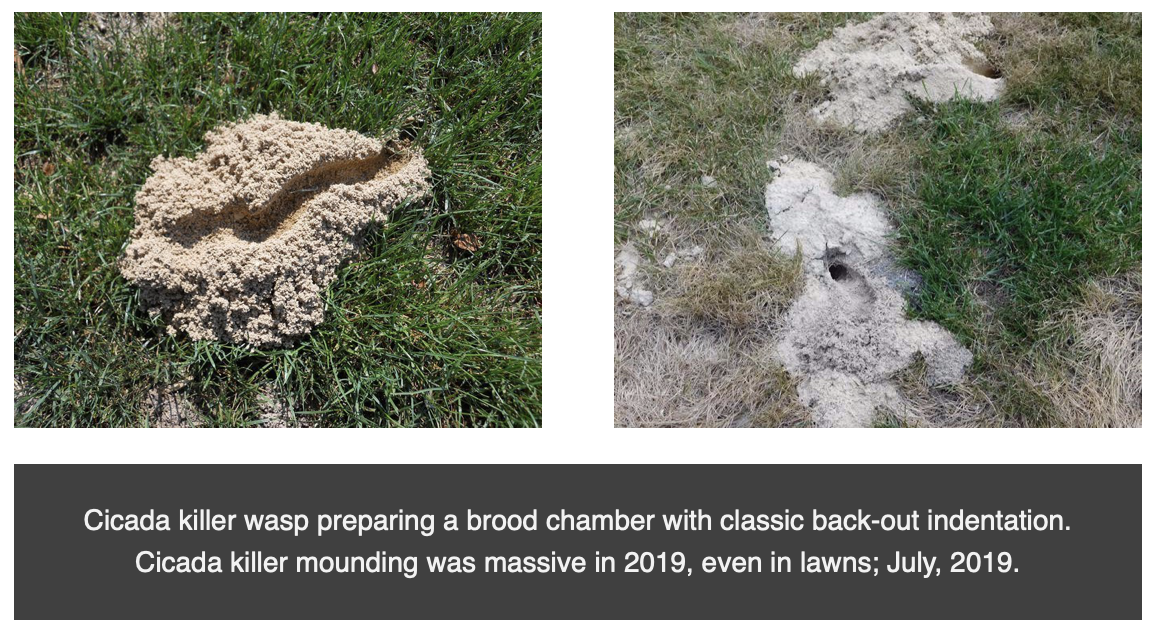
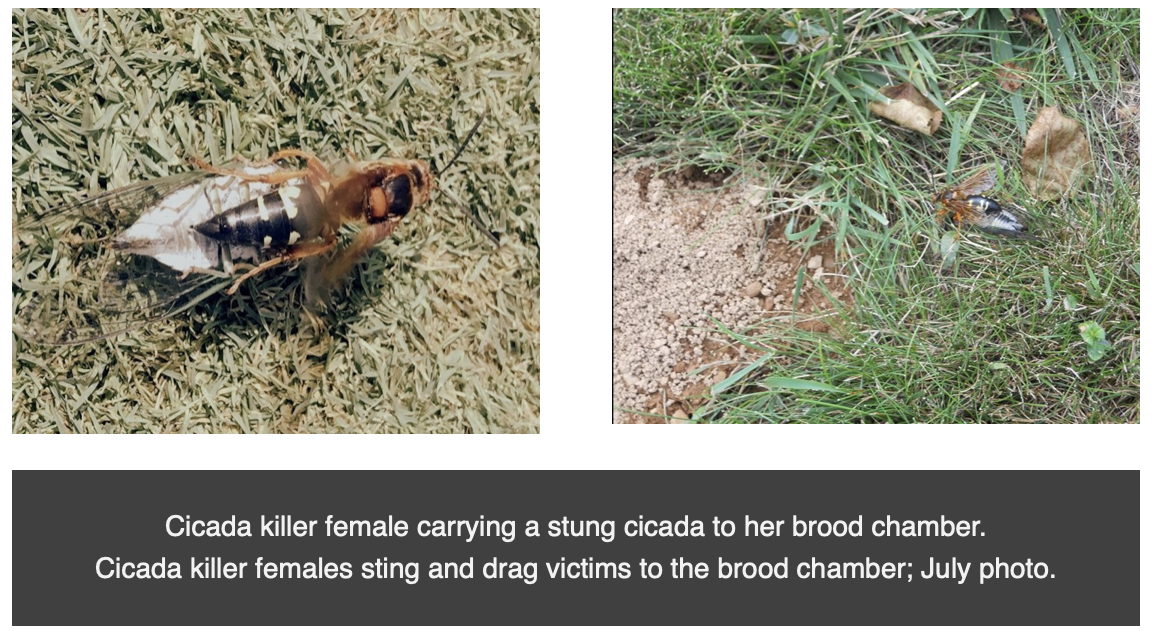
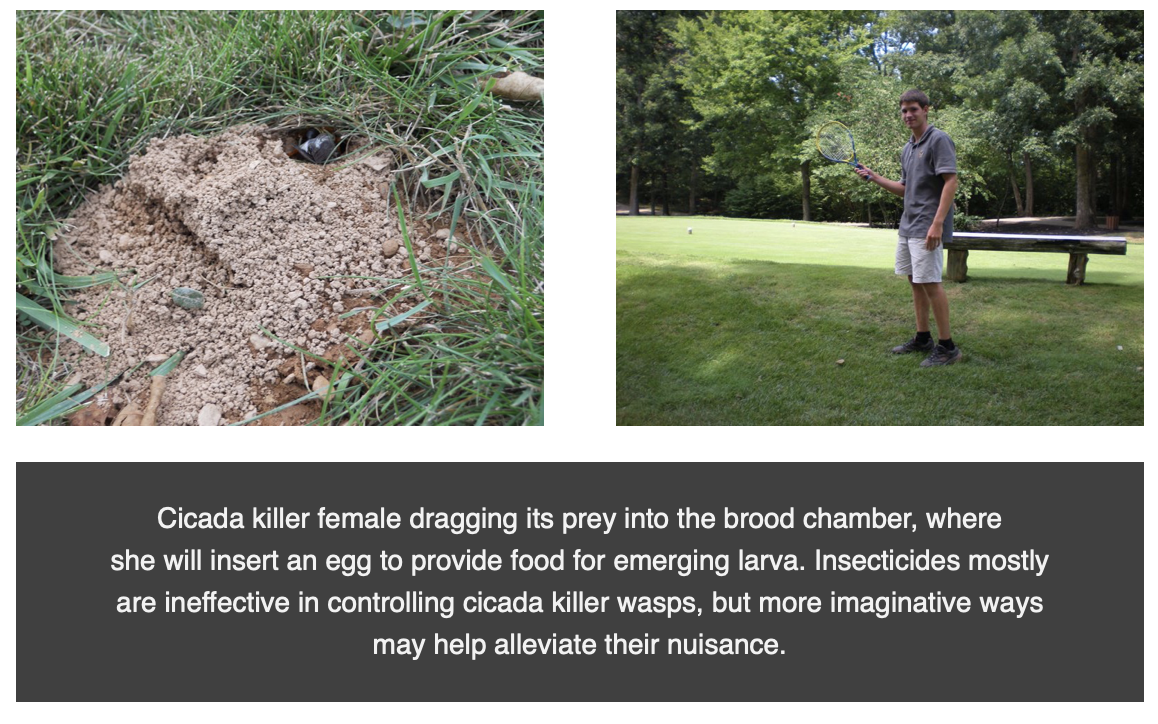
Cicada killer wasps. I have long been impressed by the mounding activities of cicada killer wasps on golf courses (esp. bunkers), until they became fond of my lawn. July and August, 2019 was the most active and plentiful assaults in memory. These sand wasps resemble very large hornets. They have yellow wings, and yellow and black striped abdomens. They have a buzzing and menacing manner, but rarely sting humans. Female wasps do all the work of hunting and digging into soil to produce their brood chambers. Females prefer to burrow into sandy embankments of bunker faces and southwest facing slopes on greens and even lawns. Soils is pushed to the surface as female’s tunnel and create U-shaped depressions on top of soil mounds. Indentation/depressions are caused by females backing-out of cells. Mounds often are the size of soft-balls, but can exceed 10” in length and several inches in height. Mounds often smother grass in patches and damage mower blades. Once burrows are prepared, females ambush adult cicadas and bring them to the brood chamber, where the wasp lays an egg in the victim. The female backs-out of the tunnel and seals the cell. I have observed females accumulating several cicadas and placing them (in separate cells?) in the same mounded /brood chamber. Emerging wasp larvae consume the cicada as a food source. Females continue the process until late summer (around Labor Day), when cicada populations naturally decline. Professional turf mangers seldom achieve effective control with insecticides, but some use insect nets or tennis racket (they work-if someone is available) to capture or incapacitate flying adults.