
It has been a tough growing season, but this is not so unusual in the mid-Atlantic. A cold, windy and wet spring slowed green-up, and for some, was associated with major losses of bermudagrass cover. Hot and dry conditions were followed by deluges of rain, which beat-up turf badly. These same conditions are, in part, responsible for major goosegrass invasions. Weather conditions promoted rapid breakdown of otherwise effective preemergence herbicides targeting goosegrass, and loss of density gave goosegrass an even greater competitive advantage, especially on golf tees and approaches.
Goosegrass, also known as silver or hard crabgrass, is a warm-season annual that germinates in spring and becomes a highly invasive and tough competitor, especially in compacted soils. Goosegrass seedlings emerge in spring about 2 to 3 weeks after crabgrass. Goosegrass can develop in higher cut turf grown on a well aerated soil, but it is most common in compacted soils. Goosegrass tolerates very low mowing and survives extreme heat and drought stress. Low cut sports turfs, and golf course greens, tees and fairways are primary sites for goosegrass invasion. Compacted paths on school lawns, parks and similar sites often are colonized. Goosegrass also can be a huge problem in sod fields, especially in areas adjacent to where heavy equipment enters and exits fields, as well as along drainage ditches.
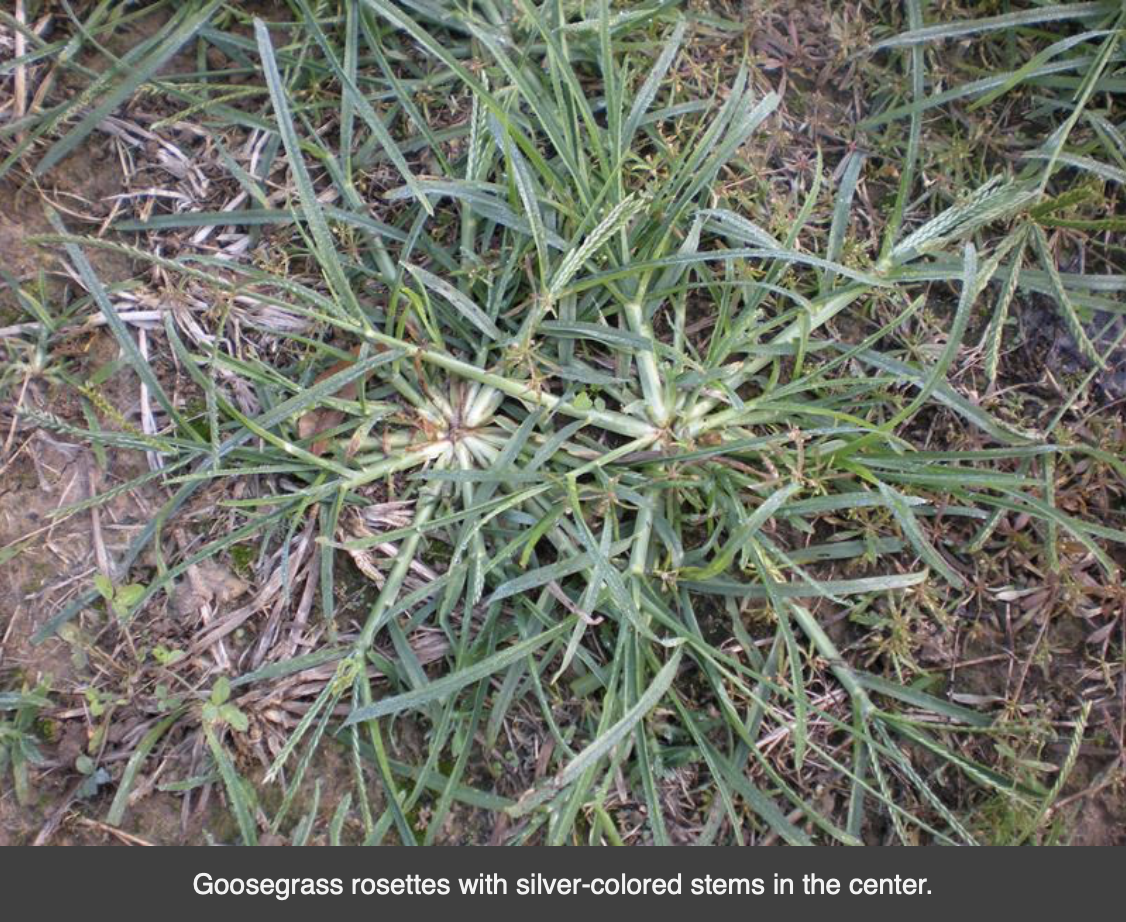
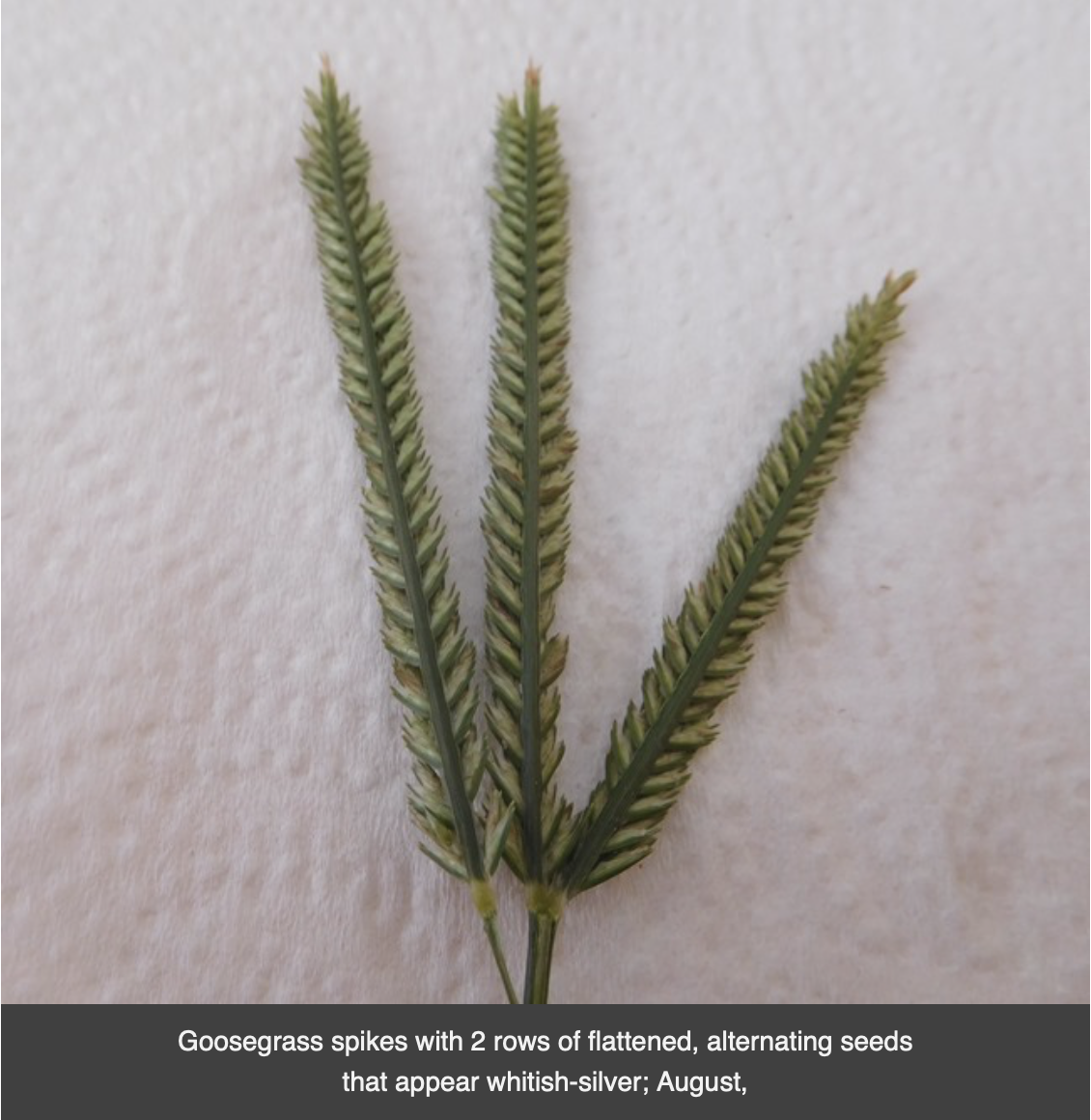
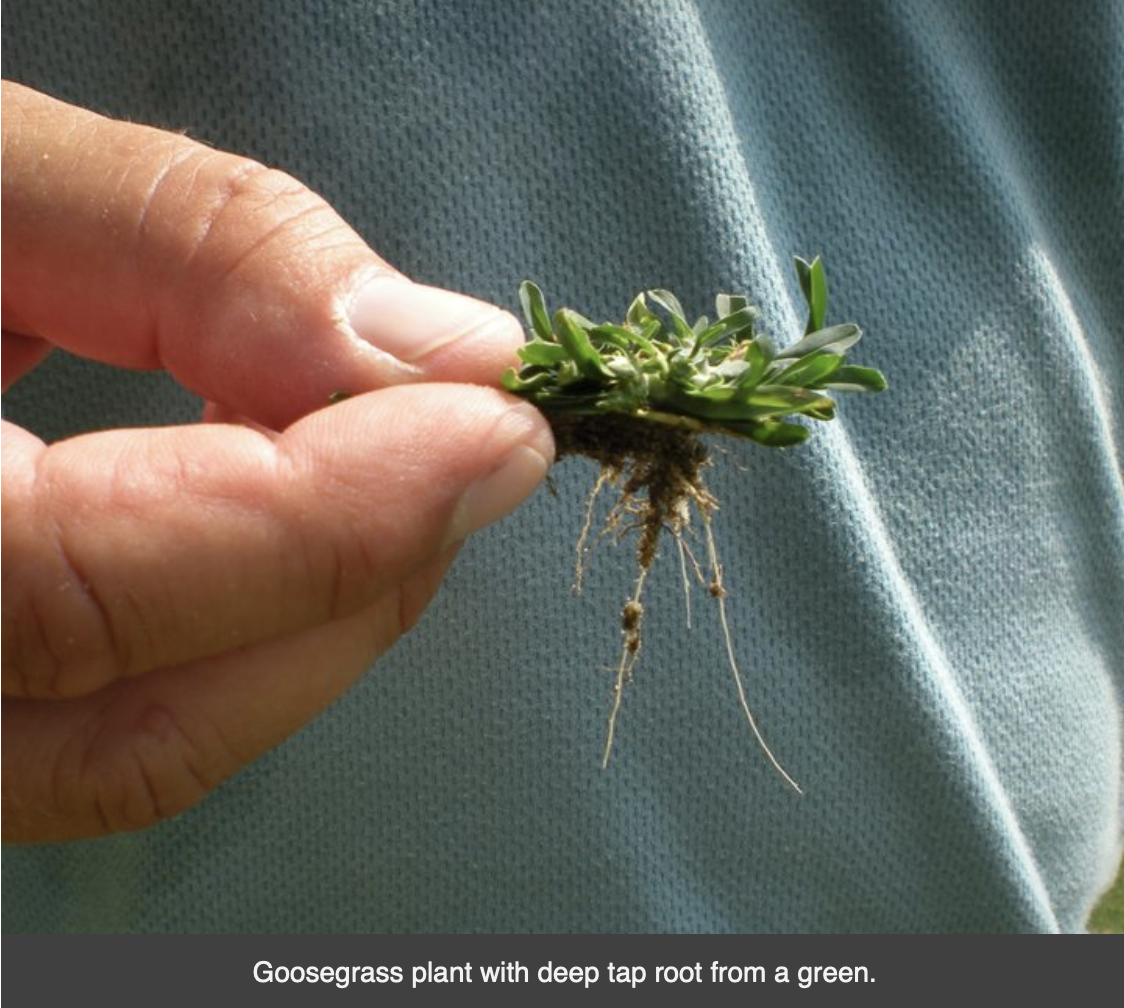
Goosegrass leaves are smooth to sparsely hairy on both surfaces and stems are flattened. During summer, goosegrass plants rapidly tiller. Leaves are dark green and have silvery-white stems in the center of the plant, which lie flat or appressed on the ground. Tillers spread out to form a rosette similar to the spokes of a wheel. Plants become anchored by a deep tap-like root, making them difficult to pull out of turf. Seedheads consist of 2 to 10 radiating finger-like spikes that develop at the top of the seed stalk. Two rows of alternating, flattened seeds appear silvery-white and “zipper-like.
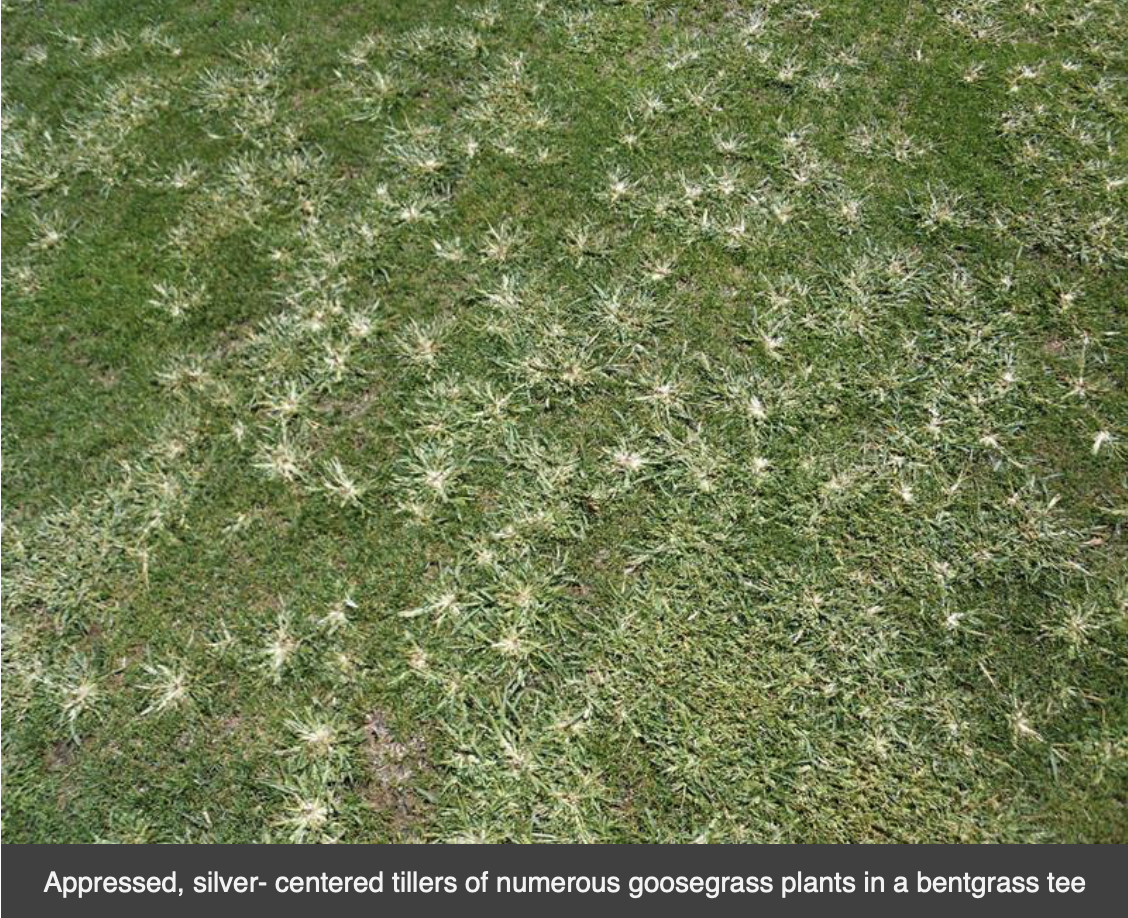
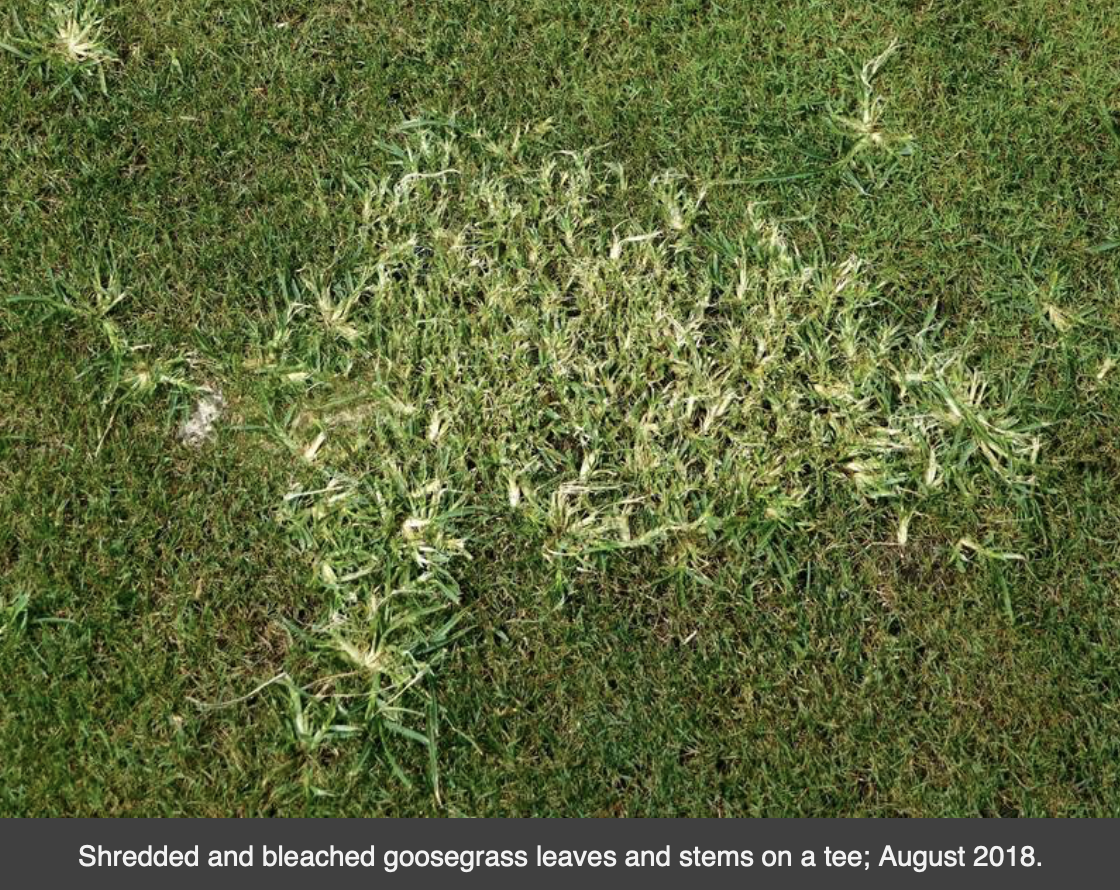
The horse is out of the barn and postemergence herbicides are needed now; not only for renovation purposes, but also to limit seed production as well as to eliminate their obnoxious winter appearance. In late summer, goosegrass “hardens” and its tough vascular bundles (woody- “lignified” tissues that move water and nutrients throughout plant parts) cannot be cleanly cut and often are shredded and turn a bleached-white color. Dead “goosegrass skeletons” remain evident all winter long, and out-compete new seedlings for space.
Acclaim (fenoxaprop) is highly effective on immature goosegrass, with safety in most cool-season grasses (even bentgrass fairways when used according to the label). MSMA, an old timer, is still around, and remains a good option for goosegrass control in bermudagrass.
Now that goosegrass is mature, multi-tillered and producing seedheads, better herbicides are available. These newer options include Pylex (topramezone) and Tribute (thiencarbazone + foransulfuron + halosulfuron). There was excitement in using Pylex to suppress common bermudagrass in cool-season-grasses. More recently, however, it has been used with better success for the purpose of postemergence goosegrass control in cool season-grasses.
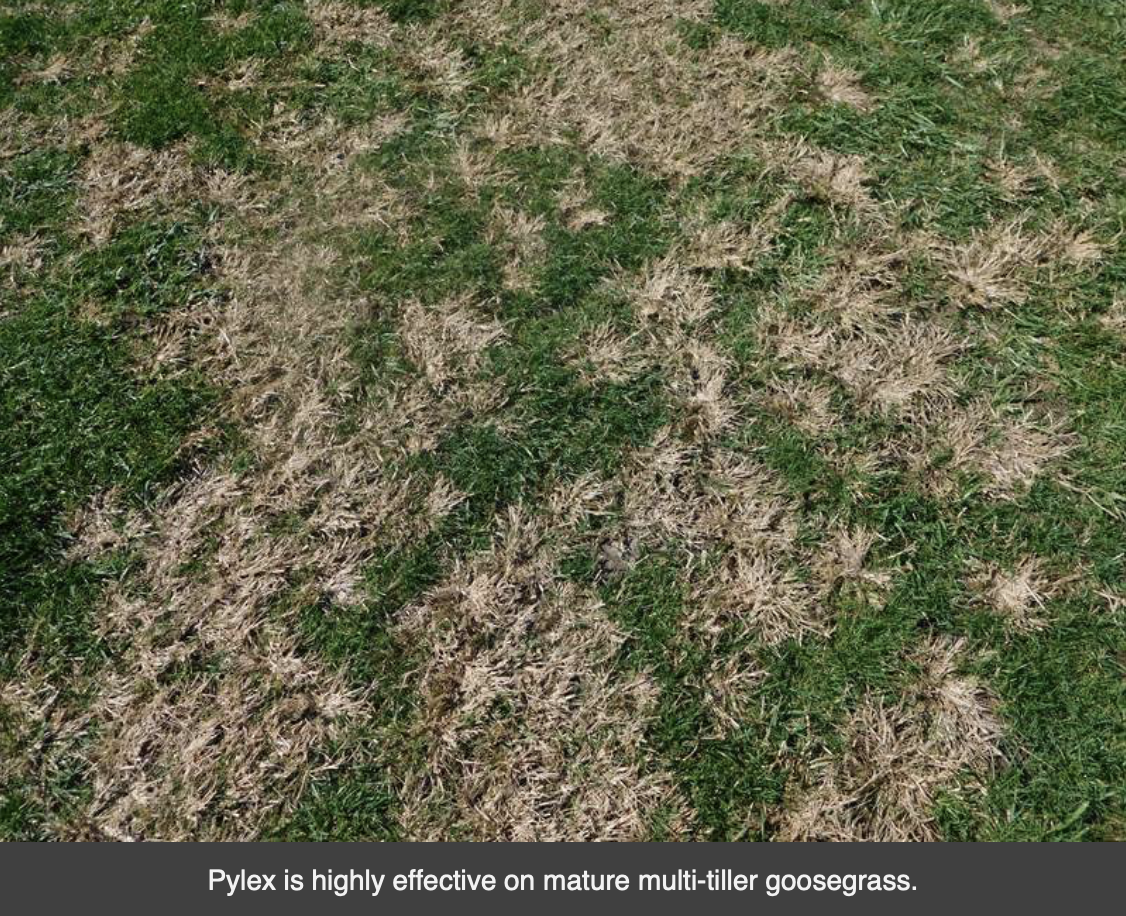
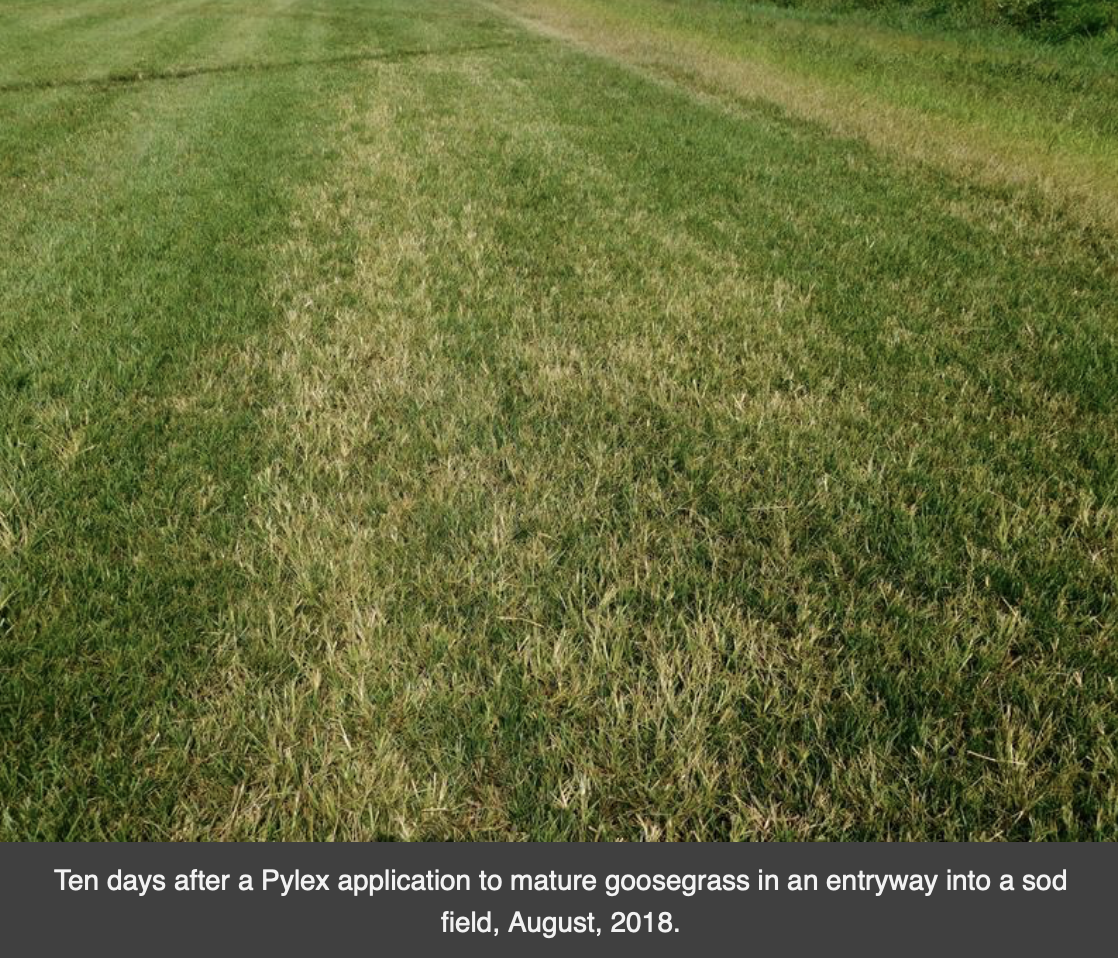
The following insights on Pylex and Tribute usage were kindly provided by Steven McDonald, MSc. (President of Turfgrass Disease Solutions).
There are bleaching concerns using Pylex in turf, which can be masked in tall fescue, perennial ryegrass and other cool-season grasses (excluding bentgrass), by tank-mixing with triclopyr (Turflon). For creeping bentgrass tees and fairways (NOT GREENS), Pylex (without triclopyr) should be applied at a rate of 0.25 fl. oz. product/A to tillered goosegrass plants. More mature goosegrass in bentgrass tees and fairways may require a follow-up application of about 0.15 fl. oz product/A. Some bleaching should be expected in bentgrass.
In higher cut, cool-season grasses like tall fescue, Kentucky bluegrass and perennial ryegrass the Pylex rate for multi-tillered goosegrass is in the range of 1.0-1.5 fl. oz. product /A. Tank-mixing Pylex with triclopyr (Turflon, others; at 34 fl. oz./A) not only masks most bleaching, but boosts performance and will help control some broadleaf weeds that may be present. Some turf yellowing is likely. Pylex is “weak” on crabgrass and Steve McDonald suggests that if crabgrass also is an important target, that Pylex should tank-mixed with Drive (quinclorac) (which has improved activity on crabgrass, but not goosegrass). An adjuvant (e.g., methylated seed oil) is recommended, and rates can vary widely depending on weed maturity and turfgrass species to be treated.
According to Steve McDonald, Tribute has become more popular for the purpose of targeting goosegrass in both mature bermudagrass and zoysiagrass. In addition, Tribute has good activity on crabgrass, Dallisgrass, and sedges and Kyllinga’s. Tribute should NOT be applied to cool-season-grasses.
In my experience, there is no faster way of destroying turf than through the miss-use of an herbicide. It is essential to carefully consult the label before using herbicides and ask questions if you are inexperienced using any pesticide. If goosegrass is a current problem, it will be back next year, and for many years to come. Map highly infested areas now, and plan to use an effective preemergence herbicide next spring. It has been a tough growing season, but this is not so unusual in the mid-Atlantic. A cold, windy and wet spring slowed green-up, and for some, was associated with major losses of bermudagrass cover. Hot and dry conditions were followed by deluges of rain, which beat-up turf badly. These same conditions are, in part, responsible for major goosegrass invasions. Weather conditions promoted rapid breakdown of otherwise effective preemergence herbicides targeting goosegrass, and loss of density gave goosegrass an even greater competitive advantage, especially on golf tees and approaches.