
Record high temperatures in December and early January, combined with long periods of rainy and overcast weather, have promoted some unusual diseases as well as some of the “usual suspects.” Purpling of greens in response to freezing temperatures as well as dollar spot, yellow patch (aka cool temperature brown patch) and yellow tuft are fairly common from late autumn to spring. While dollar spot is common, even into November, its continued activity in December 2015 and January 2016 was unprecedented. Bluegreen algae and superficial fairy ring impacted some courses, but I cannot recall ever seeing either in the Dec.-Jan. period. Somewhat surprisingly, I have not observed Microdochium patch (aka Fusarium patch or pink snow mold), but you may have seen dollar spot, which caused similar symptoms in recent weeks. We are now covered with snow, but several of the aforementioned problems may not disappear, and some new maladies may arise, once the snow recedes.

Purpling of greens (usually only bentgrass, but sometimes perennial biotype annual bluegrass) is due to hard frosts, which amplify the appearance of a purple or bluish-red pigment called anthocyanin. Purpling induced by low temperatures is most prominent among segregated clones in Penncross golf greens, but similar clonal color changes appear in older stands of most other bentgrass cultivars. On close inspection, note that the underside of purple leaves remain mostly green in color. This discoloration causes no harm and turf will regain its green color as temperatures rise in spring. Some superintendents have misdiagnosed this problem as red leaf spot, which is a rare (Penn A-1 reported) disease of creeping bentgrass that only occurs in early summer.
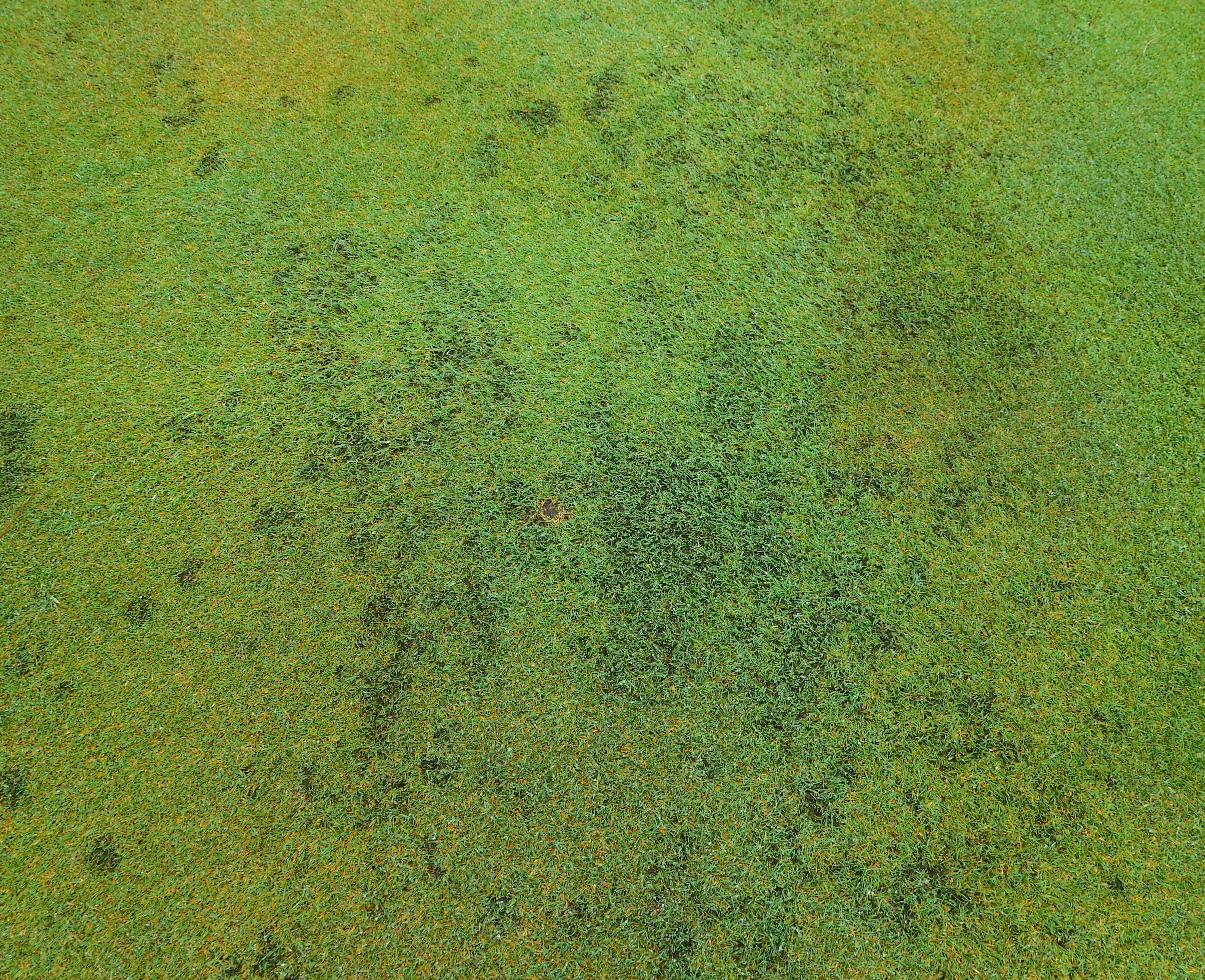 Blue-green algae (aka cyanobacteria) are most common in greens during prolonged overcast, warm and rainy weather in summer. Their growth produces a slimy mat that can act as a gasket to seal off gas and water movement into and out of root-zones. I have long respected the ability of algae to cause problems in greens, and it is my view that the problem should be addressed whenever observed.
Yellow patch is mostly a disease of annual bluegrass and sometimes bentgrass, and mostly is found on greens, but sometimes develops in approaches and fairways. The ring, rather than the solid “patch” symptom, is most common in our region. Rings can be numerous or solitary and yellow or tan in color. Occasionally, rings may have a red or bronze color. The yellow patch pathogen mostly blights leaves, disfiguring turf, but seldom kills plants. A curative application of an appropriate fungicide may not make rings disappear (unless sunny, warm, and dry air conditions move in to promote mowing), but ensures no further damage.
Yellow tuft is another disfiguring disease that seldom kills turf. This pathogen attacks nearly all turfgrasses, but is most prominent in golf greens. The disease appears as yellow spots or tufts, 0.25 to 0.5” in diameter. In low areas where water collects and puddles, infected stands may exhibit a generalized chlorosis. Each spot consists of one or two plants having an excessive number of tillers (sometimes 20 or more), giving plants a tufted appearance. The tufting, or abnormal tiller production, is induced by the pathogen, which causes a shift in the production of a hormone that regulates tillering. Roots of infected plants are short and bunchy, and tufts are easily detached from greens. During cool and moist periods, infected plants develop a yellow color. In warm and dry weather, infected plants regain their green color, lose their tufted habit, and appear amazingly healthy. At this time of year, it is unlikely to see a response from a fungicide. Just live with it; only Jordan Spieth would be distracted by the tufts.
Dollar spot damage from the Nov.-Dec. 2015 epidemic remains evident on some golf greens. Typically, in late autumn and early spring (when conditions are chilly) the peripheral areas of spots have a reddish color on greens, which mimic Microdochium patch. Dollar spot pits present a long-term problem when they develop before winter. While some plants within pits are killed, turf is resilient and recovers, especially from bentgrass stolons. If you closely inspect a bentgrass pit, you invariably will find a living stolon under or near a pit. In annual bluegrass, there can be one or two surviving plants in pits, but it takes longer for nearby plants to tiller and eventually fill voids.
Superficia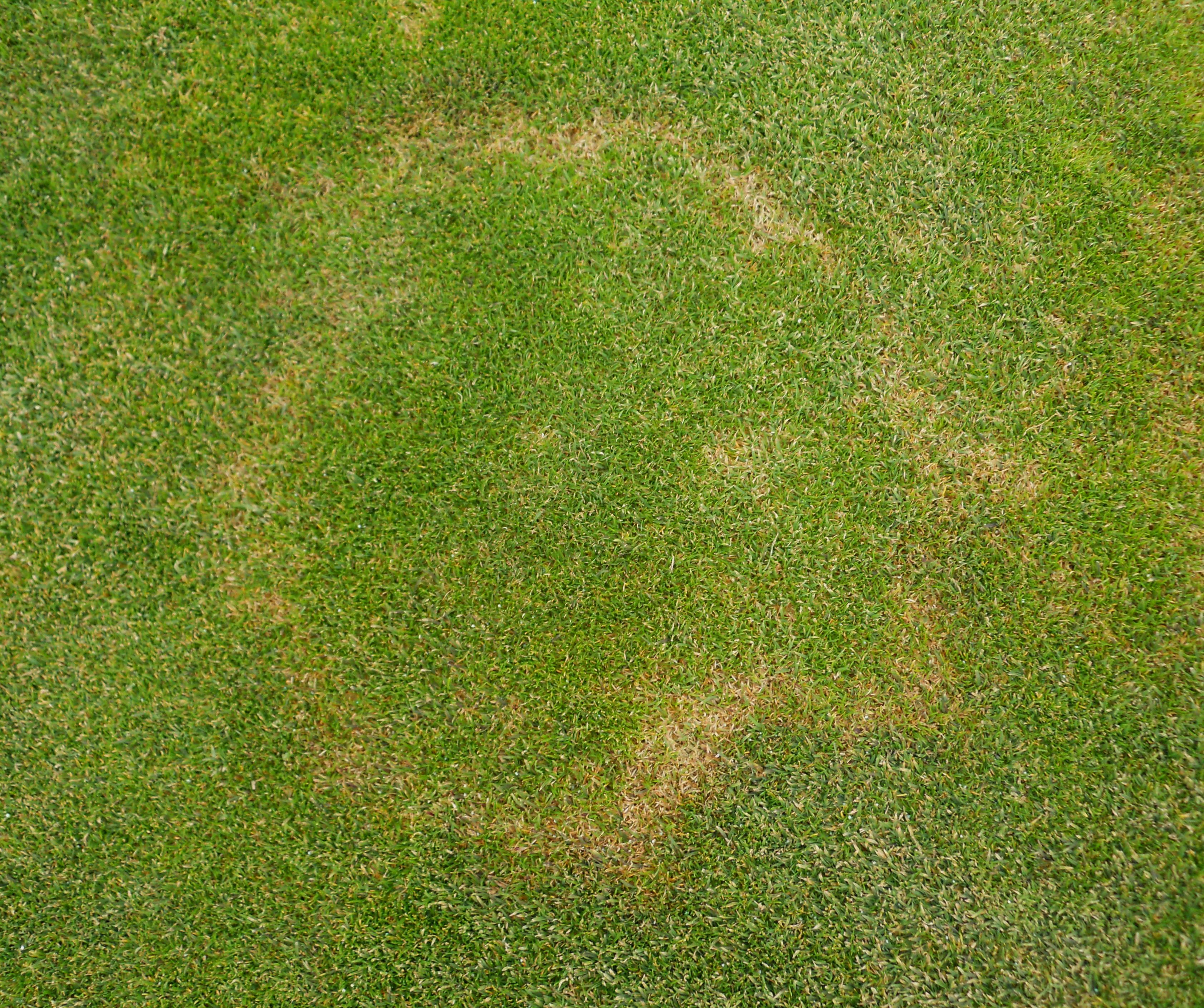 l fairy ring (SFR) is sometimes referred to as “white patch” since in affected greens the disease appears as white, circular patches ranging from 3” to 3’ in diameter. The responsible casual agents are in the “mushroom” or “fairy ring” family. At the edge of circular patches, there usually is a 1-2” fringe of more dense white mycelium. SFR normally appears in the mid-Atlantic during warm and wet periods and is most commonly observed under conditions of low nitrogen fertility. In the U.K., however, SFR is more evident in the autumn and winter, and perhaps our unusual weather has caused the disease to develop here in December. Although SFR’s are unsightly, the pathogen does not infect plants, but mycelium blocks incoming sunlight causing early senescence of affected leaves. Turf density in affected patches declines, but plants survive. These fungi develop principally in thatch-mat and do not penetrate more than 0.5 to 1.0” into underlying soil.