
Dormant seeding is fraught with problems and dormant fertilization is largely restricted by law in Maryland, Delaware and surrounding states.
Dormant seeding is defined as seeding in late fall after soil temperatures have become too cold to allow for germination. The best time to seed cool-season grasses is in the September to early October time period. For best results, seed should be in the ground no later than October 15 in our region. The goal at establishment is to get seed germinated, growing and mown a few times prior to winter weather. For most situations, there really is no advantage to dormant seeding since seed will not be able to germinate until late spring when soil temperatures warm to levels that will allow for germination. There are, however, a few exceptions.
The major cool-season grasses that we grow include creeping bentgrass, fine-leaf and tall fescues, perennial ryegrass and Kentucky bluegrass. Among the aforementioned, only Kentucky bluegrass seed would be expected to survive in high populations when dormant seeded. For other species (e.g., bentgrass, fescues and perennial ryegrass), significant winter survival of seed would not be expected. Even if seed survived, mortality rates usually are high since some seed may germinate and then seedlings could either frost heave (and subsequently dry-out) or be killed by freezing temperatures. Where there is little turf cover, significant amounts of seed may wash or erode off site, be eaten by birds or otherwise rot or degrade.
It is not uncommon, however, for sod producers to dormant seed weak tall fescue stands (the most important species in the mix) in the hope that Kentucky bluegrass will get a fast start in spring, fill-in and allow for a harvestable sod in an reasonable amount of time. In sod production in our region, tall fescue is the primary species of importance and Kentucky bluegrass is included principally because its rhizomes are needed to make sod harvestable. However, if existing tall fescue levels are low, dormant seeded Kentucky bluegrass could in time dominate the stand –either in the sod field or at its final destination.
Dormant seeding also is performed in sites that are historically and chronically too wet to use equipment on in spring. This is especially true in sports fields. In this situation, it is best to seed during mild periods in late February and March when soil is firm, but not frozen or excessively wet. The problem is that seed must be inserted into soil since so little seed will find its way into crevices created by freeze-thaw cycles. Seed that remains on the surface (including Kentucky bluegrass) is not going to survive. Therefore, it is necessary to drill, groove, slice, poke or otherwise place seed so that it is in soil and protected from erosion and other stresses. The bottom line is that dormant seeding is a “crap shoot,” but has applications in sod production and in sites that are chronically too wet to be properly seeded in the spring.
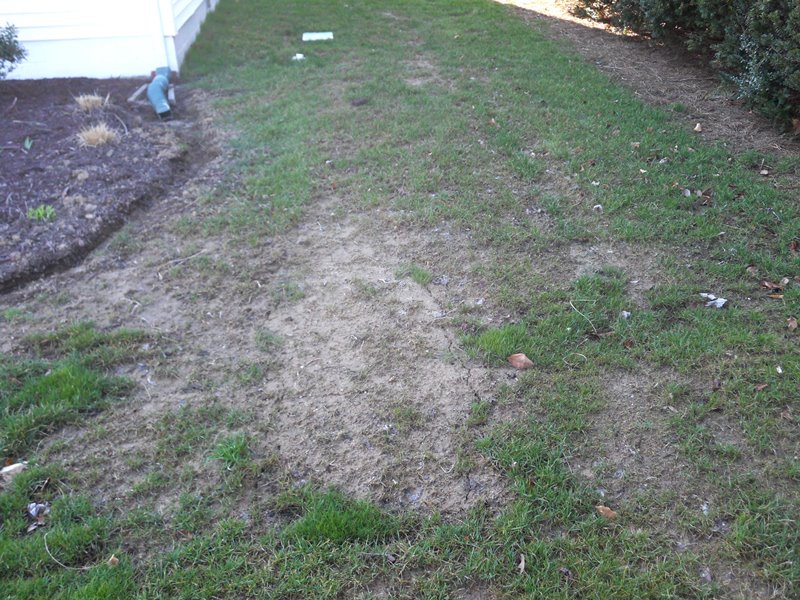
Dormant fertilization or feeding refers to applying nutrients in late fall or winter after soil temperatures have cooled to the point where little turf growth will occur. Perceptible leaf growth normally stops following several hard frosts in December. Remarkably, some leaf and root growth can occur all winter when soils are not frozen. Dormant applications of nitrogen (N) allow for plants to scavenge N during winter, resulting in an earlier spring green-up and presumably an enhancement of carbohydrate storage and subsequent root growth. The practice was used mostly in situations where turf was weak, thin and/or chlorotic going into winter. As noted below, legislation has now mandated a “black-out period” for winter applied N as well as phosphorus (P).
Elevated levels of N and P have led to decline in water quality in the Chesapeake Bay and other waterways. N and P stimulate algal growth in the Bay, which rob water of oxygen needed by marine grasses and other organisms to survive. Depressed oxygen levels in the Bay have had a demonstrable negative impact on survival of fish and other marine life. Sources of N and P pollution in water ways include: agricultural production (i.e., farming and animal husbandry); soil erosion from construction sites; waste treatment facilities (i.e., town and city sewers and rural septic systems); all of the nasty stuff (e.g., petroleum products, trash, etc.) coming off of impervious surfaces such as roads and parking lots; and fertilizer inputs onto lawns, sod farms, golf courses and landscape plantings. The urban landscape may contribute the least, since it would take soil sediments and organic matter (e.g., rotted plant debris) containing N and P to find their way into streams. Much of the potential movement of N and P from turf applied fertilizers can be greatly minimized simply by blowing and/or sweeping fertilizers and clippings off of impervious surfaces and back onto turf.
In 1998, the Maryland legislature mandated that citizens and turfgrass professionals use N and P as specified by University of Maryland agronomists. Delaware passed its laws in 1999. Both states have initiated “blackout dates” for using N and P. In MD, the law covers both citizens and professionals. Basically, no N or P may be applied between November 16 and February 28 in MD. N and P applications may commence March 1, but only if the ground is not frozen and no heavy rain event is predicated at the time of application. In DE, nutrient management laws apply only to certified applicators and those managing 10 or more acres of combined land. Blackout dates for N and P applications are December 7 to February 15 in DE, with the provision that no N be applied after 15 February if soil is frozen. Potassium (K) and lime may be applied at any time in MD and DE, regardless of “blackout dates.”