
Anthracnose is caused by the fungus Colletotrichum cereale and is a common saprophyte (i.e., living on dying or dead tissue) found colonizing thatch or dying plant tissues. This fungus often attacks weakened or senescent leaves, but under stressful conditions, C. cereale behaves as a pathogen. Anthracnose primarily is a serious problem of annual bluegrass (Poa annua; Poa) grown on golf greens and collars, and a lesser problem in creeping bentgrass. The fungus may cause either a foliar blight or a basal rot. In most cases, anthracnose attacks Poa specifically, and less commonly bentgrass in greens. What is unusual is that I have never seen anthracnose attack both bentgrass and annual bluegrass on the same green or even on the same golf course. In general, anthracnose tends to attack older bentgrass clones or where it was mechanically damaged in summer.
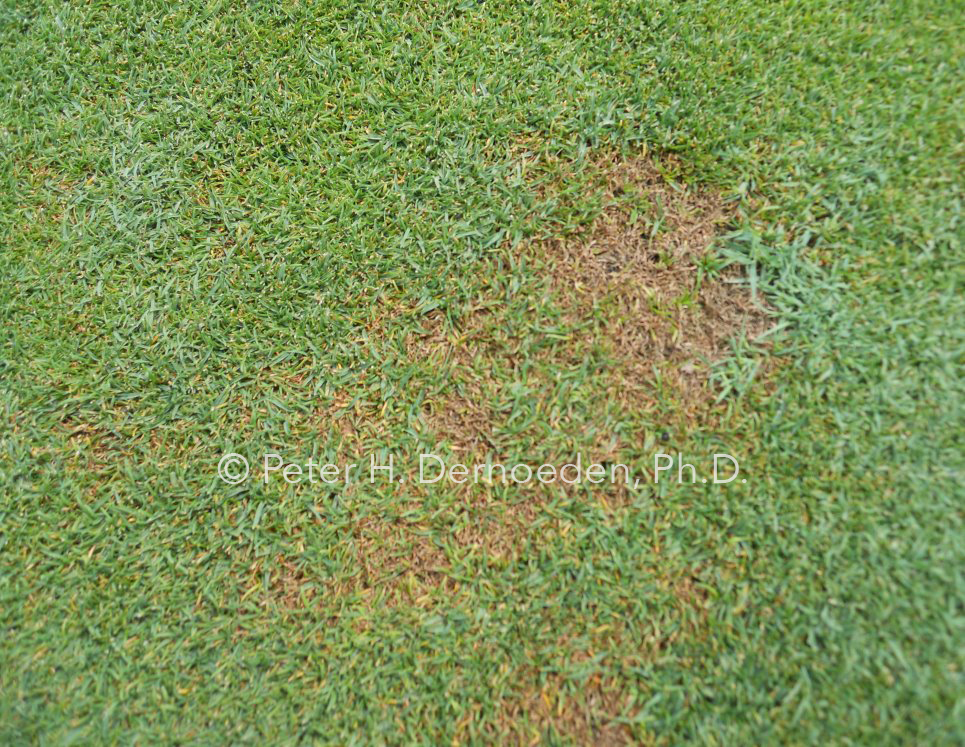
Basal rot selectively killing Poa, not bentgrass -this disease seldom attacks Poa and bent of the same green or golf course.
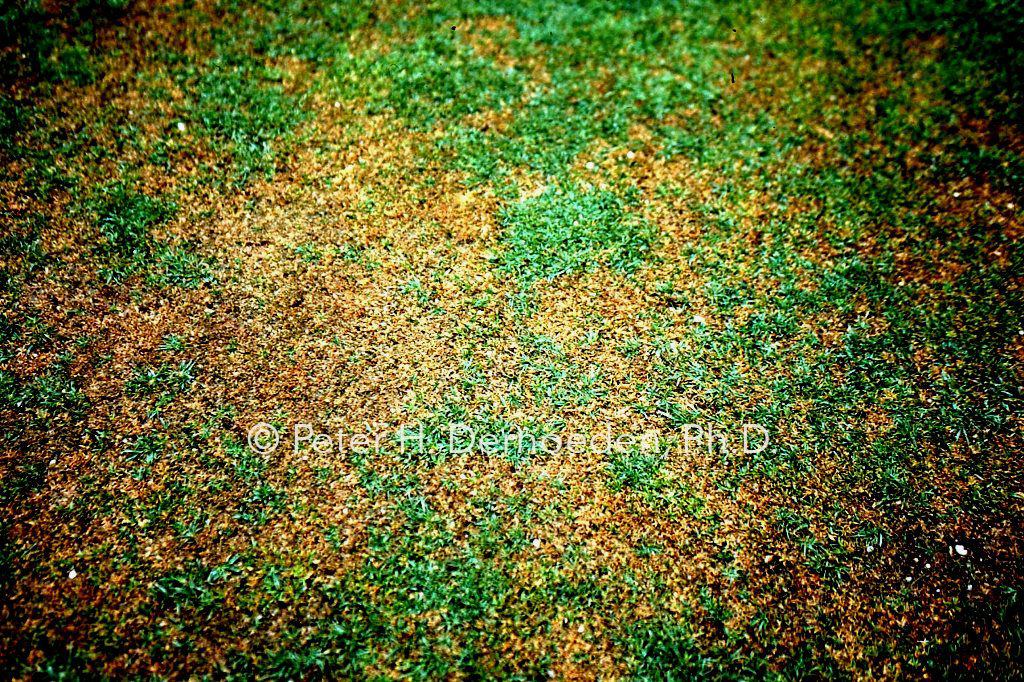
Basal rot anthracnose taking Poa out bentgrass in the 1980's-early 1990's.
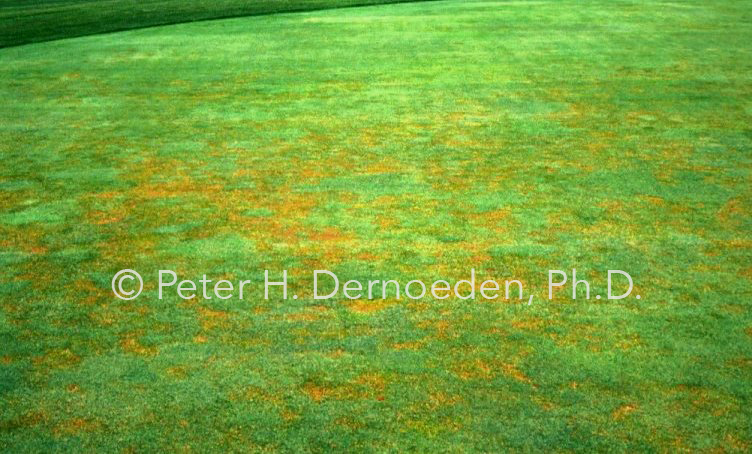
In the 1980's and 90's anthracnose basal rot was common and lite-up greens in various colors. Courtesy Dr. Barb Corwin, UMO.
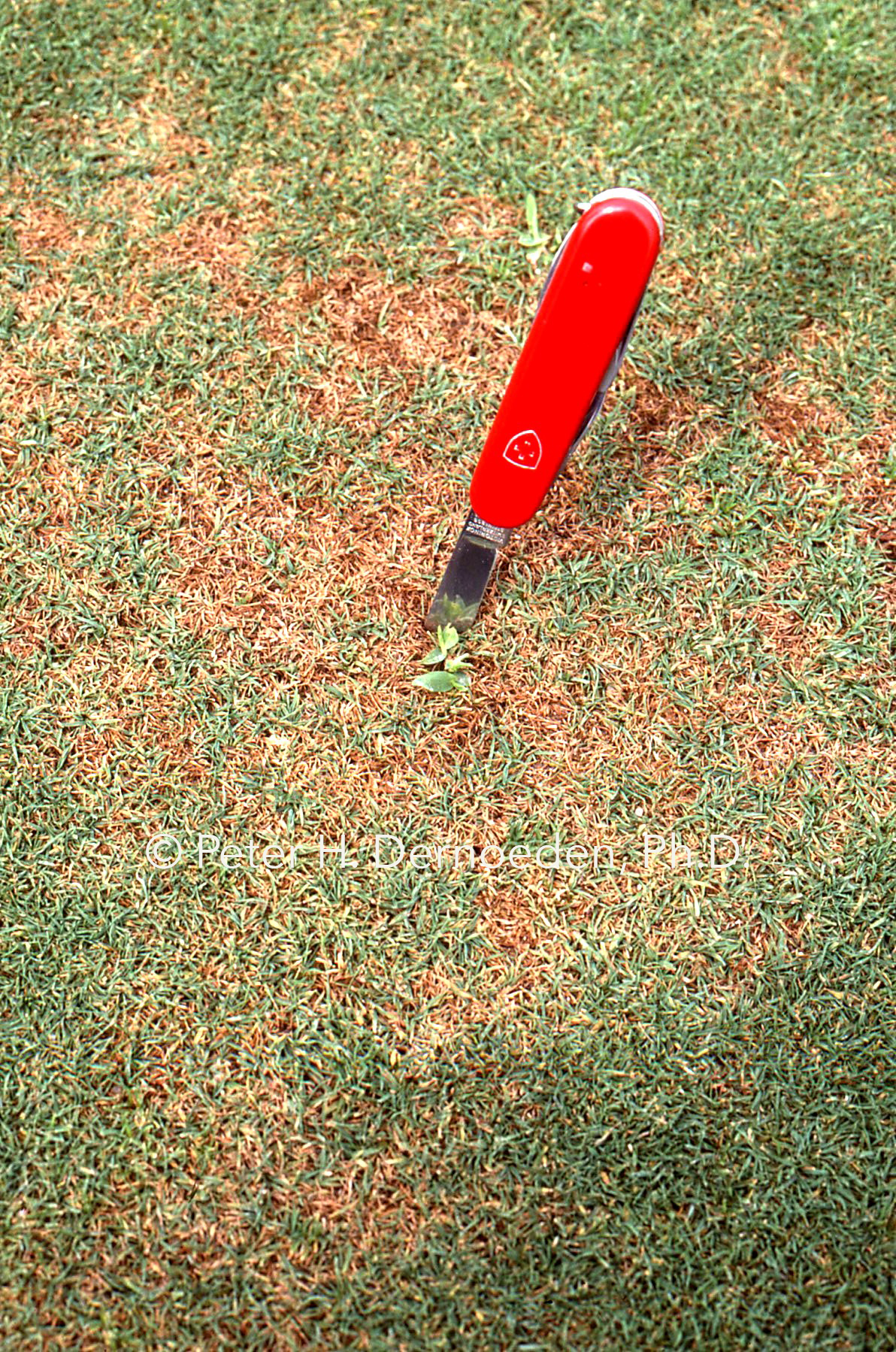
Basal rot in bentgrass occurs in summer and usually attacks older clones on greens; mechanical damage a major factor.
Foliar blighting generally occurs during periods of high temperature and drought stress. Foliar blight is a distinct type or phase of anthracnose, which may or may not progress into basal rot. Sometimes you can find/see blackish fruiting bodies called acervuli on severely stressed green tissue, as described below. In the 1980’s to early 90’s, basal rot became an intractable problem associated with lots of discoloration, thinning and pitting of putting surfaces. In the mid-Atlantic, basal rot is more common than foliar blight. Anthracnose is much more common and severe in annual bluegrass versus creeping bentgrass. It took time and research, and the advent of specialized fungicides, to put it down. If you have an anthracnose problem –it is time you learned from history.
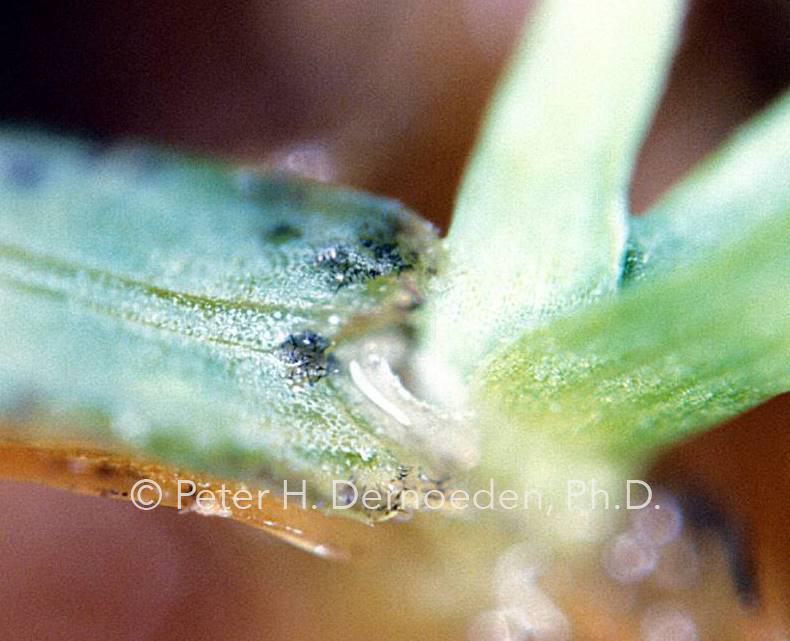
Less commonly, antharacnose causes a foliar blight, and the distinctive black fruiting bodies (acervuli) may be evident on green tissues.
Looking Back: The 1980’s was a time when annual bluegrass dominated most greens in the mid-Atlantic. At that time, a “macho” competition among superintendents began to achieve super-fast greens. The approach was to apply as little nitrogen as possible, while steadily decreasing mowing heights. Keeping greens “hard and dry” was part of management. It was before we had the tools to limit/stymie or suppress Poa invasion through growth regulators (most notably Trimmit and Cutless), and the advent of some specialized herbicides (most early herbicides turned out to be too risky). It was a time before more common sense cultural practices such as light and frequent applications of sand topdressing and spoonfeeding (i.e., spraying low amounts of water soluble nitrogen) throughout the summer months caught on. A “big game changer” was the advent of the first QoI’s/ strobilurin’s in 1997 (Heritage/azoxystrobin) followed by Insignia, Fame, Pinpoint, others. These QoI’s were much more highly effective against anthracnose and summer patch than anything else available. In time, we learned how best to use DMI/SI’s (e.g., Banner, Bayleton, Tourney, Eagle, Torque; Triton, Trinity, others) in combination or rotation with other unrelated and low risk fungicides.
In summer, affected turf initially develops a yellow, reddish-brown, or orange color and thins-out in irregularly-shaped patterns of varying size. Infected annual bluegrass plants often develop a brilliant yellow color before dying. The central or youngest leaf is last to show the yellow-orange color change. Large areas may thin or die-out completely, but distinctive leaf spotting is uncommon. Basal rot most often is associated with low mowing, soil compaction, traffic, wilt and low nitrogen fertility. This is because the pathogen is much more invasive if it enters stem tissues wounded by either mechanical damage or by extreme cold temperature stress –common to New England. In the mid-Atlantic, hot and dry weather followed by an overcast and/or rainy period can trigger or intensify the disease. Shaded and wet sites are particularly vulnerable.
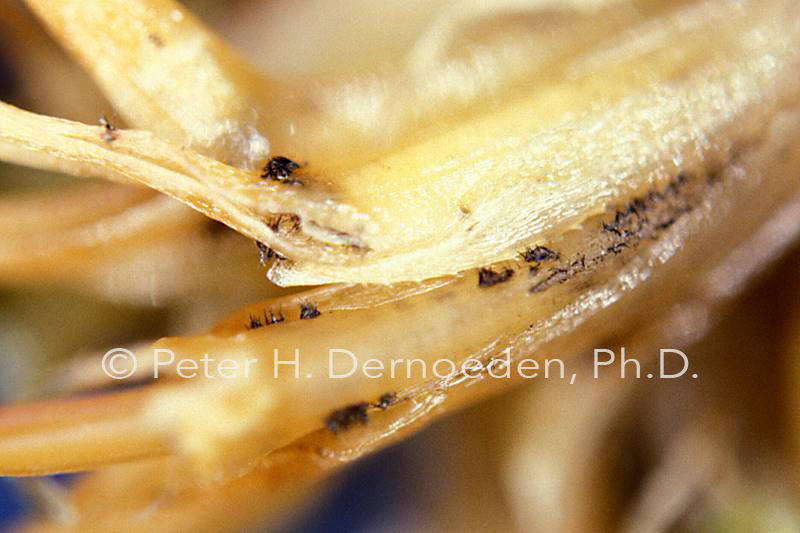
Classic bright yellowing as Poa dies; acrevuli forming on lower sheaths and stems.
The worse scenario involves thunderstorm activity or heavy rain events in summer, which not only intensifies yellowing and thinning, but often is associated with the appearance of black algae [remembrance of Steve Potter, CGCS at Woodholme CC, Baltimore]. Basal rot is difficult to suppress once it becomes a chronic, spring or early summer problem in annual bluegrass greens. Infected Poa on greens often dies leaving pits in winter that remain a visual and bumpy problem, often inviting criticisms.
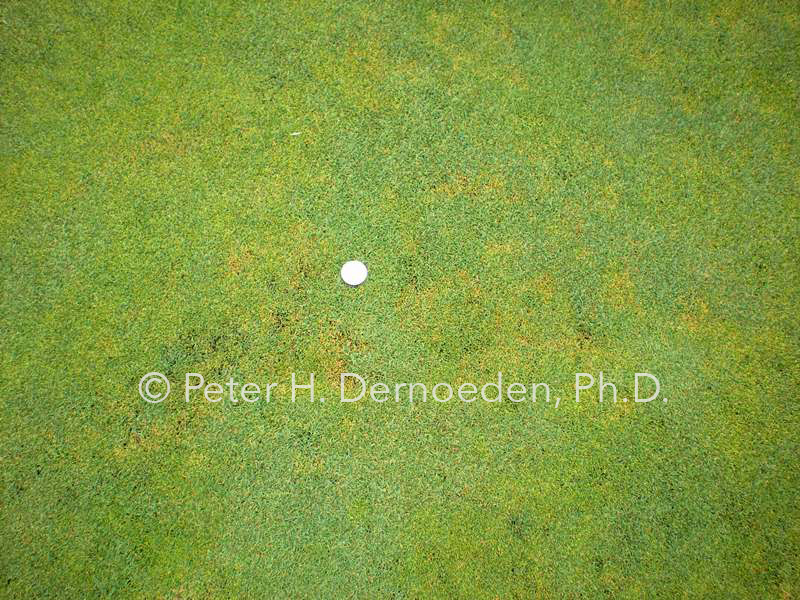
Anthracnose basal rot causing annual bluegrass to develop a yellow-orange color while bentgrass remains unaffected. Note algal blackening.
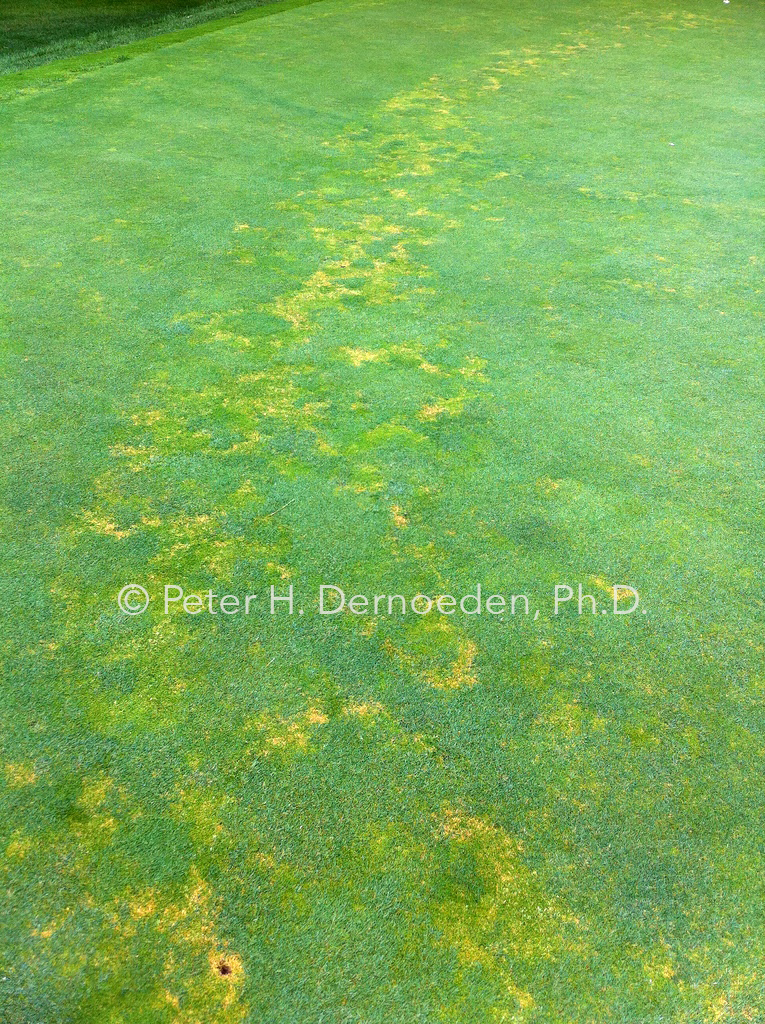
Green was extended; Poa from the original collar exhibits classic yellowing from anthracnose. Bentgrass is unaffected. Courtesy of Keith Happ, USGA. RIP.
Basal rot in annual bluegrass greens also occurs during cool to cold periods, between autumn and spring, as well as during the heat of summer. The disease can remain active in annual bluegrass throughout mild winters, but generally does not appear in bentgrass before the advent of higher summer temperatures.
Between late autumn and spring [which I call winter anthracnose], infected annual bluegrass plants may appear as yellow or orange -colored in speckled spots 0.25 to 0.50 inch in diameter. Individual plants may have both green, healthy appearing tillers, and yellow-orange infected tillers. By mid-to-late spring, the speckled-spot symptom is less common, and infected annual bluegrass plants coalesce into large, non-uniformly affected areas, which appear yellow, orange or reddish-brown. Removal of all sheath tissue to expose the stem base reveals a water-soaked, black rot of crown tissues (as described below).
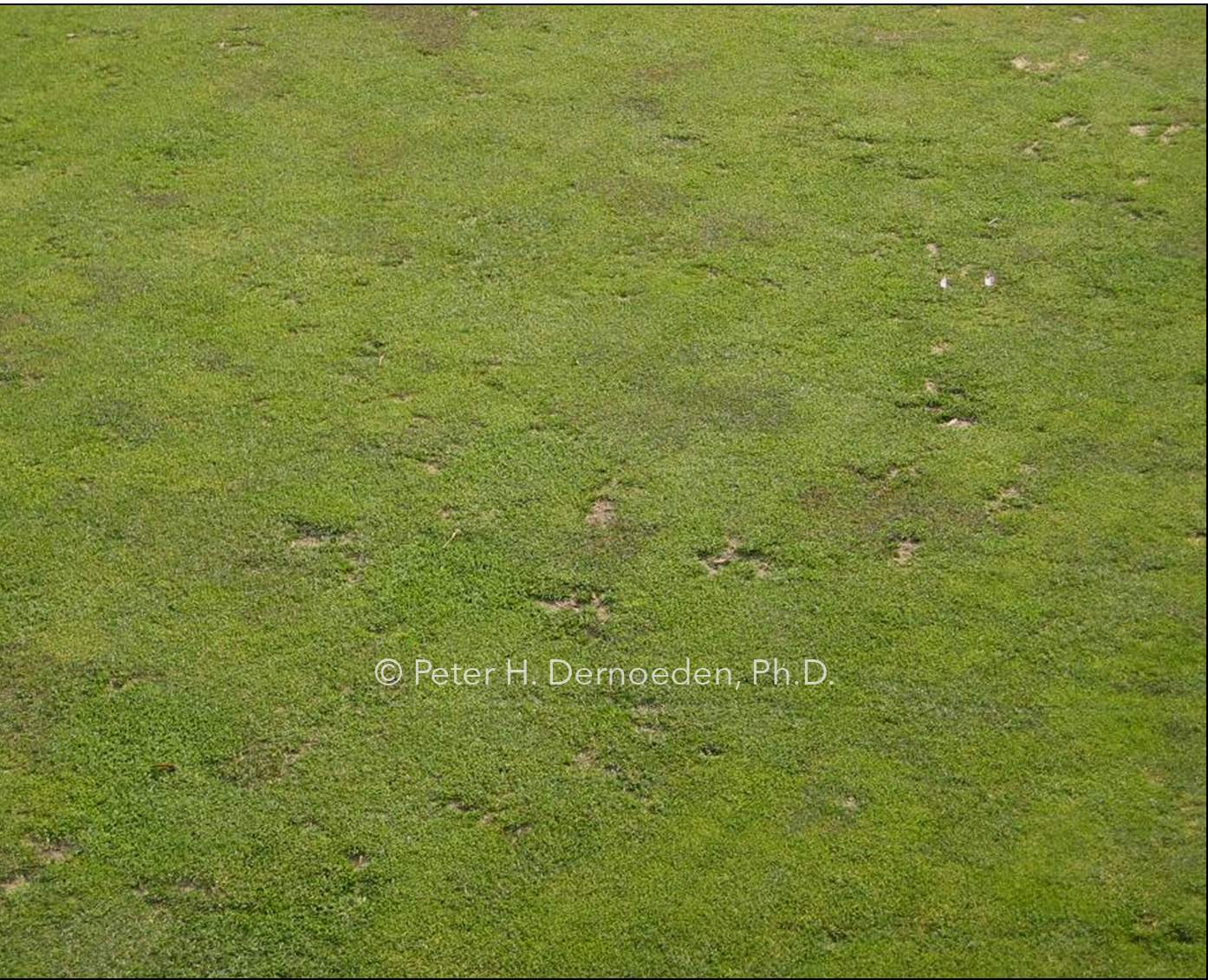
By autumn -anthracnose pitting in Poa persists all winter and invites criticisms.
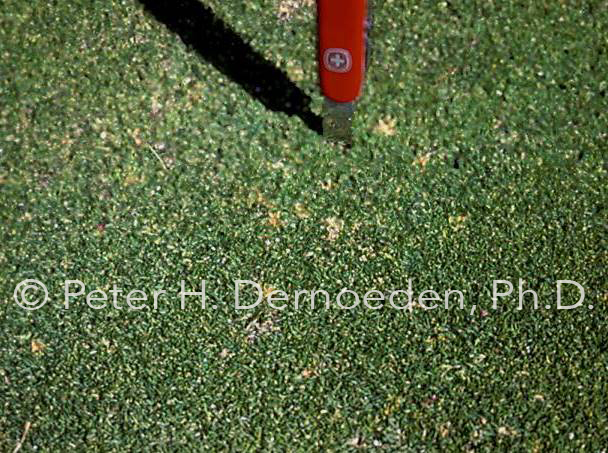
During winter, anthracnose may appear as speckles in Poa.
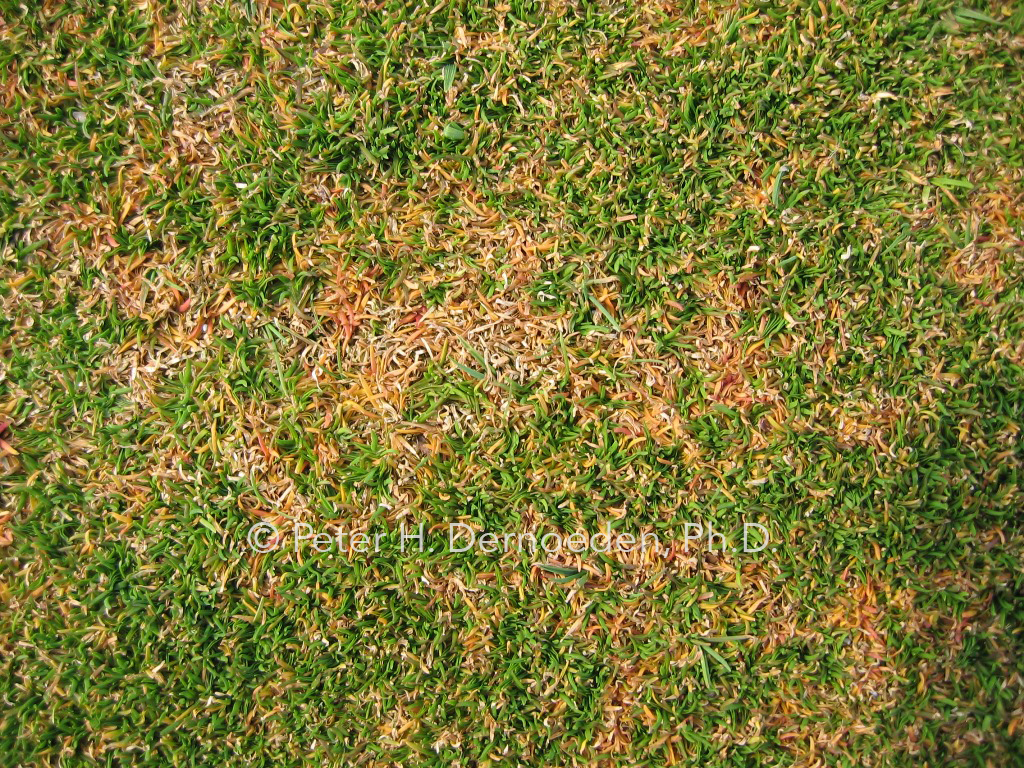
Classic orange discoloration of winter anthracnose in Poa greens.
Signs-Signs Everywhere Signs. When we describe symptoms, it usually involves visual discoloration (yellow, brown, red, reddish-brown, etc.), leaf spots, and thinning/blighting (either generalized or in circular patches). Signs refer to visual sightings of fungal structures of a pathogen, like spore producing bodies and infection structures. For most diseases, signs often are not present or only can be seen with aid of a microscope. In the case of anthracnose –there are plenty of signs to help in diagnosing the disease, although you may need a hand lens to help. During later stages of infection, it often is easy to find the distinctive fruiting bodies (i.e., acervuli) with protruding black hairs (i.e., setae). The nest of black bristles of acervuli can be observed on green and discolored leaf or sheath tissue with a hand lens; what you can’t see without a microscope is that huge numbers of crescent-shaped spores abound from acervuli. Caution: the presence of large numbers of acervuli on dead tissue in thatch does not mean that healthy plants also are infected. Under a microspore, it is almost “Hollywood” to see the distinctive fruiting bodies and spores, and black penetration structures –it’s “Hollywood” fantastic-for us turf nerds.
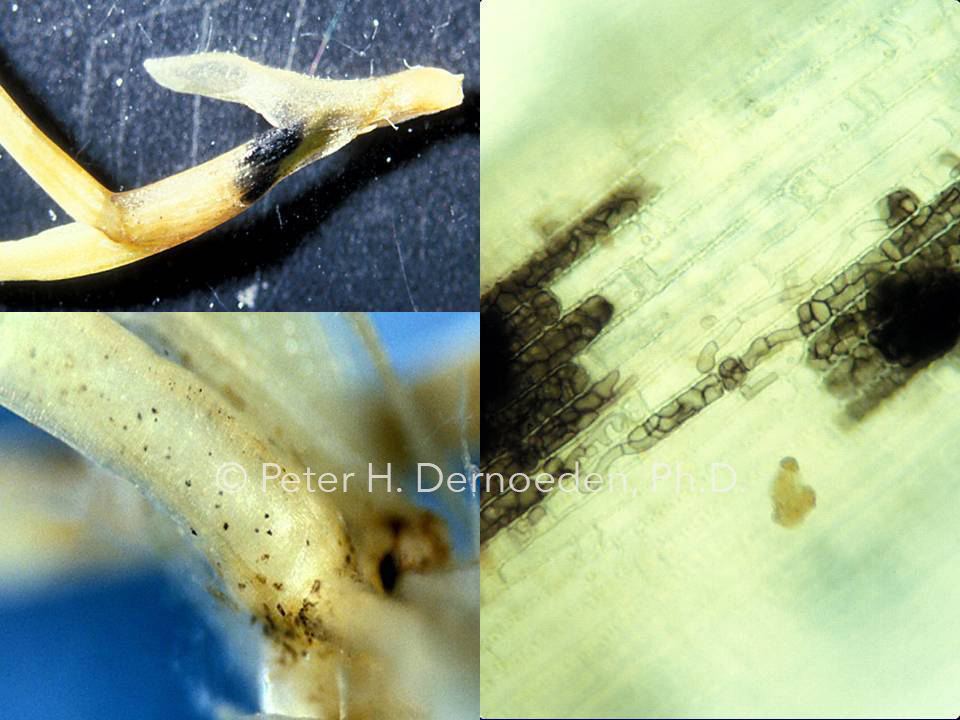
So many signs- black rot of stem base; black fly speck infection cushions; and massive infection mats on stem bases under high mag.
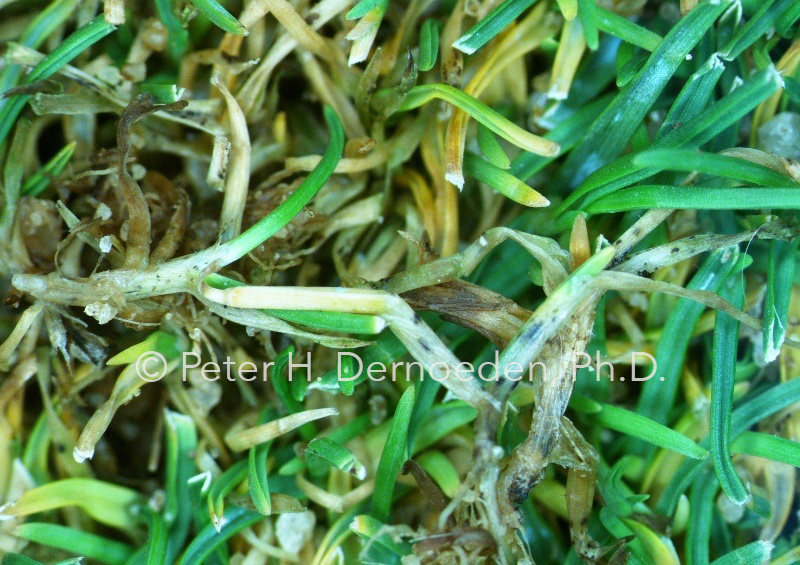
Anthracnose symptoms are diverse; signs can be seen with a closer look for black infection specks and rot on leaf sheaths and stems.
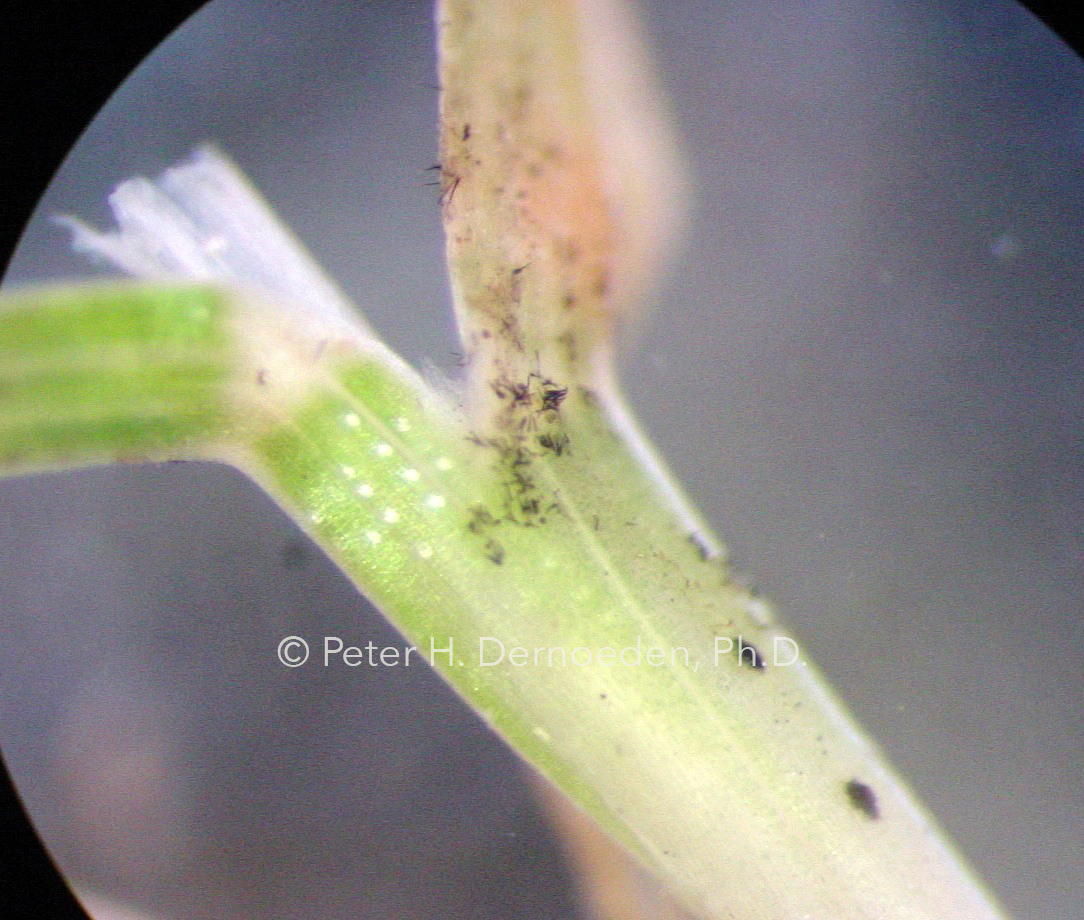
Look closely for acervuli on green sheaths of discolored Poa.
When discoloration or thinning is first observed, managers are advised to carefully look on lower sheaths and stem bases for the infection mats, which during the early stages of the disease, appear as small (pinhead sized), black “fly specks.” This involves good light and a steady hand to peal leaf sheaths to expose the whitish inner sheath tissues or stem areas. There will be no tell-tale signs or symptoms (like leaf spots) of the pathogen on leaf or sheath tissue during the early stages of basal rot. In advanced stages, black aggregates of fungal mycelium can be found on infected stolons or stem bases of creeping bentgrass and annual bluegrass. The spore bearing acervuli with short, black hairs and the black mycelial aggregates can be seen on stem bases and stolons with a hand lens. Once acervuli develop on sheath or leaf tissue, the basal rot phase is advanced and plants die
Management. Rutgers researches in 2009 revealed that basal rot severity in annual bluegrass was reduced dramatically by applying 0.10 lb. N/1000ft2 every 7 days. They also demonstrated that increasing mowing height from 0.110 to 0.141 inches reduced injury significantly. Light and frequent sand topdressing helped to lessen severity by protecting stem tissues –the sand around crowns acted as a buffer against abrasive damage from mowers. It is important to again note, that there usually are no leaf spots, blighting of leaves or the appearance of acervuli on leaves or sheaths during early stages of basal rot development. Basal rot is the killer and you need to look carefully at lower sheaths and stems whenever you see yellowing or other odd discoloration of putting surfaces, especially in summer!
Cultural Management: To alleviate anthracnose, use walk-behind mowers and increase height of cut immediately. Divert traffic away from affected areas by rotating cup locations. Lightly and frequently topdress when turf is vigorous (i.e., catching enough clippings each AM in summer), and when greens are free from environmental stresses (esp. wilt). Spoon-feed (e.g., spray water soluble N [e.g., urea] ≈ 0.125lb N/ 1000 sq. ft.).every 10-14 days during the summer. The advent of “highly effective fungicides’ has greatly reduced the occurrence of serious anthracnose problems, but along the way, resistance happened.
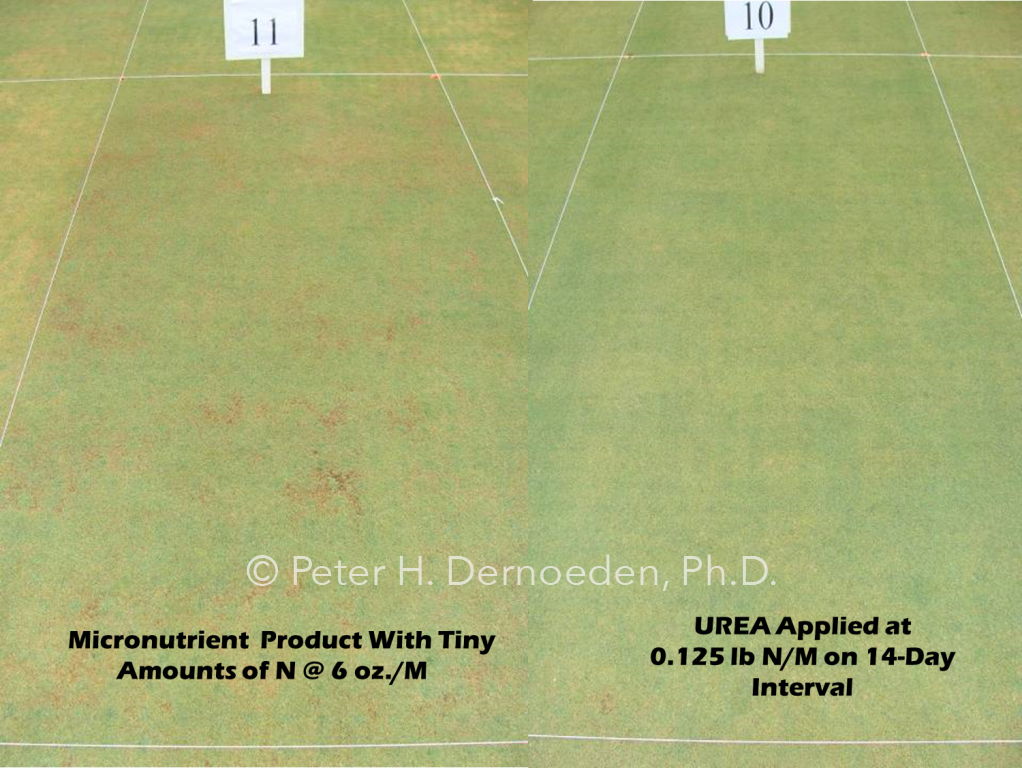
Spoonfeeding Is A Powerful Summer Tool!
Fungicides: Controlling anthracnose in bentgrass is a “no brainier.” Apply Daconil (or other low risk fungicides like Medallion, Affirm, Velista, ) + DMI (Banner, Bayleton, Torque, Tourney, Triton , etc.) + 0.125 lb. N from urea or other water soluble N- source [info. Courtesy S. McDonald, MSc. President Turf Dis. Solutions]. Bentgrass should show recovery within 7-10 days with follow-up spoonfeeding. Note: there have been NO reports of DMI-resistant anthracnose.
Chronically infected annual bluegrass greens may not respond favorably to any fungicide program once annual bluegrass becomes yellow-reddish-brown and shows signs of thinning. This is especially true when annual bluegrass develops the disease in spring. It is so important to tank-mix the penetrant of your choice (e.g., DMI, QoI, thiophanate [TM]) with a low risk fungicide (e.g., Daconil, Affirm/Endorse, Medallion, Velista, others) when anthracnose is active.
Thiophanate [3336, TM, Topspin] is the Highest of High Risk of all fungicides for developing resistance, when targeting both anthracnose and dollar spot. It takes only 3 or 4 applications of TM (with no tank-mix partners or low risk rotations) to develop a resistance problem. Highly effective fungicides that are applied constantly without tank-mixing with a low risk partners have developed resistance, including thiophanate and QoI’s. When strobilurin’s (QoI’s), most notably Heritage/azoxystrobin, hit the market in 1997, they were a sensation for controlling a multitude of tough diseases including summer patch in Poa greens and gray leaf spot in perennial ryegrass. When used alone, and applied repeatedly, however, Heritage-resistance happened in both the case of anthracnose and gray leaf spot. Now, it is known that resistance can occur when using Heritage-relatives like Insignia, Fame, and Pinpoint.
People who don’t learn from history are doomed to repeat it! Indeed, there was a time when annual bluegrass greens, which were chronically infected with basal rot anthracnose, were fumigated with methyl bromide and re-seeded with an improved cultivar of creeping bentgrass.
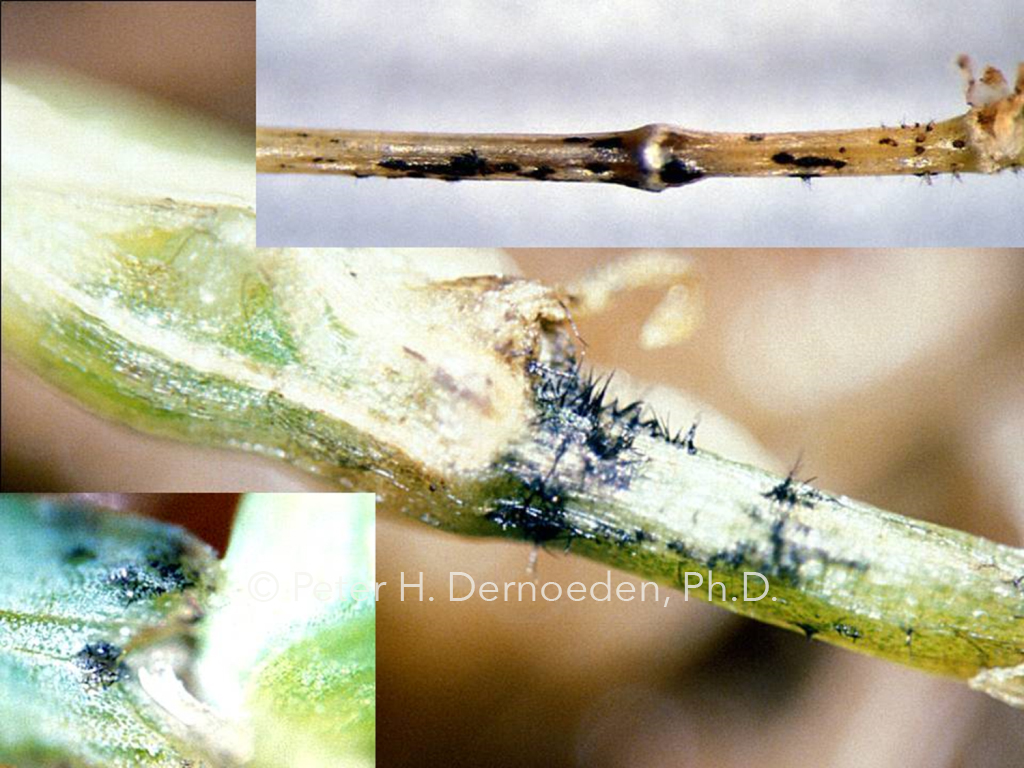
Anthracnose – just take the time to take a close look for signs- and avoid a bad history lesson.
Thanks for reading! For more articles and information, visit the Dr. Pete's Turf Tips Archive