July 2020 was among the top four hottest July’s on record. The heat began mid-June and by mid- July I could read that “Fatigued-August” look on the faces of many superintendents. Heat and generally dry weather prevailed throughout July. Hurricane Isaias broke the drought in many places on August 4, but not on most of Delmarva. Before the end of the day, sunshine appeared and the following day it turned hot and sunny causing many problems associated with waterlogged soils including: collar decline and death, scald, wet wilt and Pythium blight outbreaks. Multiple, widely spread thunderstorms moved across portions of the region in subsequent days, further contributing to damage and misery. It reminded me of one of Stan Zontek’s (USGA Agronomist; RIP) notable quotes “too much water in summer kills more grass than too little.” Adding insult to injury was a massive, labor-intensive effort to clean-up downed trees, limbs, leaves and other debris.

Bentgrass Collar Decline and Death: Turf grown in collars, especially creeping bentgrass and annual bluegrass, often experiences a significant loss in density during hot and humid weather or when turf is mowed when excessively wet (or bone-dry) in summer. The mechanism of injury or death of plants on collars is due mostly to mechanical injury inflicted by mowers, rollers and topdressing sand. Collar damage is greater in walk-on and walk-off areas; areas adjacent to bunkers where soil temperatures are higher (and the abrasive effects of sand pitched up from bunkers); and shaded areas. Damage is especially common in curved areas, where mowers make meandering turns. It is the twisting of the longer leaves and exposed stems on collars, which results in a destructive grinding action. I have even seen operators of rotary mowers trimming green and bunker surrounds turning on collars and approaches. Huge mistake!
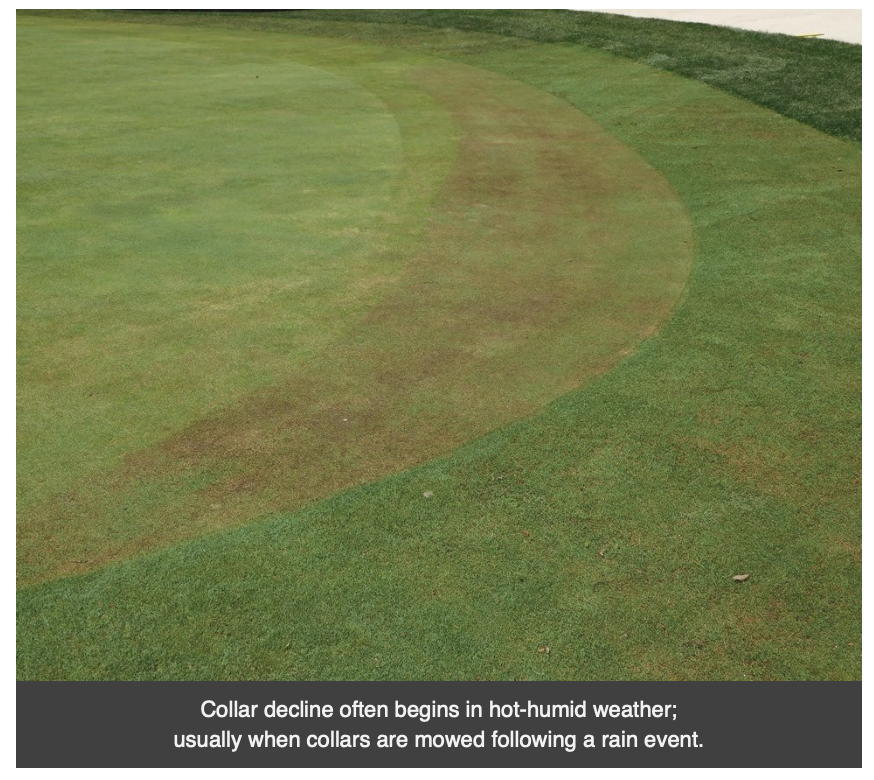
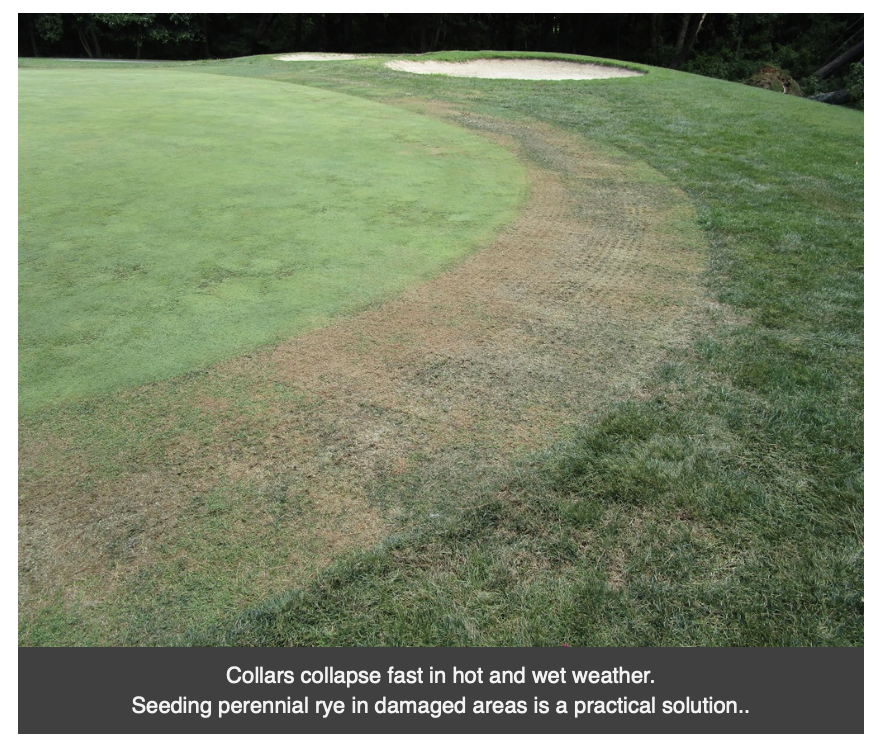
Topdressing sand and heavy rollers are a major contributors to collar decline. Topdressing sand is much more damaging to taller (i.e., greater leaf surface area) succulent leaves of the collar canopy as well as exposed stems. A decline in plant density on collars following topdressing may not appear for several days. The summer sun heats the sand particles after topdressing or adjacent to bunkers where sand is pitched onto collars. The increase in temperature combined with the angular shape of sand causes additional stress and abrasion to the longer leaves of plants growing in collars. It is important to keep sand off collars in the summer and to topdress when the surface is dry to facilitate the downward movement of sand to stem bases and off leaves. After topdressing, blow sand off collars prior to mowing the following day.
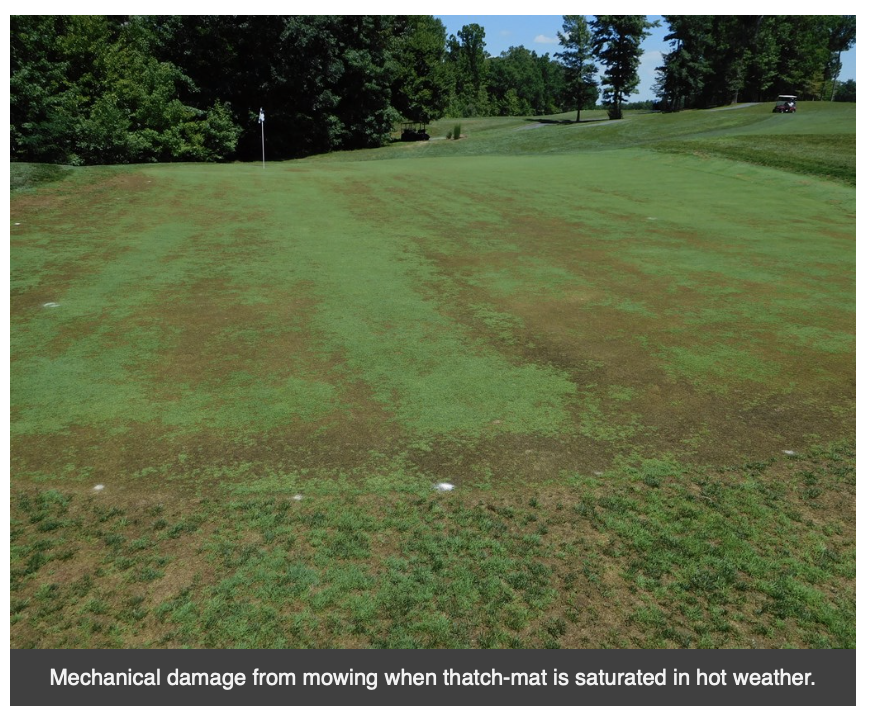
Management: Whenever mechanical injury becomes evident it is important to reduce mowing frequency and to avoid sand topdressing if weather conditions are hot and humid. Use a light-weight walk-behind mower equipped with smooth rollers to cut weak collars. During periods of heat stress, reduce mowing frequency of collars to once every three to four days and mow only when surfaces are dry. Do not mow collars or the putting surface when there is casual water or when thatch-mat layers are waterlogged during hot and humid periods. Some superintendents lay-down rugs, mats, plywood or plastic lattice on collar areas where mowers cross or turn to reduce mechanical injury. A gradual reduction in height of cut to 0.25 inches oftentimes alleviates collar decline. According to Steve McDonald MSc. (President, Turfgrass Disease Solutions), spoon-feeding helps weak collars to recover. Use a drop spreader and apply a non-burning natural organic fertilizer (e.g., Milorganite, others) to collars at a rate of 0.2 to 0.3 lb N / 1000 ft2 per month. Hand syringe frequently when weather conditions warrant and avoid water puddling. Where collar decline is chronically severe it may become necessary to overseed with perennial ryegrass, which better tolerates wear stress on collars and is a very practical solution to this problem.
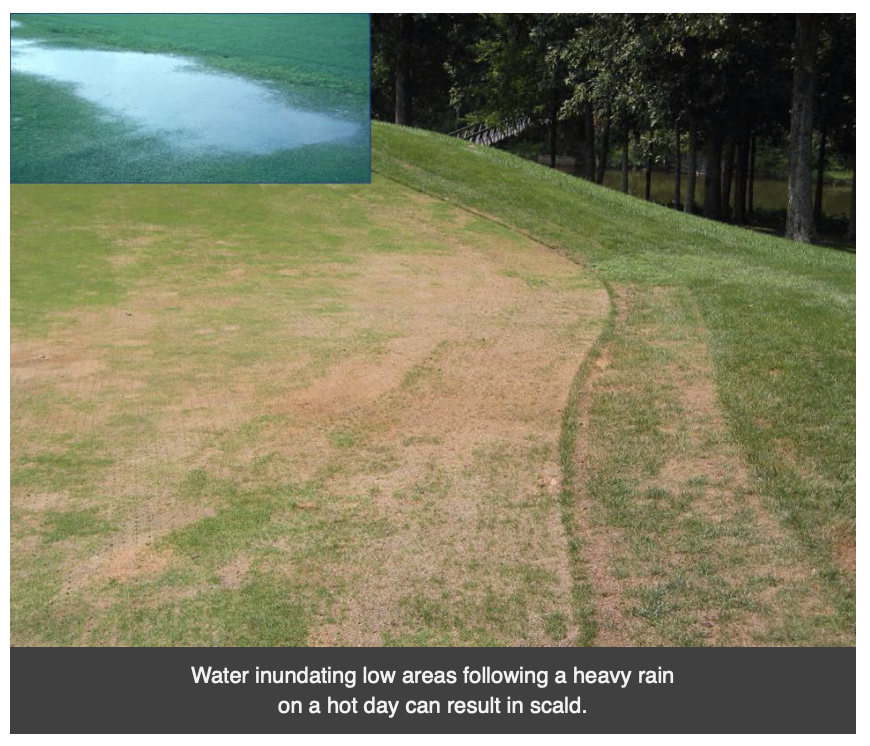
Scald occurs when water puddles (even causal water) and inundates plants due to heavy rain events during sunny and hot weather. Turf can be killed or severely damaged in just a few hours. Basically, standing or casual water rapidly absorbs lethal levels of heat (>100F) from the sun on hot and sunny days. The hot water causes protein denaturation. Scalded tissues become bleached, matted and can have a texture similar to paper ‘Mache’ or even sauerkraut. Water that saturates thatch/mat and the root-zone displaces oxygen; thus oxygen depletion also plays a key role in plant death during a scald event. The injury pattern may be random, but damage is most severe in low areas where water puddles. Scald also occurs on higher cut grasses even sod fields and lawns.

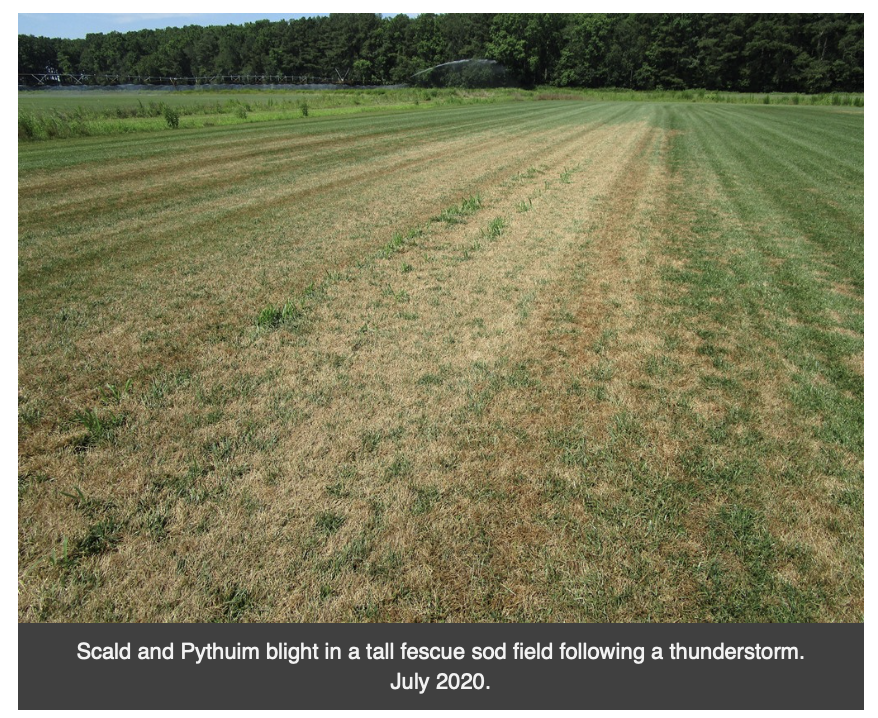
Wet-wilt occurs when there is adequate soil moisture yet roots cannot absorb water fast enough to meet the transpiration (i.e., the natural cooling process whereby water moves from roots to shoots and evaporates through open stomates [like pores] on leaf surfaces) needs of a plant. Wet-wilt mostly occurs during hot and humid periods when soils or thatch-mat layers are waterlogged. Affected greens will have a brown, gray, water soaked or wilted appearance .Water in or on the surface of thatch/mat absorbs heat from the sun. Heat in water is transferred to the soil and stored around roots and vital stems). This is why the upper 1-2 inches of soil can have temperatures exceeding 95°F on sunny days, when ambient temperatures are about 90°F. Due to a combination of heat stress from high air and soil temperatures, low soil oxygen levels, and stomatal closure, roots are unable to absorb water. Turf grown on greens, tees, fairways and even in roughs can be killed in just a few hours. On affected greens, turf initially appears brownish and water-soaked, and turf thins-out in irregular patterns. The combination of heat stress, waterlogged soils (and poor gas exchange) and mechanical injury from mowing causes leaves and stems to collapse. Simply stated, the turf is dying from a combination of super heat stress and suffocation during a wet wilt event. Mowing (especially when using grooved rollers) during a wet-wilt event places additional and often lethal stress, which can kill greens in just a few minutes.


Scald and Wet-Wilt Management: At the first onset of hot and humid weather (normally late June-early July), replace grooved rollers with smooth rollers. Following an afternoon thunderstorm, it is very important to squeegee or otherwise remove as much standing water as possible before the sun returns. Fans are especially beneficial for cooling and drying purposes during wet wilt events. Fans should run 24/7 during wet wilt events to improve air circulation. Syringing involves the application of a light film of water onto leaves without any water penetrating underlying soil. Syringing can be helpful, but only if water evaporates off leaves between syringes. Syringing should be done with a hose rather than with the overhead irrigation system to avoid applying too much water. If water does not evaporate (e.g., on high humidity days) fairly rapidly, stop syringing since more harm than good may occur. Syringing greens (still a skilled art) in concert with operating fans is highly effective in reducing heat and wet wilt stress. Roots need oxygen to survive in waterlogged soils and improving soil aeration is needed. Greens affected by wet wilt (or when thatch/mat is saturated with water) should be solid tine aerated or spiked to improve gas exchange and speed drying. Venting of any degree should not be attempted until it is possible to operate equipment safely on putting surfaces. Where rooting is shallow, extreme care should be taken to avoid sod lifting or surface disruption.

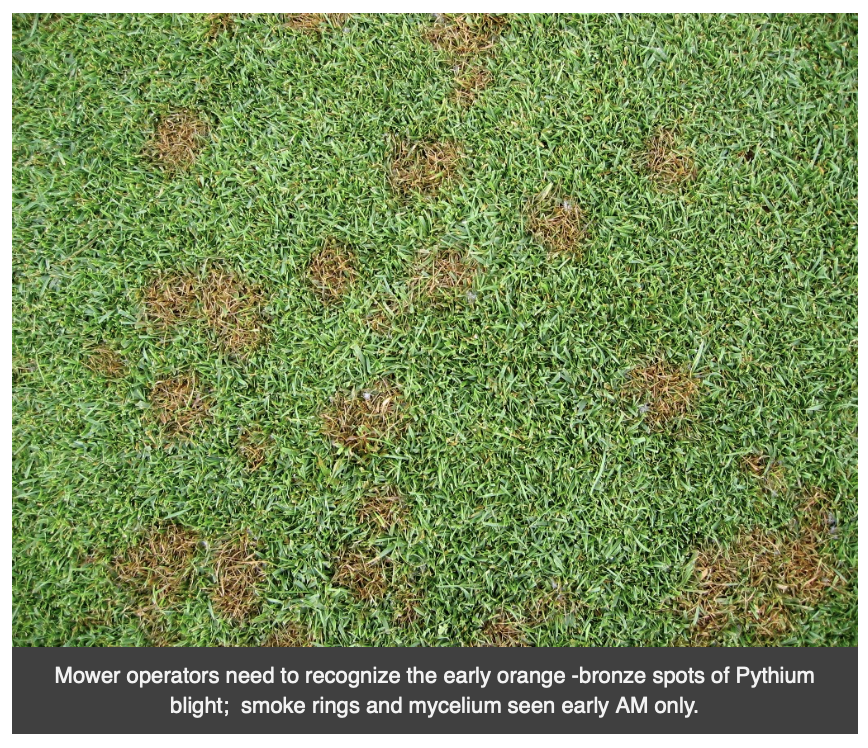
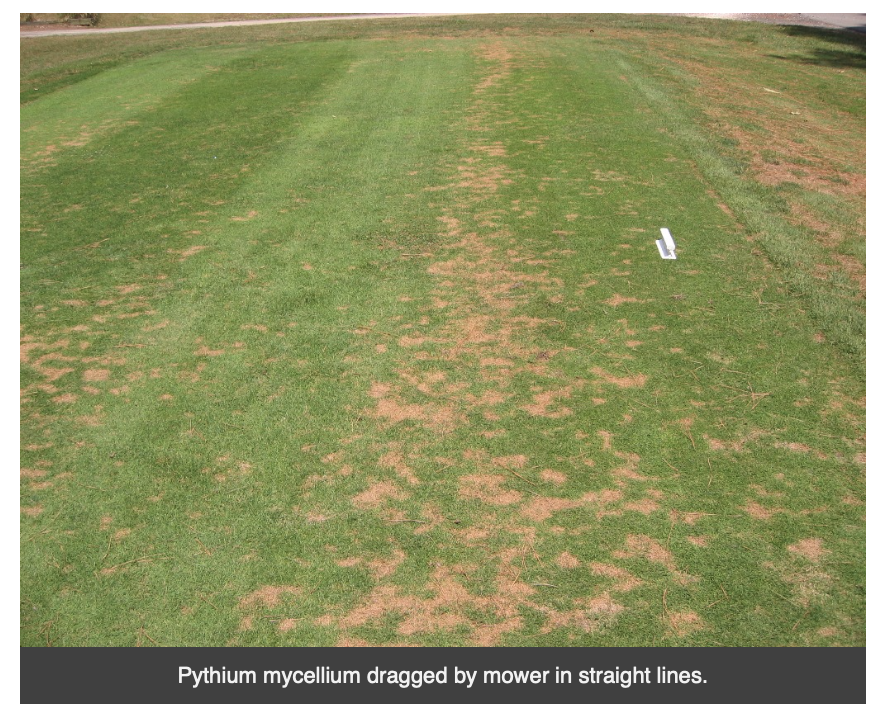
Pythium Blight On Greens-Recognize the Orange Spots: Pythium blight on greens often is sneaky and overlooked and thus has nasty outcomes. Pythium disasters occur due to lack of attention by the guy mowing greens. Those responsible for mowing greens in the morning should be trained to “observe and recognize” the warning-signs. During sultry nights, marked by high humidity (>78%) and nights (lows > 73F), the disease rapidly develops in darkness- especially if there has been a thunderstorm in recent hours. Normally, the disease appears in small spots on greens about the diameter of a golf ball. Active spots in the early morning before dew dries usually have a grayish-appearance and/or a cob-web or grayish-cottony look. Affected spots appear bronze or brilliant orange and mimic gasoline, wetting-agent and other types of burns. Left unchecked, hundreds of spots can develop on greens in just 2 or 3 nights. Once numerous spots develop, a generalized blighting can occur with an overnight thunderstorm or even by puddles caused by a stuck irrigation head. It’s a killer on greens and once you see any blighting all affected areas are dead. Remember, this pathogen is a water mold that will run wherever moving water carries its mycelial fragments and spores. It is especially deadly where water puddles and/or is carried on wheels and rollers on equipment, causing straight line stripes of dead turf.
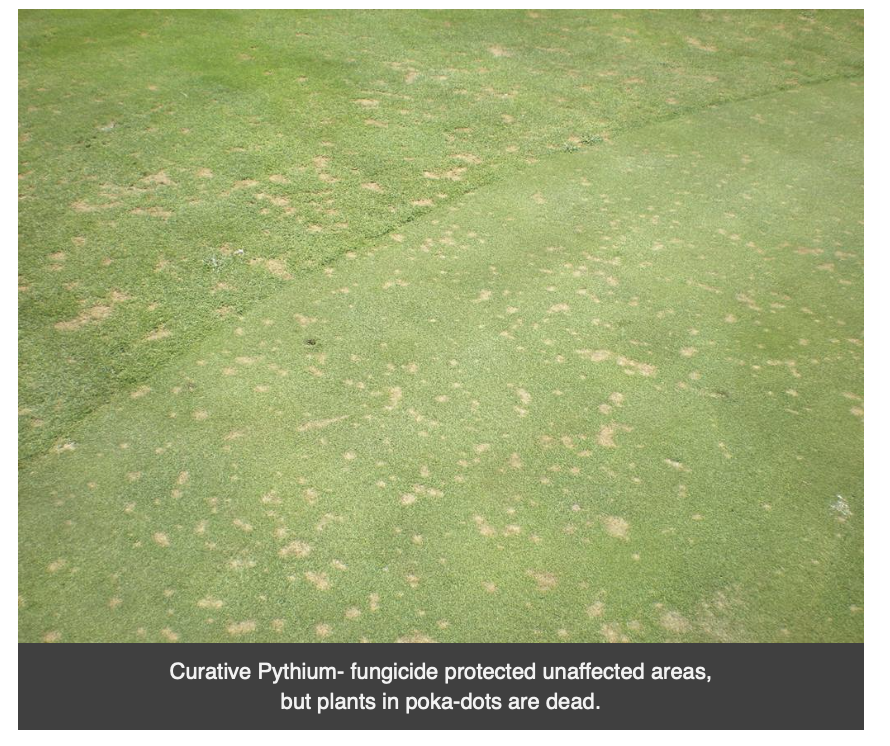
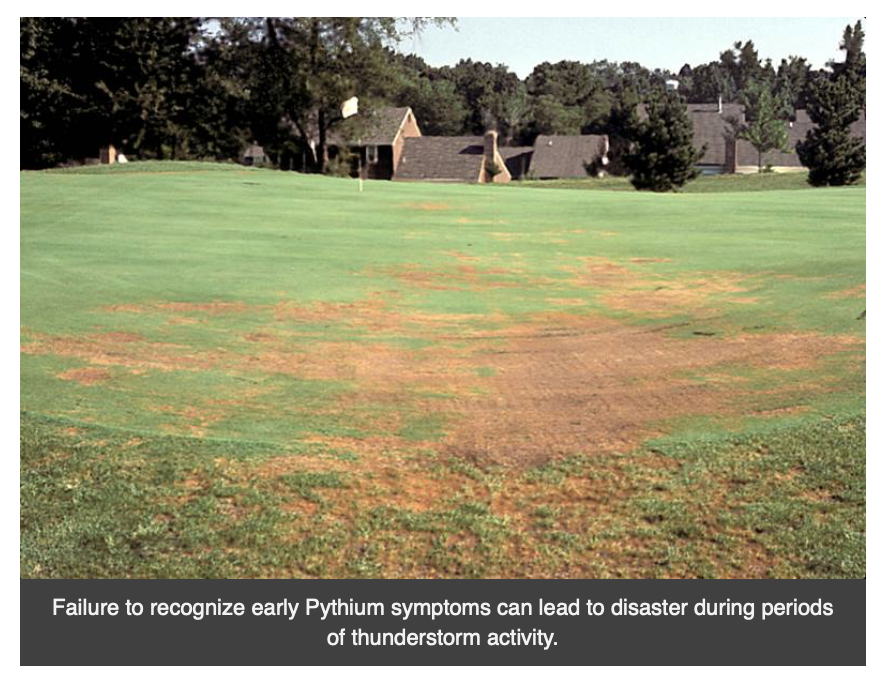
Pythium Blight Control: Effective Pythium fungicides include: Banol (propamocarb); Segway (cyazofamid); Signature (fosetyl-Al) and other phosphites,); and Subdue MAXX (mefenoxam/metalaxyl). These fungicides are highly effective when applied preventively (i.e., before any disease symptoms appear). Predictions of thunderstorms on hot and sultry nights should give superintendents the Green Light to spray. Curatively (i.e., applied after damage has appeared), all of the aforementioned tend to work slowly to stop disease progression. Segway may be the fastest and most effective material to apply once active blighting is in progress. Even Segway won’t bring badly infected turf back to life –it only will protect existing living plants.