
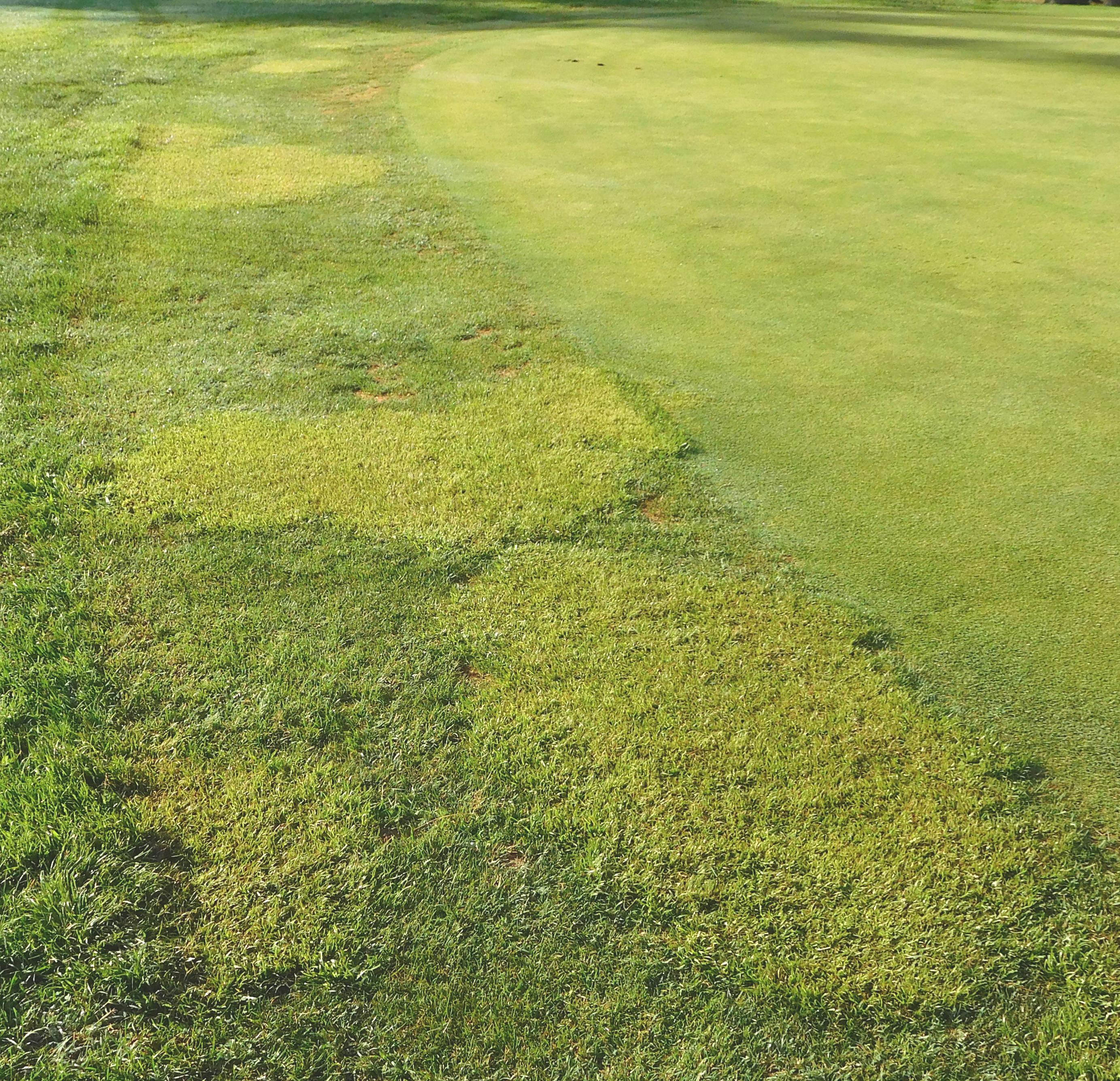
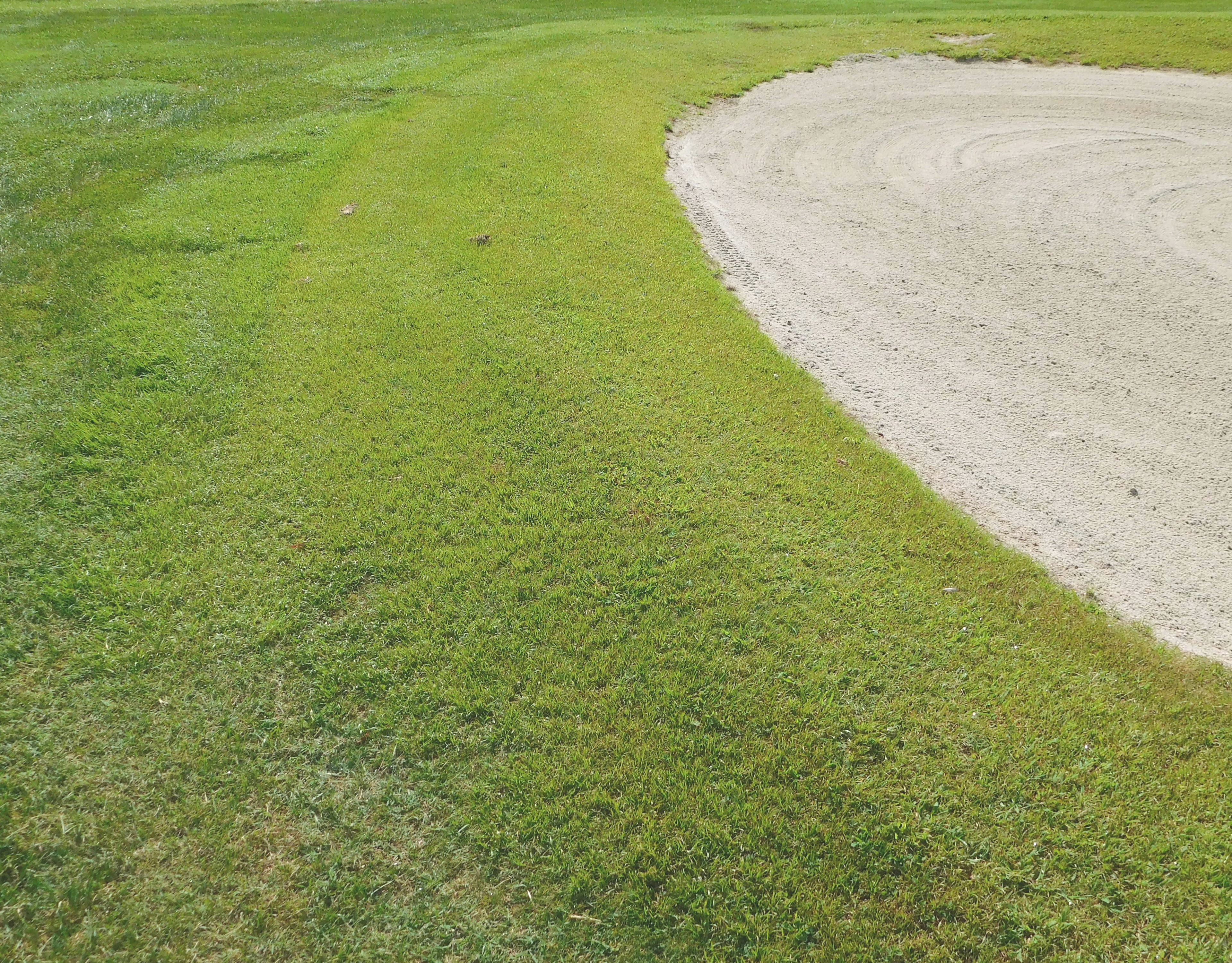
Large, yellow mats of Kyllinga in a collar and extending into a green, and Kyllinga bunker face.
Sedges mostly are a problem in wet areas. Under irrigation, however, sedges emerge sporadically throughout summer and colonize both sunny and shaded sites, including well-drained slopes. Kyllinga emerges in spring from rhizomes and seed, but it may not become noticeable in higher cut turf until late summer when seedheads are produced. Kyllinga produces masses of fleshy and long rhizomes that enable plants to spread rapidly in dense, circular mats. Yellow nutsedge plants are easily detached, but not Kyllinga, due to its very thick and aggressive mats of rhizomes. Indeed, a shovel is needed to dig a mat of Kyllinga from a turf surface. There are several species of Kyllinga. Green Kyllinga produces seedheads throughout summer months, but what I see is mainly false green Kyllinga, which produces seedheads in late August and September. Kyllinga is much sneakier than yellow nutsedge. Yellow nutsedge plants can extend 2-3” in height in lawns or roughs in just a few days after mowing. Conversely, Kyllinga does not grow as rapidly and blends in better. Indeed, many turf mangers don’t recognize a Kyllinga problem in higher cut lawns, roughs and surrounds until early September when seedheads become abundant. Kyllinga seedheads develop in globe-like clusters, initially are yellow-green, and then turn brown. Autumn frosts kill leaves, but Kyllinga plants survive from rhizomes and seed.
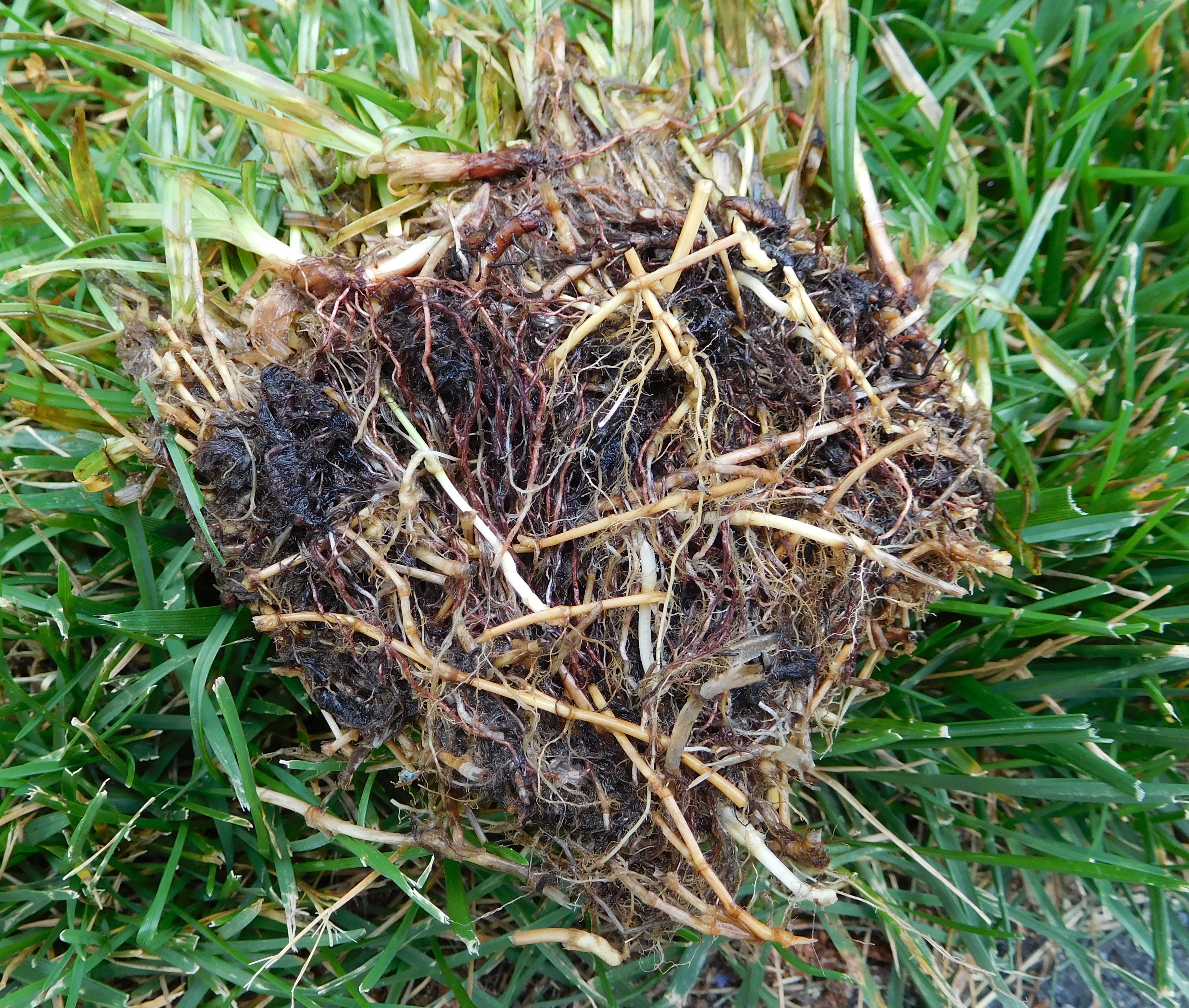
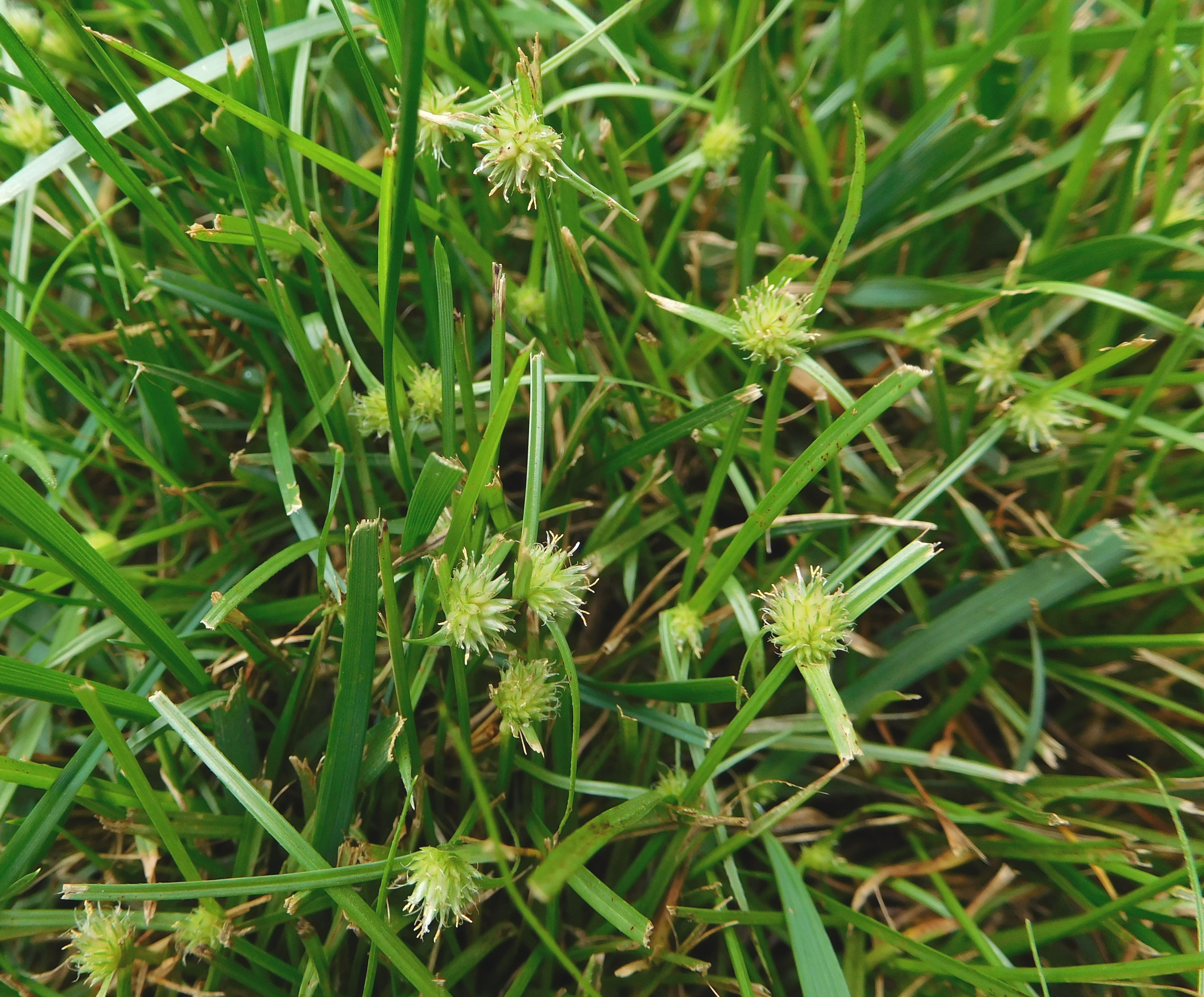
Dense mat of Kyllinga rhizomes in tall fescue, and yellow-green, globe-like seedheads of Kyllinga.
Currently, there are no preemergence herbicides that effectively target sedges. Kyllinga is especially difficult to control given its extensive network of thick-fleshy underground rhizomes. Dismiss and Sedgehammer are the most commonly used herbicides for targeting sedges. Sedgehammer is less likely to discolor bentgrass turf, but it is slow to react and thus does not produce an immediate effect. Dismiss can cause yellowing of turf, but a response normally is seen within a few days of application. Professional’s either swear by or swear at both products, but Dismiss appears to be more effective on Kyllinga. Neither herbicide is labeled for greens, but low rates are used by some to suppress Kyllinga, but I don’t know of anyone who has been highly successful using any herbicide on greens or approaches. The problem is that under low mowing on greens, and even tight approaches and fairways, there is just not enough leaf surface area of the weed to intercept and take-up herbicidal levels. The most effective strategy for greens is a combination of suppression with herbicides, and when there is time and labor available, cut out the plants. Of course winter is the perfect time, but unfortunately Kyllinga turns brown and disappears rapidly following a few frosts. Thus, some method of marking is needed to find and physically remove Kyllinga from greens after a frost. In fairways, tees and roughs, multiple applications of one of the aforementioned is needed, but I’m not sure any herbicide available today will give complete control of large, mature Kyllinga mats. It is especially important to aggressively attack Kyllinga in green surrounds and approaches as soon as it is observed; otherwise it will soon invade collars and greens. Kyllinga will be a recurring problem since it is rapidly disseminated by seed and because it is tough to kill once mats develop. So, add Kyllinga to your list of other intractable and chronic pests like dollar spot, annual bluegrass and annual bluegrass weevil.
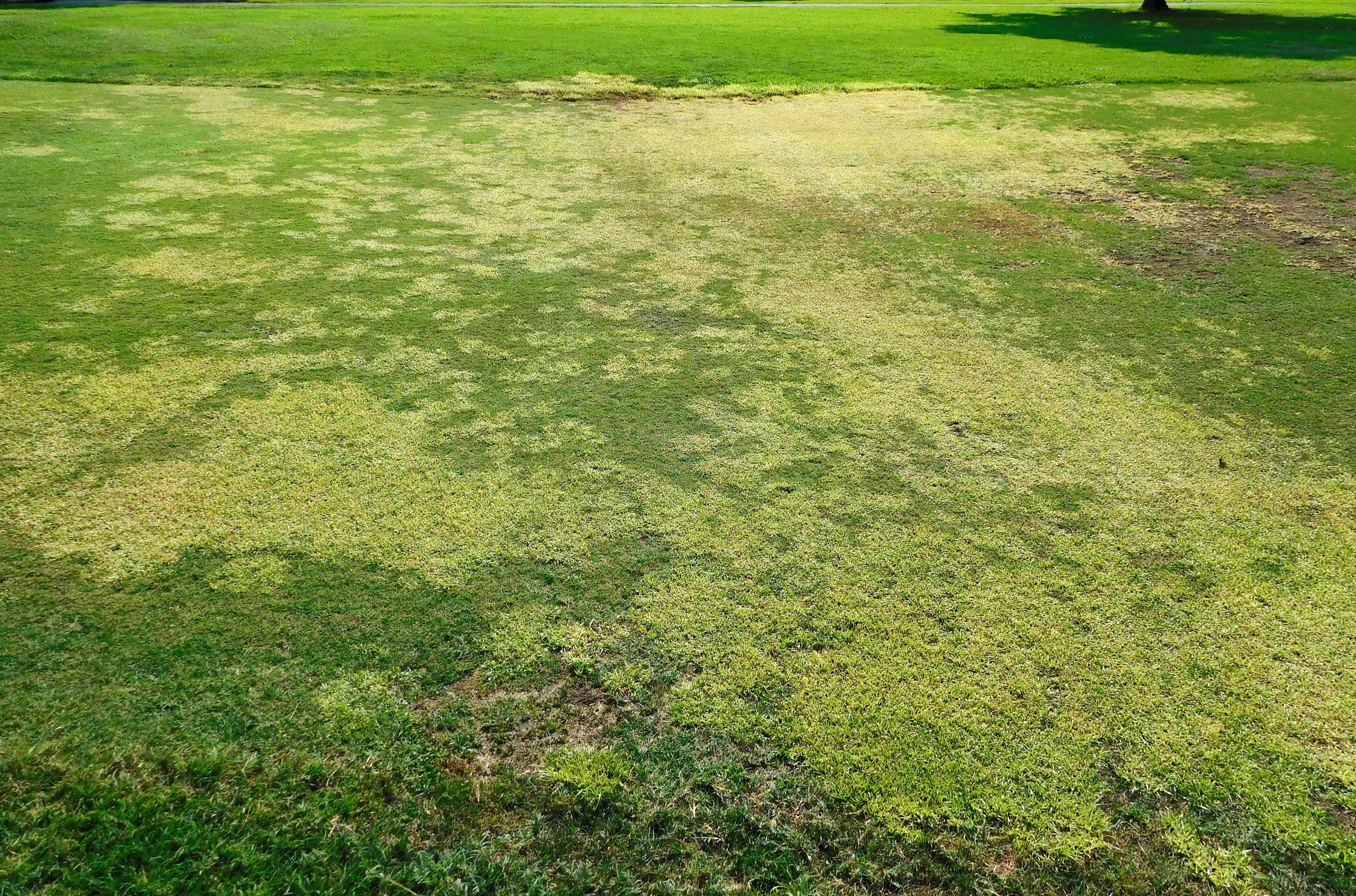
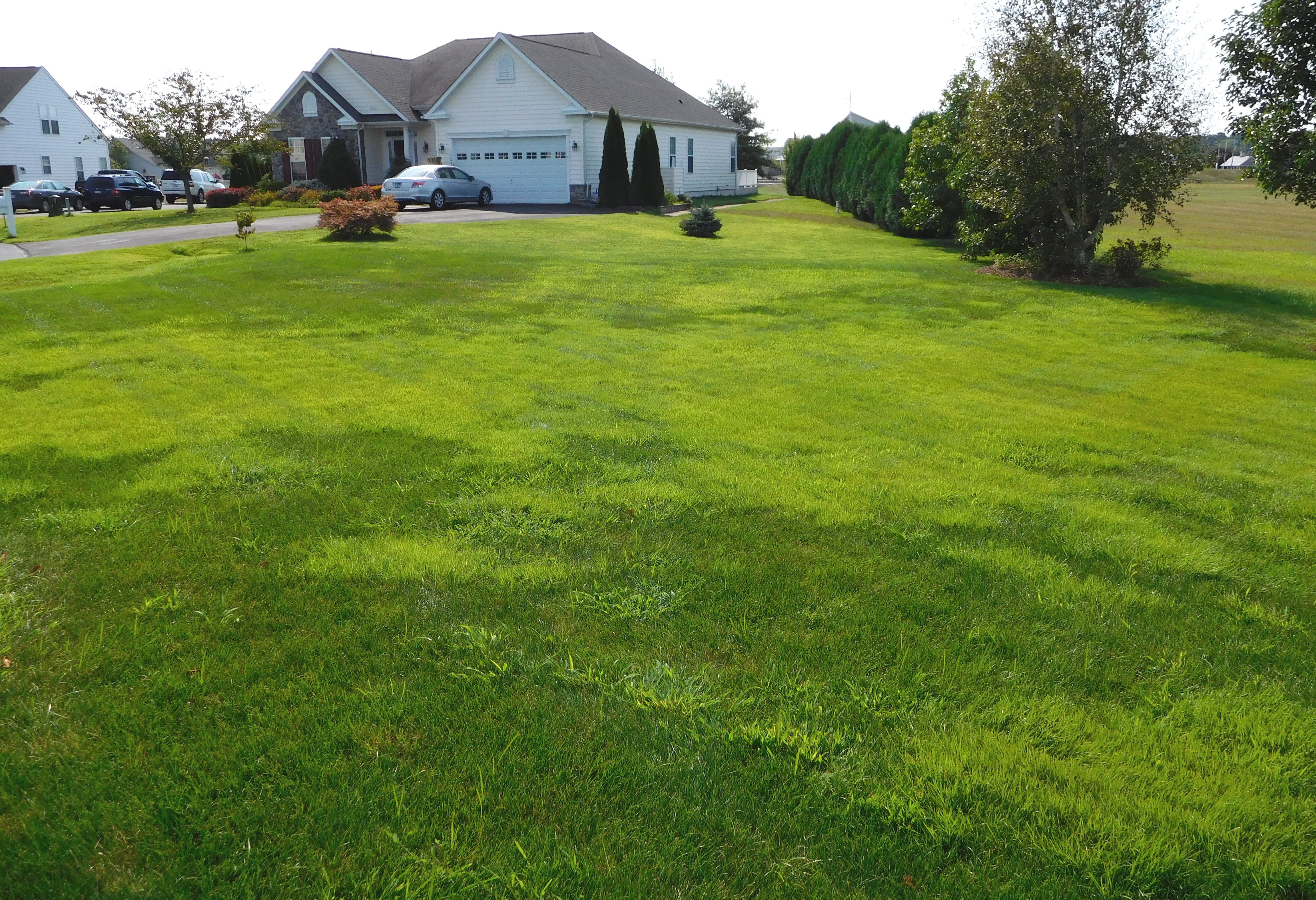
Kyllinga treated with Dismiss in Bermuda grass approach. Kyllinga dominating a DelMarVa Lawn.
Dr. Peter H. Dernoeden, Ph. D.