
I don’t remember hearing of Kyllinga as a problem in turf until about 10 years ago. It is likely that it was misidentified as being yellow nutsedge for a very long time. Yellow nutsedge and Kyllinga are members of the sedge family. Sedges are neither grasses nor broadleaf weeds. All sedges produce slightly fleshy, shiny, three-ranked, triangular- shaped (i.e., 3-angled) leaves. Yellow nutsedge leaves are conspicuously yellow. However, as explained below, Kyllinga leaves can be darker green, blend in and do not grow as rapidly. These sedges are perennials, meaning that if left uncontrolled they will return year after year, enlarge in size and become more difficult to control. Sedges emerge in spring and throughout the summer. Leaves are killed by frosts, but plants survive as seed, underground stems (i.e., stem bases and rhizomes) and tubers (i.e., look like very small onion bulbs). Tubers, however, only are produced by yellow nutsedge and only by very mature plants.
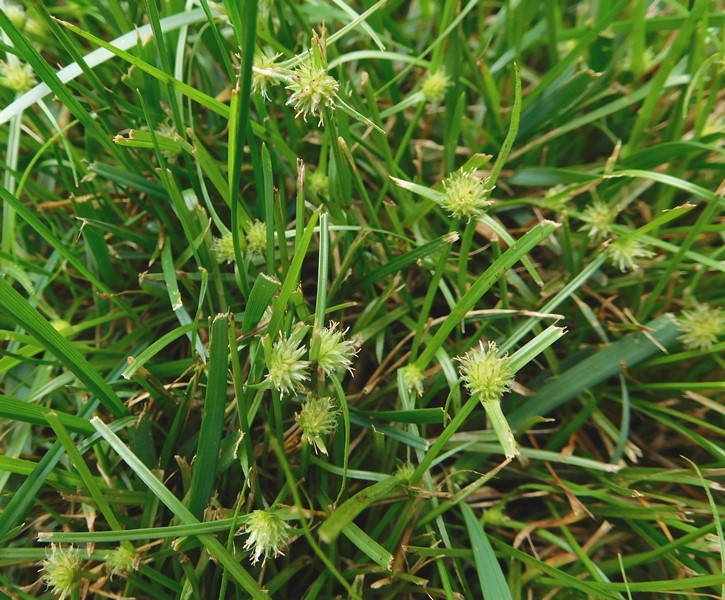 Sedges emerge in spring and are most invasive in wet soils, especially low areas that are poorly drained and frequently puddle. Because most of our turfs are irrigated, sedges emerge sporadically throughout the summer, even in well drained areas. Sedges colonize both sunny and shaded sites. Kyllinga initially is similar in appearance to yellow nutsedge, but generally plants go unnoticed for long periods. There are two species of Kyllinga found in turf, but green Kyllinga is most common in our region. Yellow nutsedge seedheads do not develop in routinely mowed turf, but Kyllinga seedheads are produced in abundance in mowed lawns, roughs and green surrounds in late summer. Kyllinga seedheads are yellow-green (eventually turn brown) in which flowers develop in globe-like clusters. Yellow nutsedge plants can extend 2-3” high in lawns and roughs in just a few days after mowing. Conversely, Kyllinga does not grow as rapidly and its color blends in well in higher cut lawns and roughs. Indeed, many turf mangers don’t recognize a Kyllinga problem until early September, when seedheads become abundant.
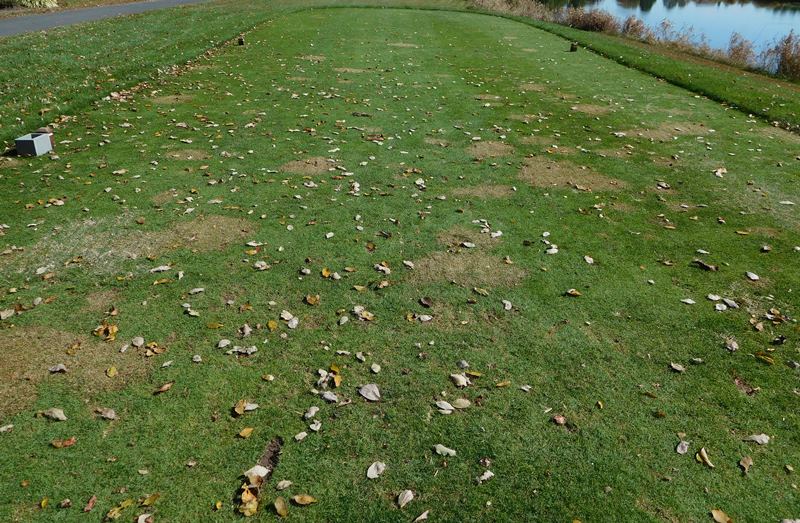
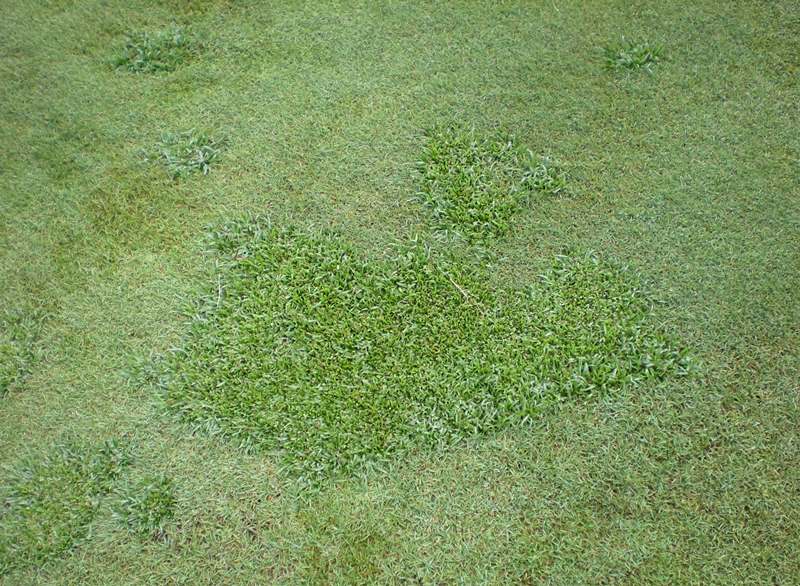 Yellow nutsedge plants blow out of the ground in July and August. Emerging plants grow rapidly, are bright yellow and are easily hand-pulled. Since rhizomes are very short (except mulched beds) there is no matting. Young Kyllinga plants are inconspicuous, darker green and blend in with turf. It is only after plants have developed distinct, circular, thick-matted patches of vegetation when they become evident. Kyllinga’s dense patches are the result of their thick and aggressive rhizomes. Kyllinga stems growing in patches cannot be detached by hand – it takes a shovel to remove plants from the mats. In late summer, massively dominated Kyllinga areas appear yellow.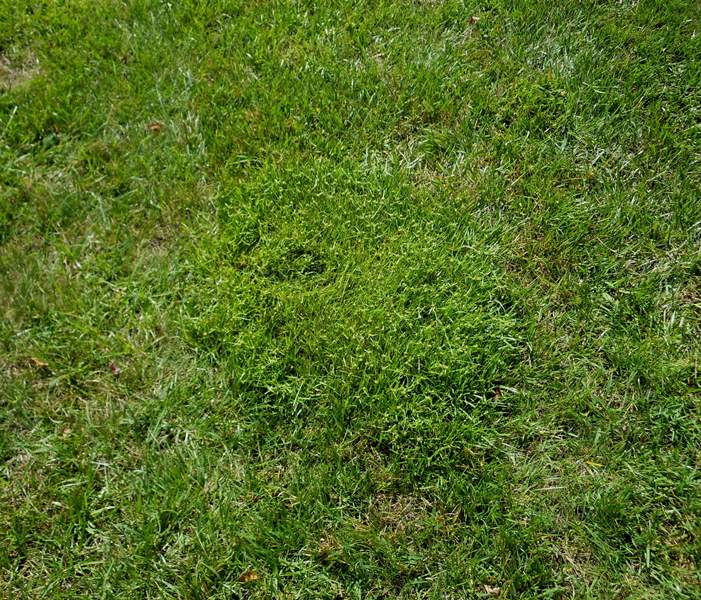
Currently, there are no effective preemergence herbicides that target sedges. Postemergence herbicides like Dismiss (sulfentrazone) and Sedgehammer (halosulfuron) effectively control yellow nutsedge, but the problem is that plants emerge all summer from seed and so multiple applications become necessary. Kyllinga is especially difficult to control given its extensive network of thick-fleshy underground rhizomes. Sedgehammer is less likely to discolor bentgrass, but its’ activity is slow and thus does not produce an immediate effect. Dismiss can cause yellowing of turf, but a response normally is seen within a few days of application. Professional’s either swear by or swear at both products, but according to Mr. Steven McDonald’s research (President, Turfgrass Disease Solutions), Sedgehammer can be highly effective on Kyllinga in bentgrass tees and fairways, but success involves several applications and a lot of patience. Steve’s research has shown that Sedgehammer (1.3 oz. product/acre tank-mixed with a non-ionic surfactant) applications should begin in June. Ensure that good soil moisture is present at application timing and for the next few days. Sedgehammer should be applied 2 to 3 times on a 21 to 28 day interval. The herbicide works very slowly and treated areas need to be scouted for recovery. Some spot-applications of recovering plants may be necessary.
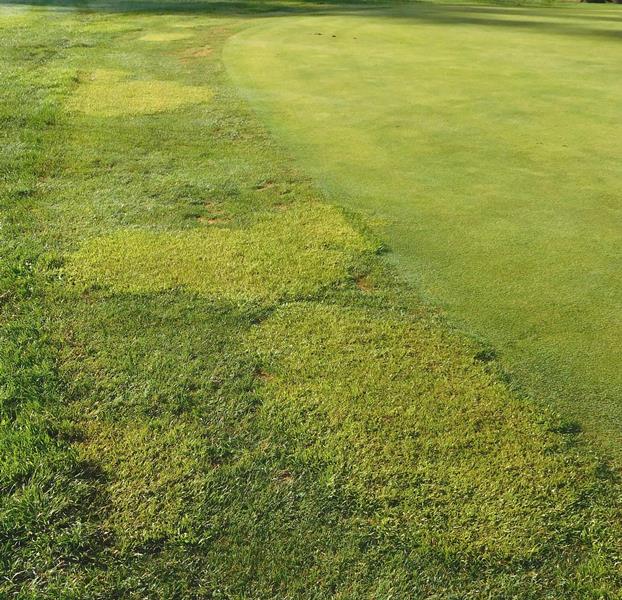 Neither herbicide is labeled for greens, but low rates are used by some to suppress Kyllinga, but I don’t know of anyone who has been highly successful using any herbicide on greens. The problem is that under low mowing on greens there is just not enough leaf surface area of the weed to intercept and take-up herbicidal levels. The most effective strategy for greens is a combination of suppression with an herbicide, and when there is time and labor available, cut out the plants. Winter is the perfect time, but unfortunately Kyllinga turns brown and disappears rapidly following a few frosts. Thus, some method of mapping or marking is needed in autumn to find and physically remove Kyllinga from greens during winter.
 Both Dismiss and Sedgehammer are more effective in higher cut roughs and lawns since there is more weed leaf surface area to intercept the herbicide. LCO’s generally target Kyllinga in late summer and autumn and prefer Dismiss since it is fast acting and thus the customer sees the response in a few days. In higher cut turf – two applications are needed. Again, there may be survival of some plants, which should be spot-treated when observed. A real problem is that it is likely that a significant Kyllinga seed bank exists in soils where plants have been allowed to flower.