From Part 1: Grasses fall into two general categories based on physiology: cool-season (C-3) and warm-season (C-4). We can further sub-divide these weeds as annual and perennial. Among the most common C-4 annuals include crabgrass, goosegrass and foxtails, and the most common C-3 annual grasses (although there are annual and perennial biotypes) include annual bluegrass and sweet vernalgrass. Among the most common perennial C-4 warm-season grass weeds include wiregrass (aka common bermudagrass) and Dallisgrass and other Paspalum species. Highly invasive cool-season C-3 grass weeds include creeping bentgrass and roughstalk bluegrass As implied, cool-season grasses grow best in cool to cold temperature zones and warm-season grasses perform better in warm to hot temperature zones. Warm-season grasses (i.e., C-4) better tolerate heat and drought stress, but turn brown and enter a state of winter dormancy in late autumn. A distinguishing feature of most warm-season grasses is the presence of hairs on leaves, which do not develop on cool-season grasses. Conversely, cool-season grasses (i.e., C-3) maintain some green color in winter, but during hot and dry summers they rapidly enter a brown and dormant state. When heat and drought are extreme, cool-season grasses will die; whereas, warm-season grasses are more likely to survive drought dormancy.
Paspalums: There are three species of Paspalum that are common turf weeds in our region. They include: Dallisgrass (Paspalum dilatatum), field paspalum (P. laeve) and bull paspalum (P. setaceum). All of the aforementioned Paspalum species are warm-season, perennial C-4 grasses. All produce thick clumps of coarse textured leaves in summer and all are nearly impossible to pull out of the ground in the summer. All have prominent leaf mid-ribs, are rolled in the bud, and have a tiny (need a hand lens to see) membranous ligule with numerous fine hairs in the collar. There are large variations in the degree of leaf and sheath hairiness, and whether leaves are flat or wavy. Some variants produce a purplish coloration in some leaves. There can be subtle differences on the arrangement of spikelet’s on seedheads, but only a botanical taxonomist, can identify individual species. Taxonomists are a dying breed and few Universities remain that teach plant systematics. These grasses are not easily differentiated and will be collectively referred to as Dallisgrass/Paspalum.
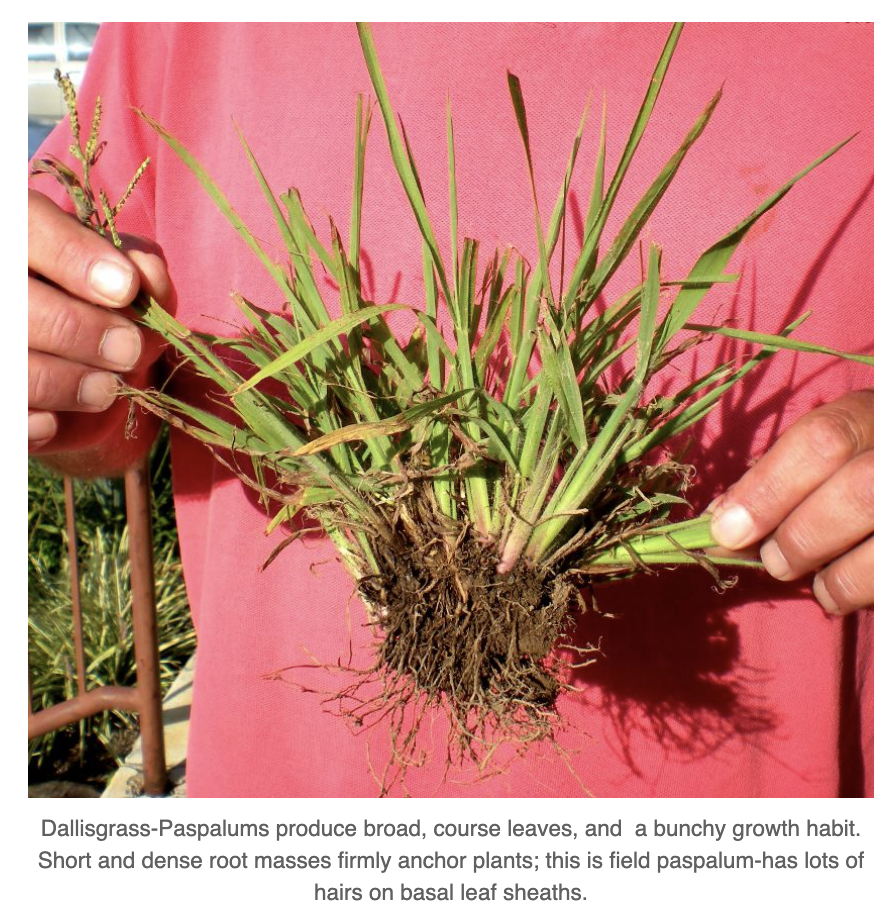

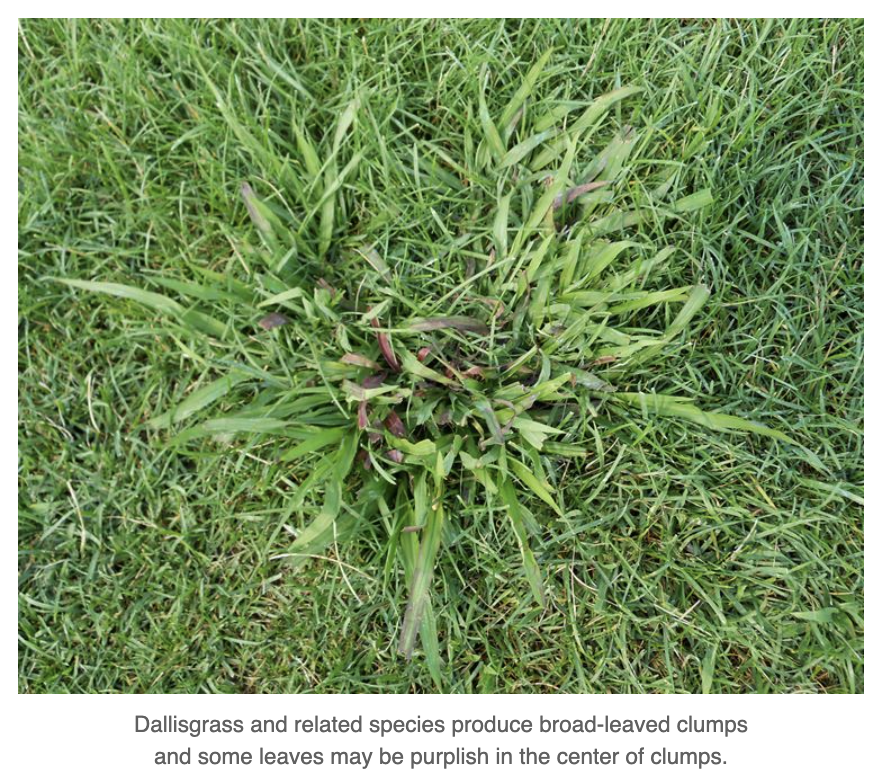
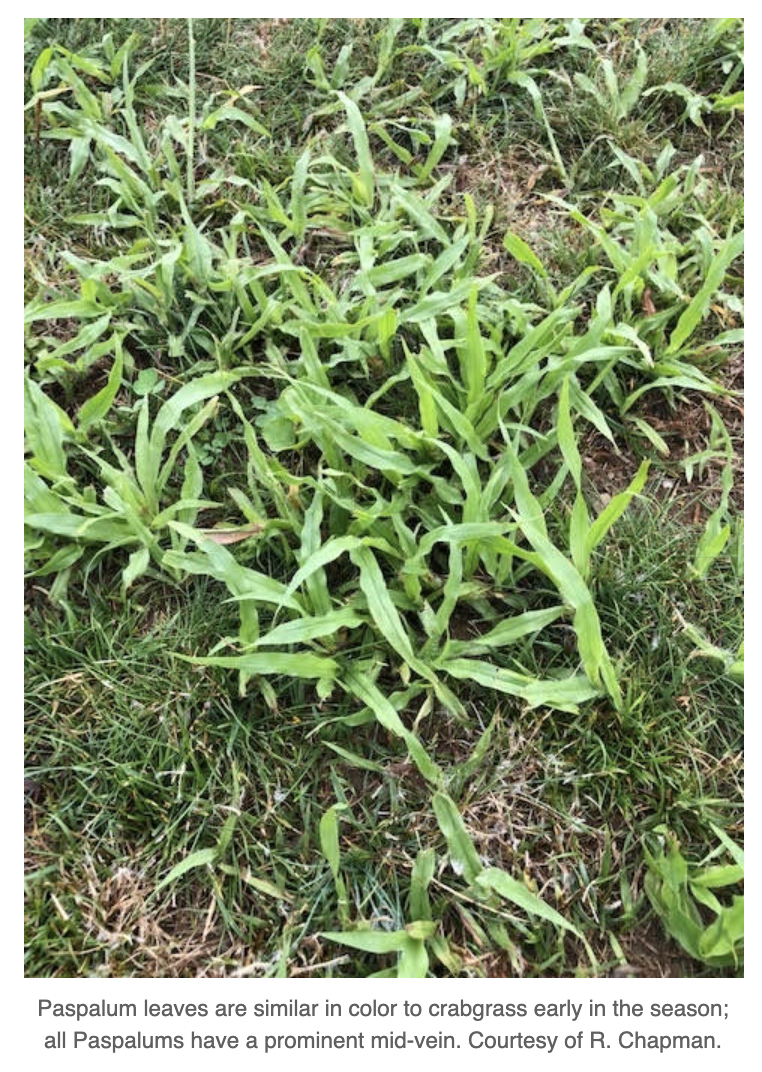
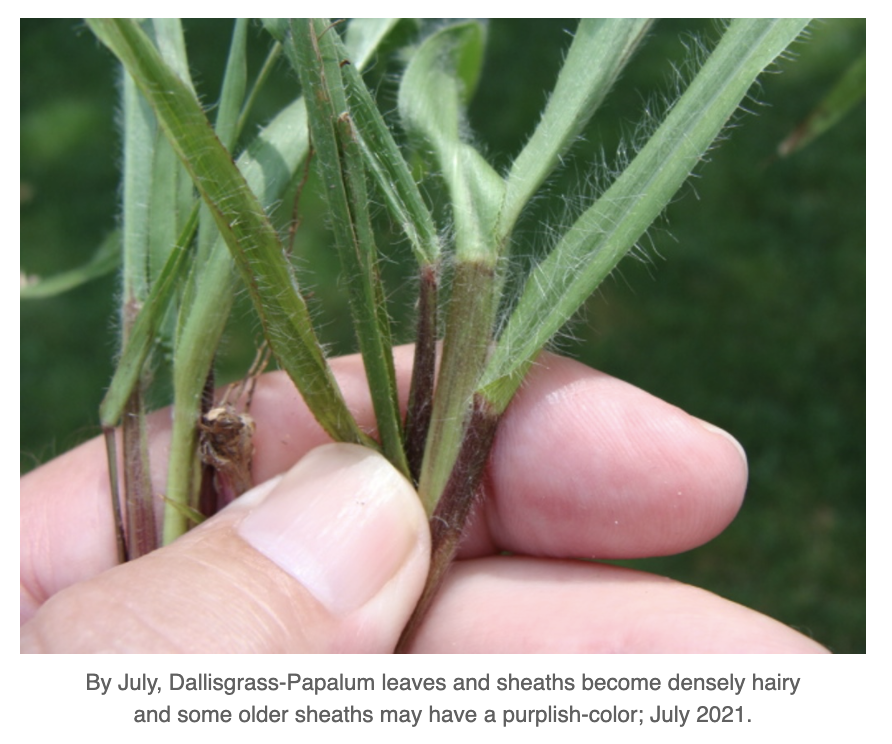
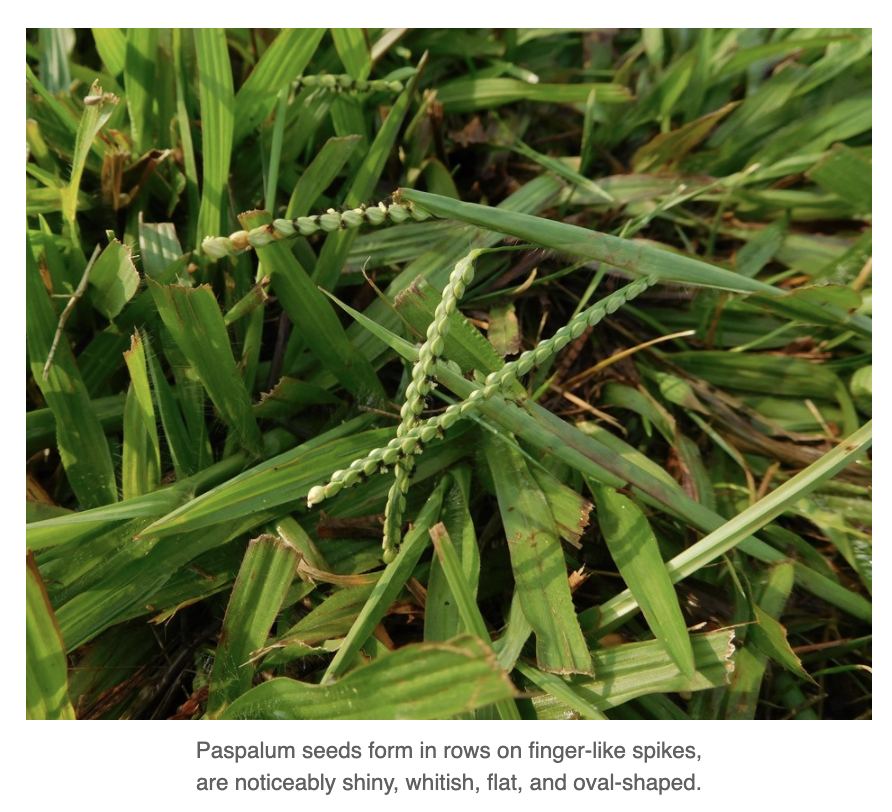
At spring-green-up, dormant overwintering stems of Dallisgrass/ Paspalum produce yellow-green leaves that look like crabgrass. As temperatures heat up in July, leaves darken in color and tufts of very broad; coarse-textured leaves develop into ugly tough clumps. Clumps increase in size due in part to the growth of short, shallow and thick rhizomes, but it does not form mats like wiregrass/common bermudagrass. As previously noted, some leaves are flat or wavy, but by July numerous hairs can be observed on leaves and sheaths. Variants may have densely hairy leaves and sheaths and purplish older sheaths. A common biotype in our region produces some leaves that are purple in color, especially in the center of clumps. Seedheads form in late summer and are most abundant in infrequently mowed turf. Dallisgrass/ Paspalum seeds form in rows on finger-like spikes and are noticeably shiny, whitish, flat, and oval-shaped. Dallisgrass/Paspalum grasses are adapted to all soil types, have excellent heat and drought tolerance, and turn brown following a few hard frosts and enter a state of winter dormancy. Once the frost-killed leaves die, the clumps disappear, but will return as weather warms in mid-to-late spring. In spring, new leaves grow from dormant buds on stem bases. Young, yellow-green leaves usually become evident in June- at which time they look like crabgrass plants.
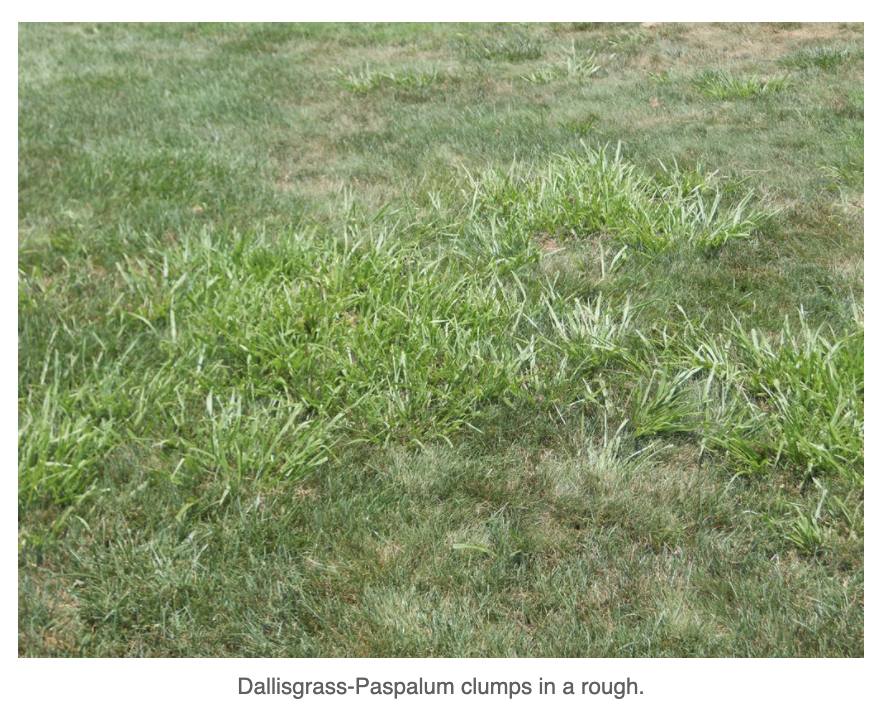
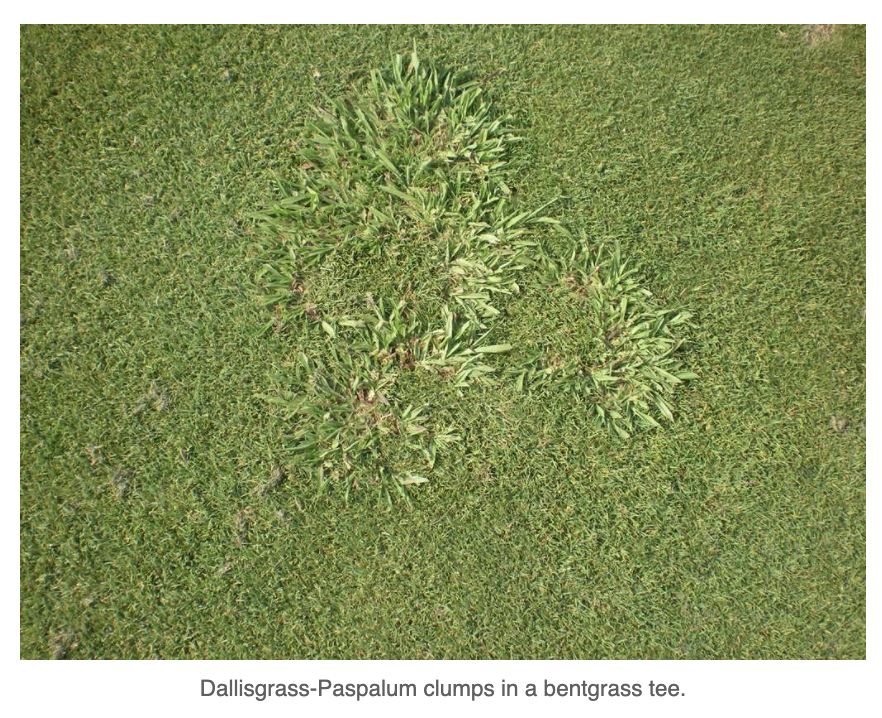
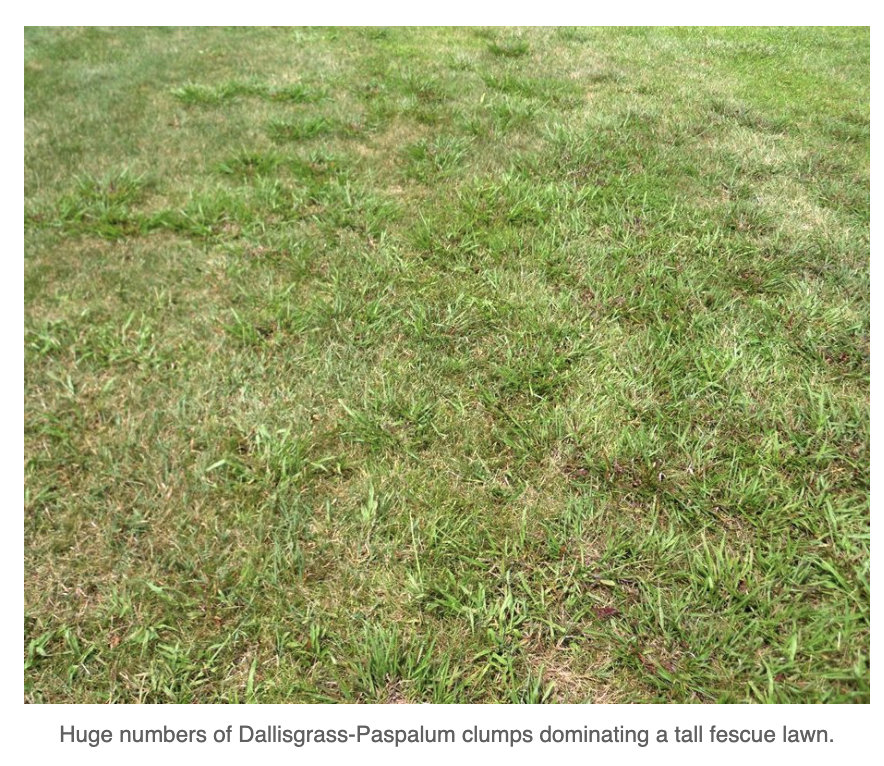
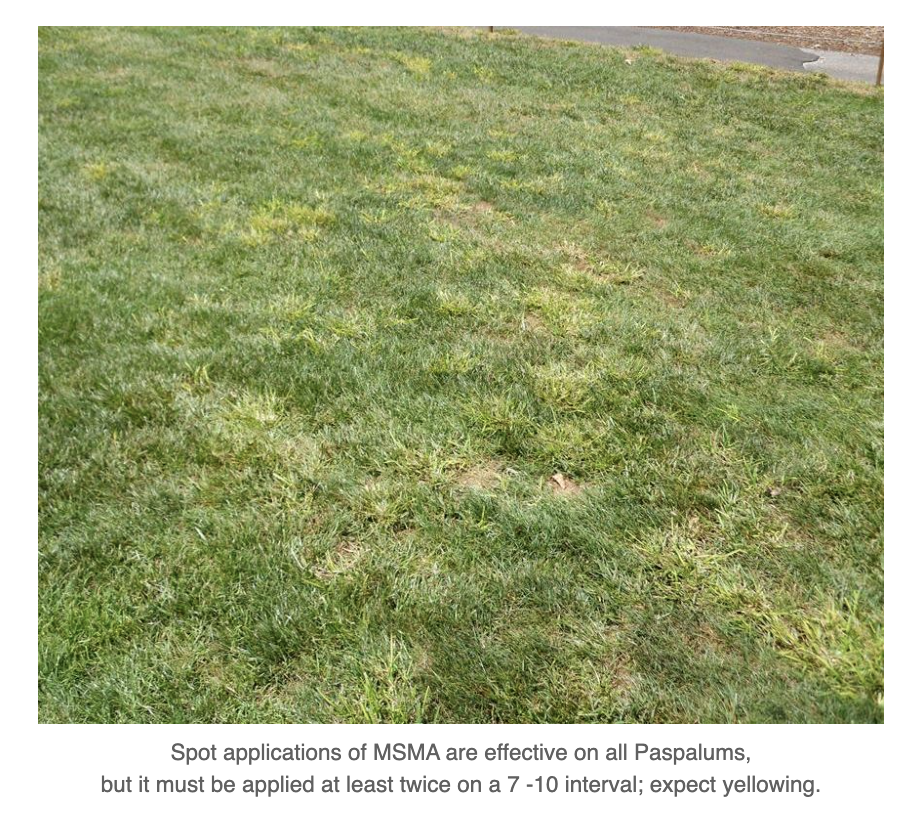
Dallisgrass/Paspalum Control Measures Are Mostly Anecdotal: Only MSMA (monosodium methane arsonate) is known to effectively control Dallisgrass/Paspalum. MSMA only is labeled for use on golf courses and sod farms. MSMA causes excessive amounts of yellow discoloration and can cause severe injury when applied in hot summer weather. For reasons of economy and safety, most professionals opt to spot-treat clumps with MSMA. Spot-treatments localize yellowing and potential turf injury, while at the same time achieving better control. Normally, at least two spot-applications of MSMA are required on 7-10 day interval for effective control. Some safety can be achieved with MSMA, by doubling the water volume, using half rates and more frequent applications (i.e., half rates need to be applied on 5-7 day intervals at least three times). It is worth noting again, that if miss-handled, MSMA, can cause severe turf damage in the summertime.
Observations suggest that annual use of Dimension (dithiopyr), which targets crabgrass, may have good pre-activity on Dallisgrass/Paspalum. Indeed, the Dimension labelX states that it does control Dallisgrass seedlings. I am not aware of another preemergence herbicide that targets Dallisgrass/ Paspalum. Anecdotally, and don’t take this to the bank, but there are two postemergence products {Pylex and Solitaire} that may help to suppress these weeds. The Pylex (topramezone) label states that it will suppress or control Dallisgrass; the Solitaire label does not. Pylex is an herbicide that targets goosegrass and common bermudagrass in cool-season turf. Solitaire is a pre-pack mix of sulfentrazone [Dismiss – a post sedge herbicide] plus quinclorac [Drive -a post crabgrass herbicide]. Spot applications of Pylex and Solitaire burn-down foliage and prevent seedhead formation, but plants are likely to survive. Pylex causes treated leaves to turn white; whereas, Solitaire treated leaves turn brown. These color-effects are objectionable, and they should be considered and made known to all involved when using these materials.
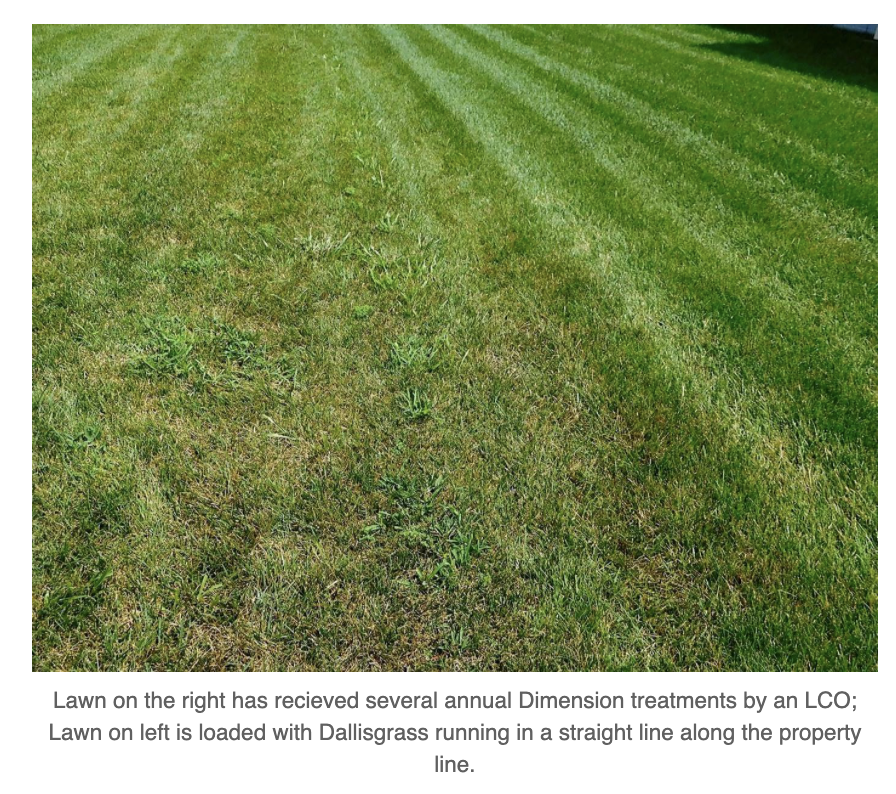
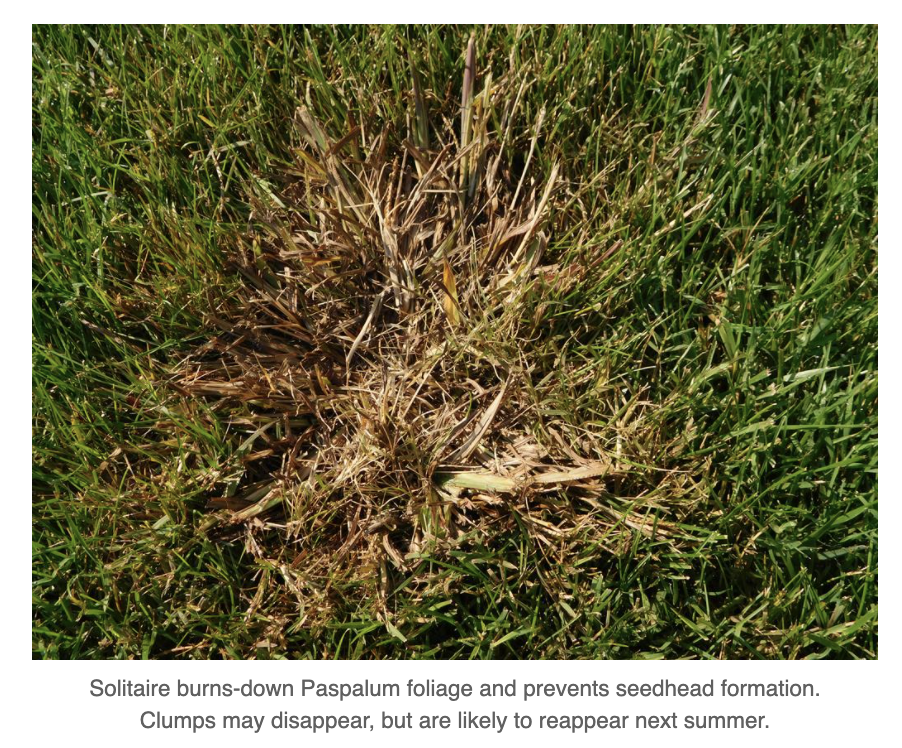
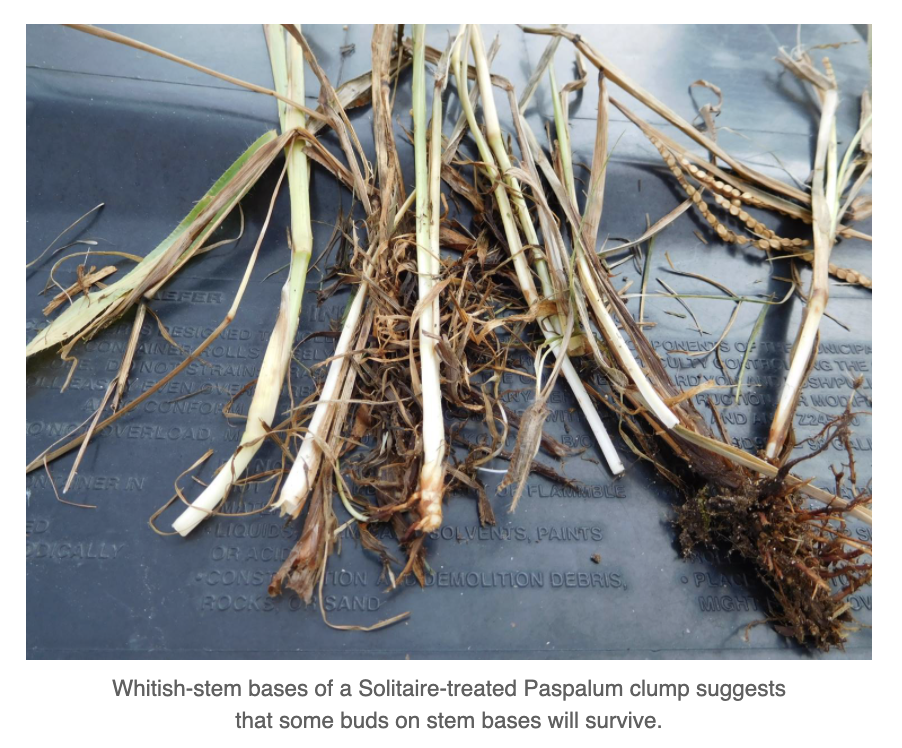
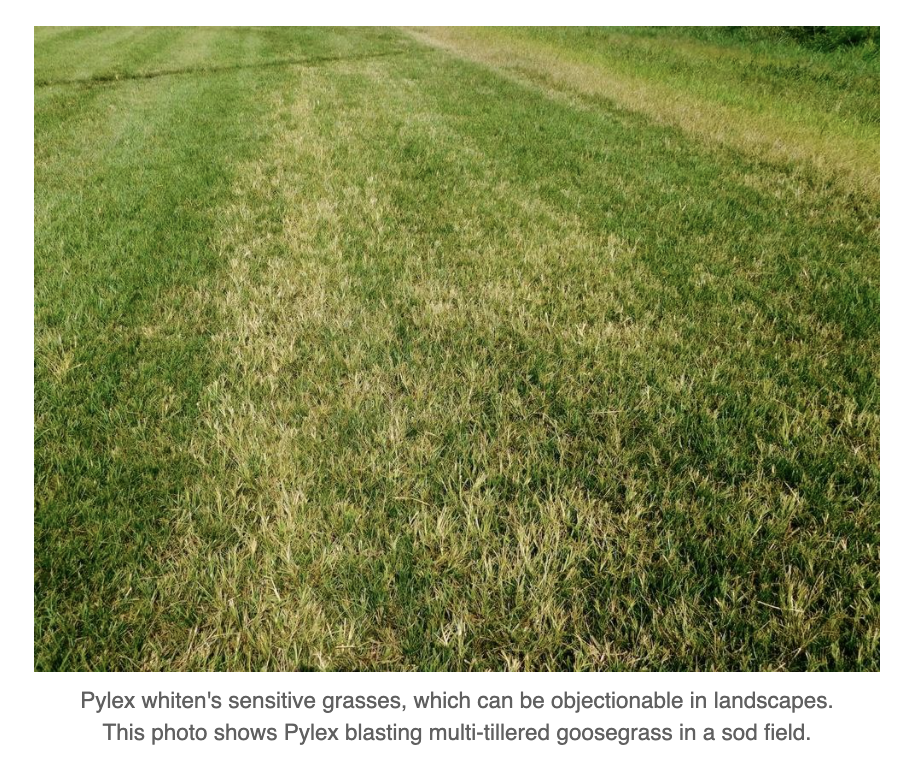
A burn-down approach is a war of attrition. In the short-run, leaves are killed and clumps no longer become strikingly noticeable. In the long-run, burn-downs will improve turf competiveness, but it is not a one shot deal. Keep in mind that if the clumps have been around for only one year, they would have produced thousands of seed. Hence, some consideration is needed for use of Dimension in a spring “crabgrass” application timing. Basically, use Dimension where you are targeting crabgrass (and/or goosegrass) and Dallisgrass/Paspalum. Hand digging is a realistic approach in combating Dallisgrass/Paspalum when clump numbers are small, and in early summer before seedheads are produced. The problem is that homeowners only notice the problem after it has gotten out of hand. Round-up (glyphosate) spot-treatment would work. However, Round-up wicks and drifts, and usually when spot-treating, people are likely to kill an area twice or more the size once occupied by clumps. Large ugly dead spots usually require re-seeding, which is more hard work!