
Grasses fall into two general categories based on physiology: cool-season (C-3) and warm-season (C-4). We can further sub-divide these weeds as annual and perennial. Among the most common C-4 annuals include crabgrass, goosegrass and foxtails, and the most common C-3 annual grasses (although there are annual and perennial biotypes) include annual bluegrass and sweet vernalgrass. Among the most common perennial C-4 warm-season grass weeds include wiregrass (aka common bermudagrass) and Dallisgrass. Highly invasive cool-season grass, C-3 weeds include creeping bentgrass and roughstalk bluegrass As implied, cool-season grasses grow best in cool to cold temperature zones and warm-season grasses perform better in warm to hot temperature zones. Warm-season grasses (i.e., C-4) better tolerate heat and drought stress, but turn brown and enter a state of winter dormancy in late autumn. Conversely, cool-season grasses (i.e., C-3) maintain some green color in winter, but during hot and dry summers they rapidly enter a brown and dormant state. When heat and drought are extreme, cool-season grasses will die; whereas, warm-season grasses are more likely to survive drought dormancy.
Foxtails: There are three foxtail species found in turf : yellow foxtail (Setaria glauca), green foxtail (Setaria viridis) and giant foxtail (Setaria faberi). All foxtails are annual, warm-season grasses. Foxtails have a very similar lifecycle compared to crabgrass and goosegrass. Seed germinate primarily in the spring (mostly late April to early July), but some seedling emergence can continue following rain events in summer. Seedheads are produced mid-to-late summer and plants eventually are killed by autumn frosts.
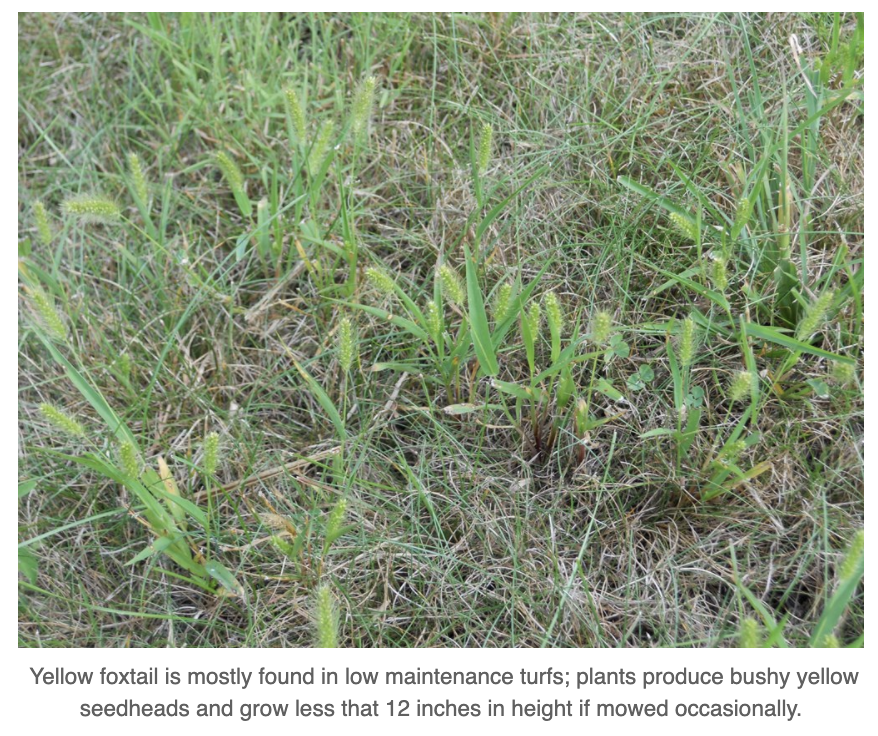
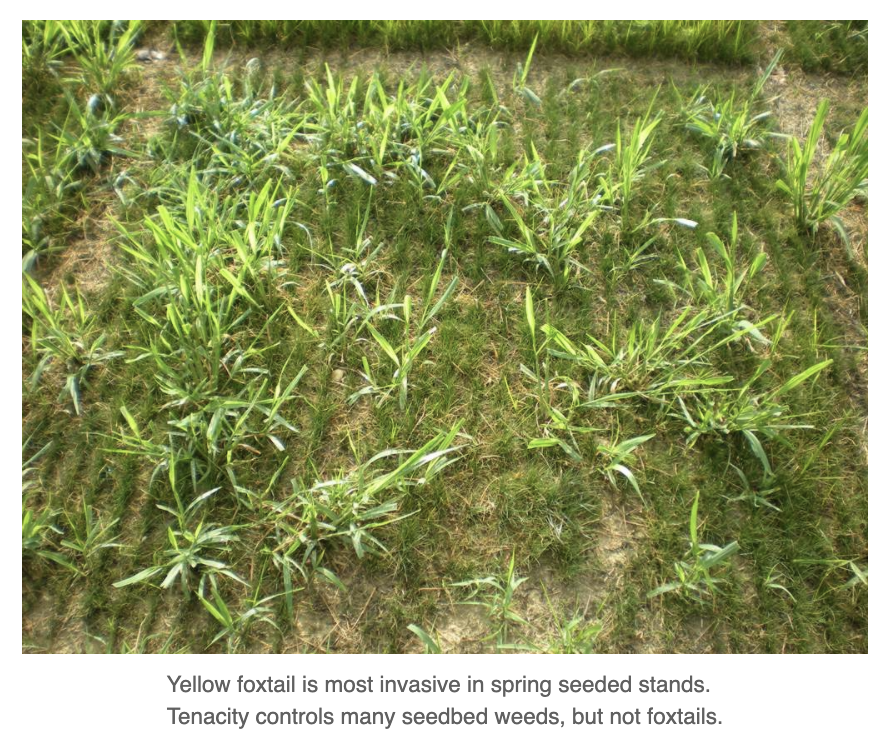
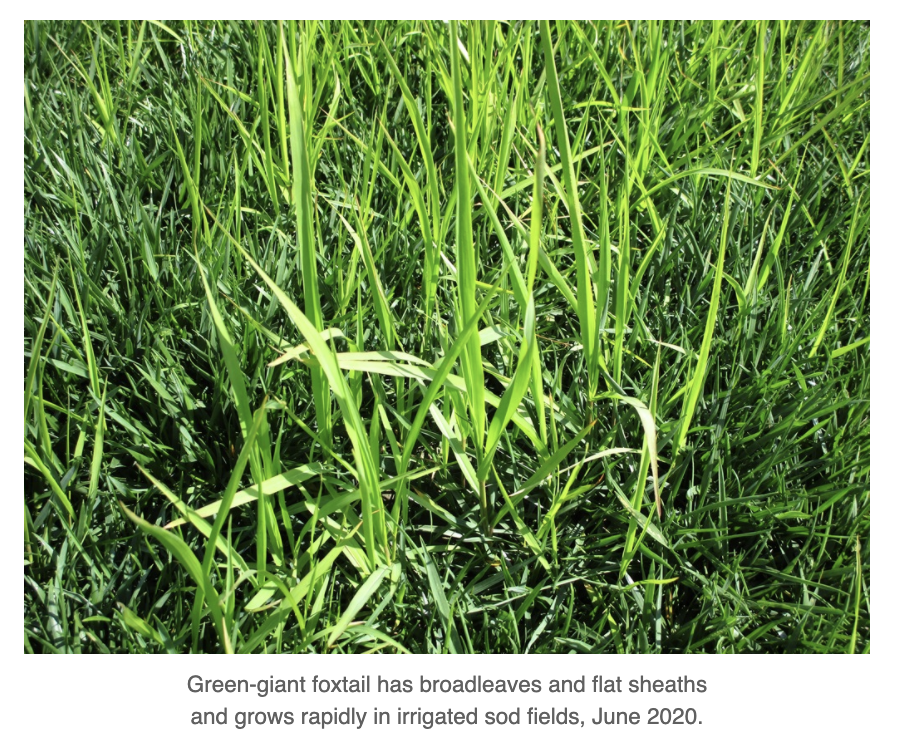
Normally, yellow foxtail is mostly invasive in spring-seeded stands and in very low maintenance turf (i.e., little mowing, irrigation and fertilizer applied). Green-Giant foxtail, however, can be highly invasive in both fall and spring seeded stand in sod production. This is especially true on sod farms that have pivot irrigation, and drainage ditches whose purpose is to remove large amounts of water off of relatively flat surfaces from heavy rainfall events.–regardless if the crop is sod, corn or soybeans. In corn and soybeans, however, foxtails are effectively removed in Round-up Ready Crops.
All three foxtail species share similar characteristics. In the absence of mowing, yellow foxtail seldom exceed 12 inches in height; whereas, green and giant foxtail grow to heights of over 2 to 3’ in un-mowed sites. Green and giant foxtails are most invasive in drainage ditches on farms where soil moisture water is plentiful via pivot irrigation. In weed contaminated irrigation ditches, green-giant foxtails produce zillions of seed that move rapidly via wind or heavy rain events into cultivated fields. If left unchecked – plants and thus more seed are moved further and further away from ditches and produce more and more seed to contaminate future crops. One option for farmers is use as crop rotation and selective herbicides to “clean-up” weed contaminated fields.
Yellow Foxtail: Since foxtails and crabgrass emerge at about the same time it is nearly impossible to distinguish among species when in a seedling stage. Leaves of 1 to 3 leaf yellow foxtail seedlings are yellow-green and tend to elongate slightly quicker than crabgrass. Leaves and sheaths are smooth (hairless) and reddish and the base. The collar region has a ring of hairs. It is not until seedheads emerge that yellow foxtail and crabgrass can be easily distinguished. Seedheads consist of clusters of compact, stalk-less flowers (i.e., spikelet’s), which appear bushy and foxtail-like. Initially light green, seedheads become yellow as they mature in late summer. Plant growth is upright, and tufted and unlike crabgrass, it does not produce large numbers of flat and procumbent tillers in late summer. Yellow foxtail is not competitive in dense, properly maintained and well established turf. It normally develops in low maintenance, open turfs that are not properly fertilized with nitrogen. Yellow foxtail is most competitive and invasive in spring seeded stands of cool-season grasses.
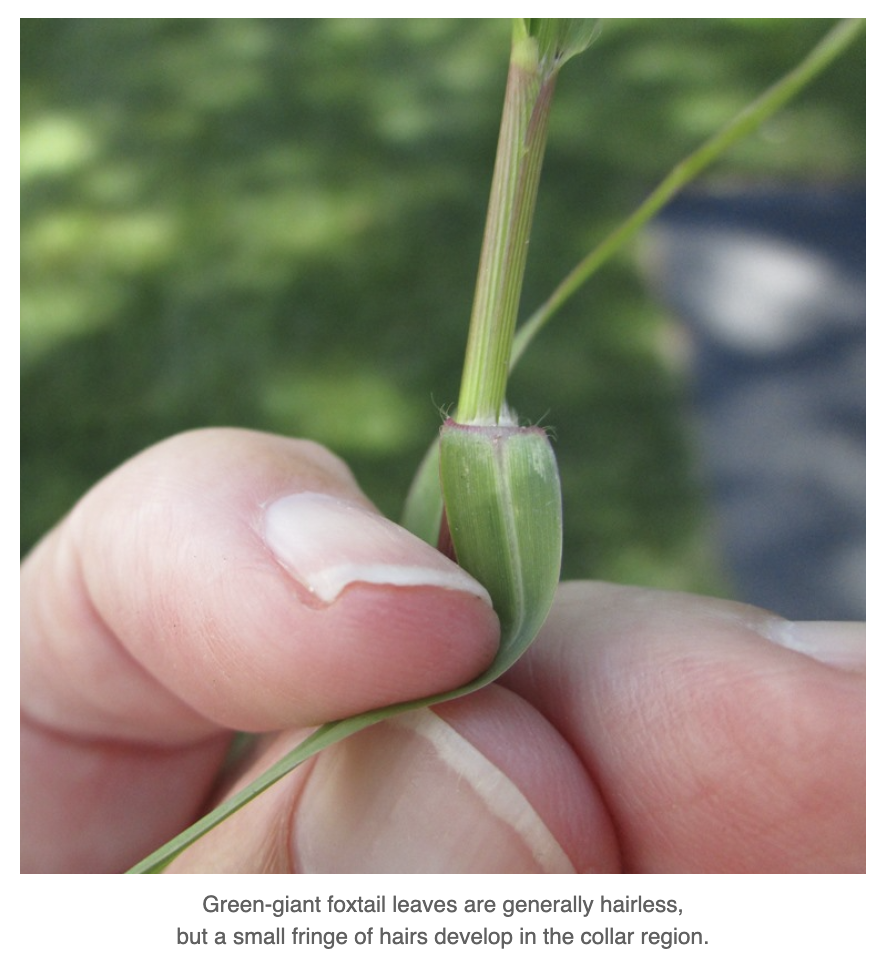
Green and Giant Foxtail: Green and giant foxtail only can be separated based on subtle seedhead characteristics and otherwise are indistinguishable-so let’s call it green/giant foxtail. Both species develop in clumps with short and compressed root systems that make individual plants tough to pull out of dry soils. These grasses have very wide blades ( ≥ 0.25”), and very flat (i.e., compressed) and broad sheaths. Collar regions consist of a ring of hairs that are best seen with aid of a hand lens. Leaves and sheaths are generally smooth (not hairy) and wavy, however, depending on species, there may be some hairs on leaf margins or elsewhere.
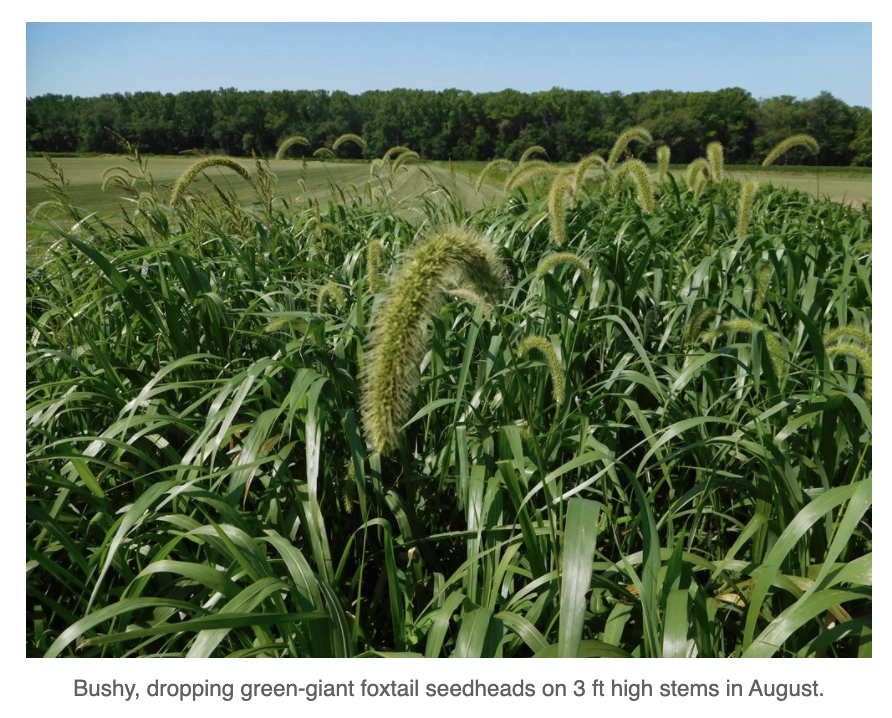
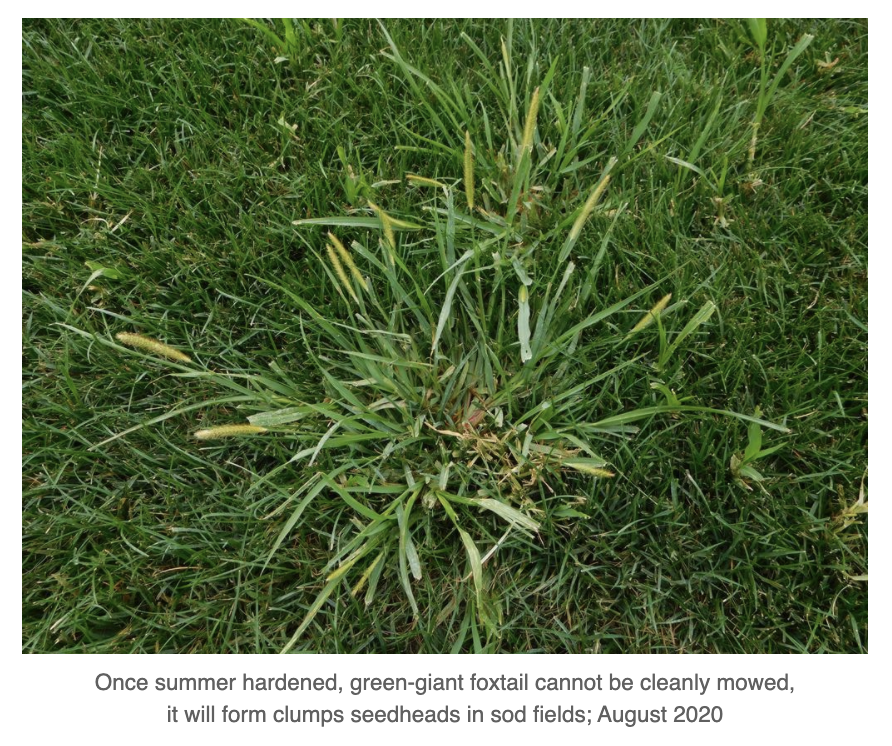
Unlike yellow –green-giant can grow to heights of over 2 to 3’ in un-mowed sites. Green/giant foxtails produce bushy, nodding and green seedheads along unmowed drainage ditches and roadsides. Summer-hardened tillers and stems are so tough that mowers can only whack-off higher growing leaves. What amazes me is that under routine rotary mowing (say 5-7day intervals), these foxtails not only continue to tiller, but also will produce thick clumps with an abundance of seedheads, which turn yellow at maturity.

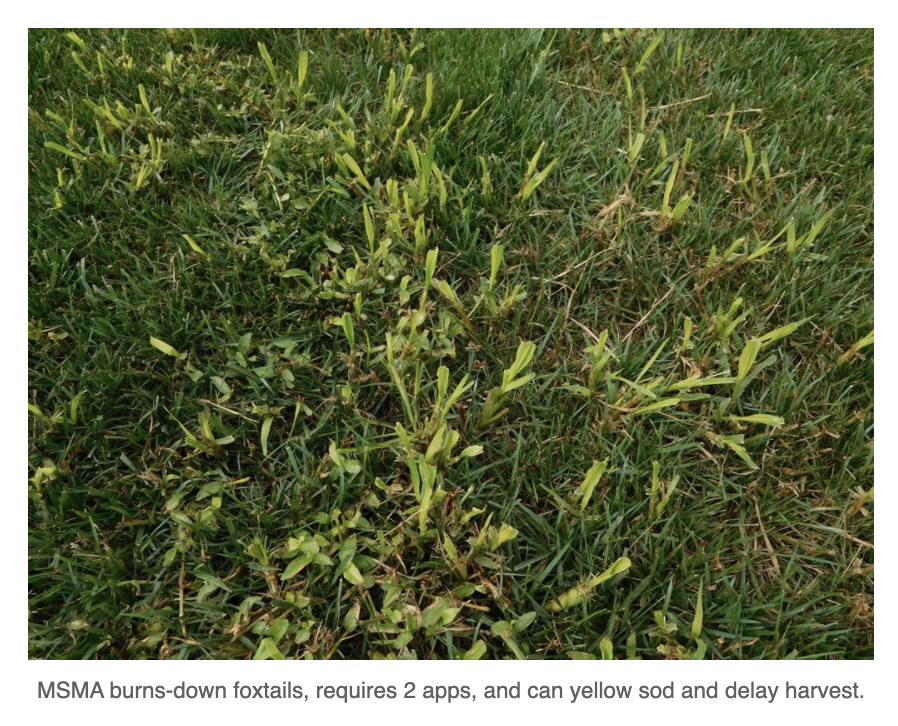
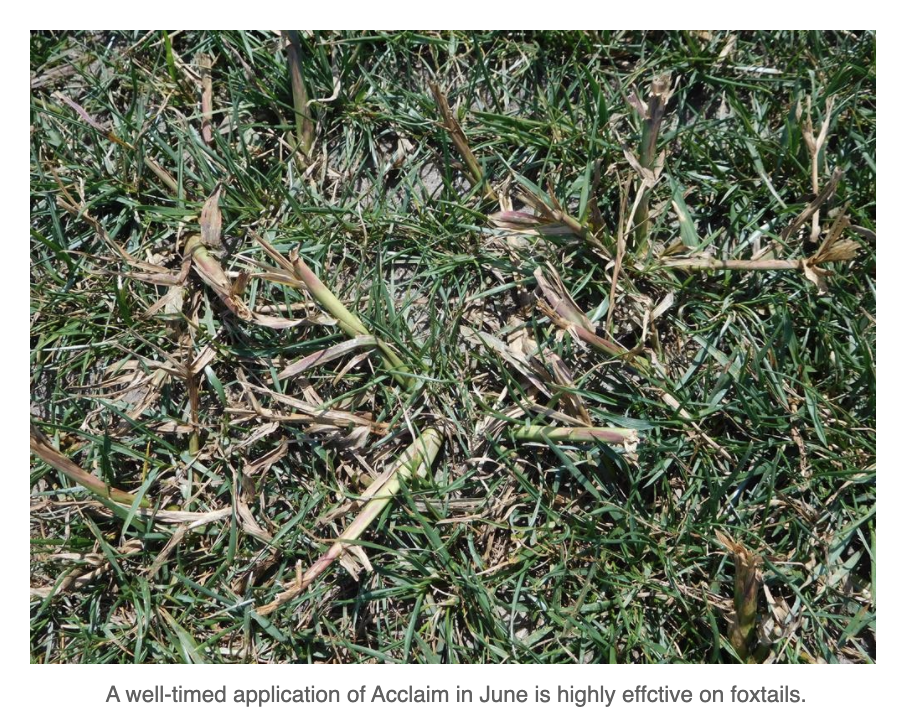
Foxtail Control: Preemergence herbicides used to target crabgrass effectively control yellow foxtail in established turf. Green-giant foxtails are seldom a problem in lawns, golf courses or sports fields. Green-giant foxtails are almost exclusively a problem in sod production. In spring-seeded sod fields, many farmers use mesotrione (Tenacity) in the seedbed at planting. Tenacity is highly effective on crabgrass, yellow nutsedge and many broadleaf weeds, but it is ineffective against foxtails. For sod farmers with a green-giant foxtail problems may need a postemergence solution. By far, Acclaim Extra (fenoxaprop-ethyl) is the mostly highly effective herbicide and causes little discoloration in tall fescue, Kentucky bluegrass and perennial ryegrass. MSMA (monosodium methane arsonate) also can be effective, but it often requires two applications, and can cause severe yellowing in the summer. If applied in hot weather (i.e., daytime highs exceeded 88F), MSMA can injure tall fescue-Kentucky bluegrass severely enough to delay its harvest until late autumn and sometimes not until the following spring.
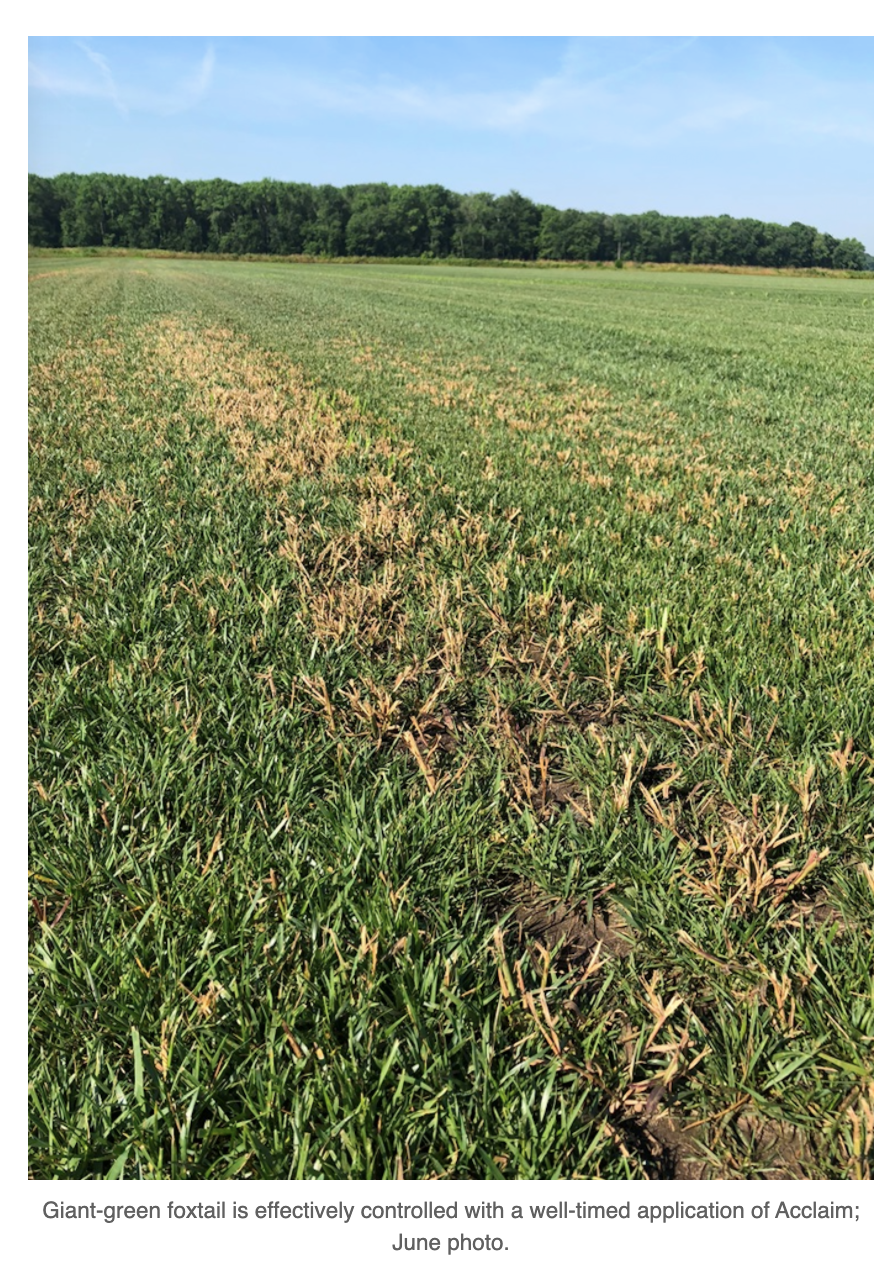
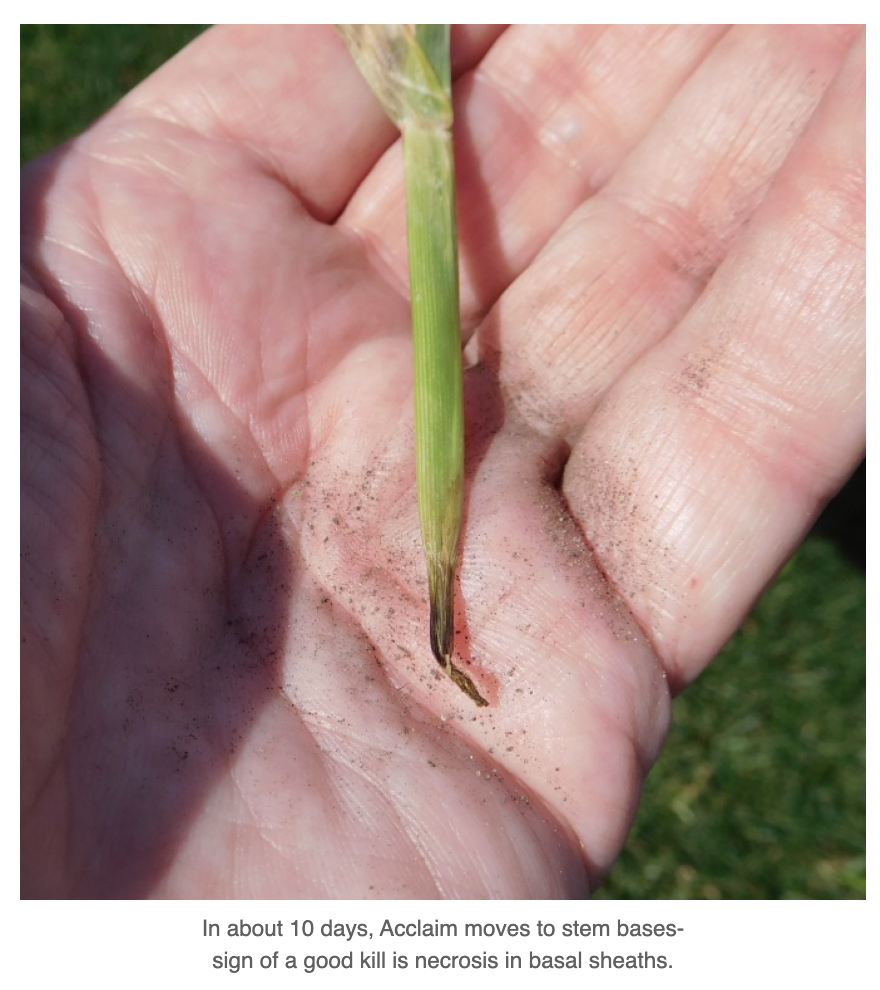
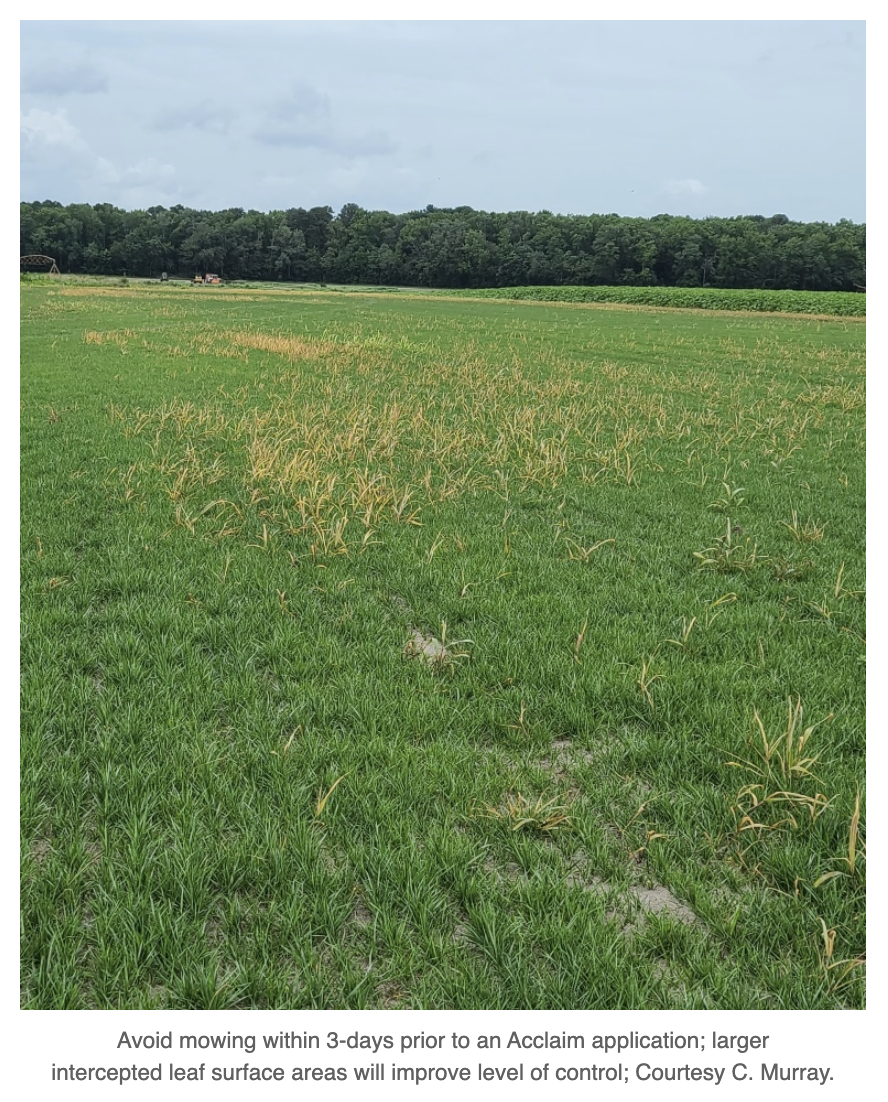
To be highly effective, Acclaim is best applied in a June timing. During June, green-giant foxtails may develop only 2- to 4 tillers (which are lush and not summer hardened). Moist soil moisture conditions are essential for effective control; thus, applications are best made after a root-zone soaking rainfall event. Once green-giant foxtail produces numerous summer-hardened tillers (usually by early-mid-July) it becomes more resistant to Acclaim. It is important not to mow within 3 days prior to an Acclaim application; longer, more exposed leaf surfaces will greatly improve herbicide contact and thus level of control. Indeed, mowing 1-2 days prior to an Acclaim application likely will reduce efficacy and may result in less effective control.
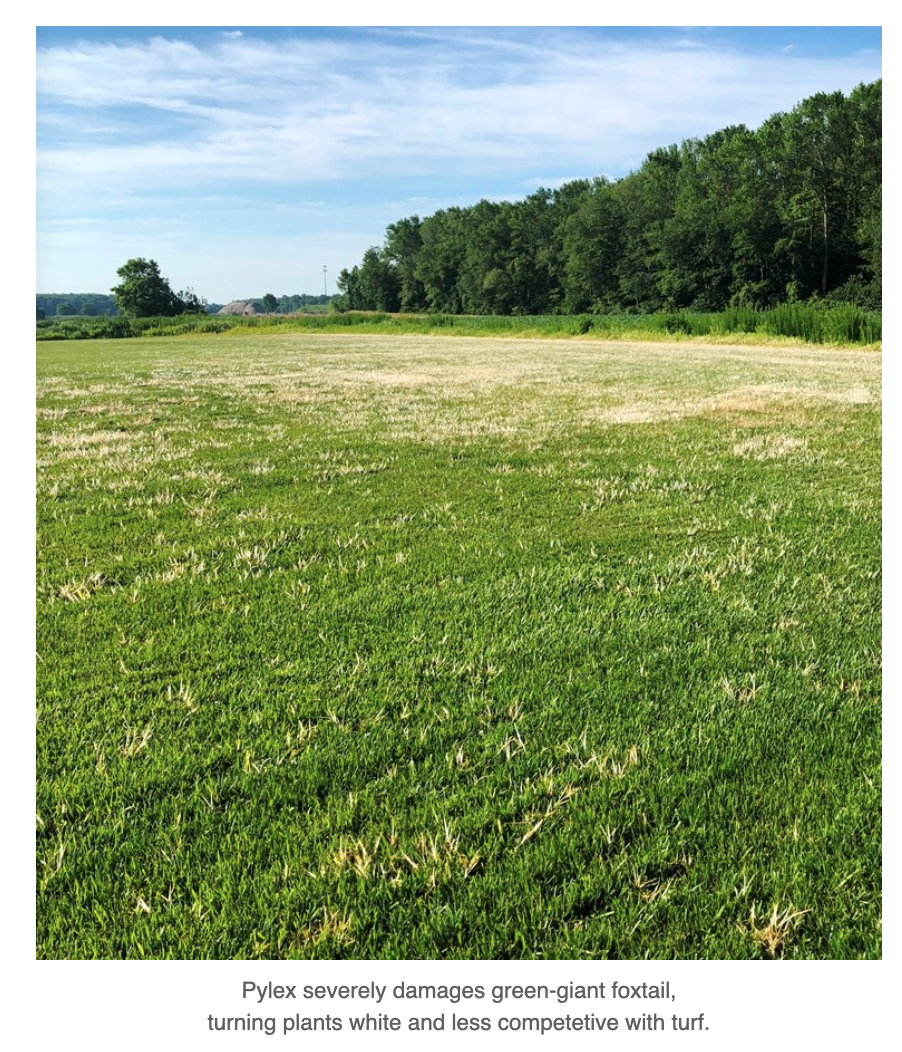
Thereafter, Pylex may be a good choice, but don’t expect any kill. Pylex (topramezone) will severely stunt and damage mature green-giant foxtail and reduce its invasiveness and seed production, but plants likely will survive. Regardless, Pylex can provide a competitive advantage to tall fescue and sod destined to be harvest in early winter may be good to go. Pylex can cause severe yellowing to tall fescue-Kentucky bluegrass sod fields. Pylex-induced yellowing can be greatly minimized by tank-mixing Turflon Ester (triclopyr). Nobody knows why triclopyr eliminates yellowing, however, when tank-mixed with Pylex, it may help to boost control, while eliminating many any broadleaf weeds that may be present. Conversely, treated foxtails turn a bleached-white color, because the mode of action is to prevent green-chlorophyll production.
Thanks for reading! For more articles and information, visit the Dr. Pete's Turf Tips Archive.