
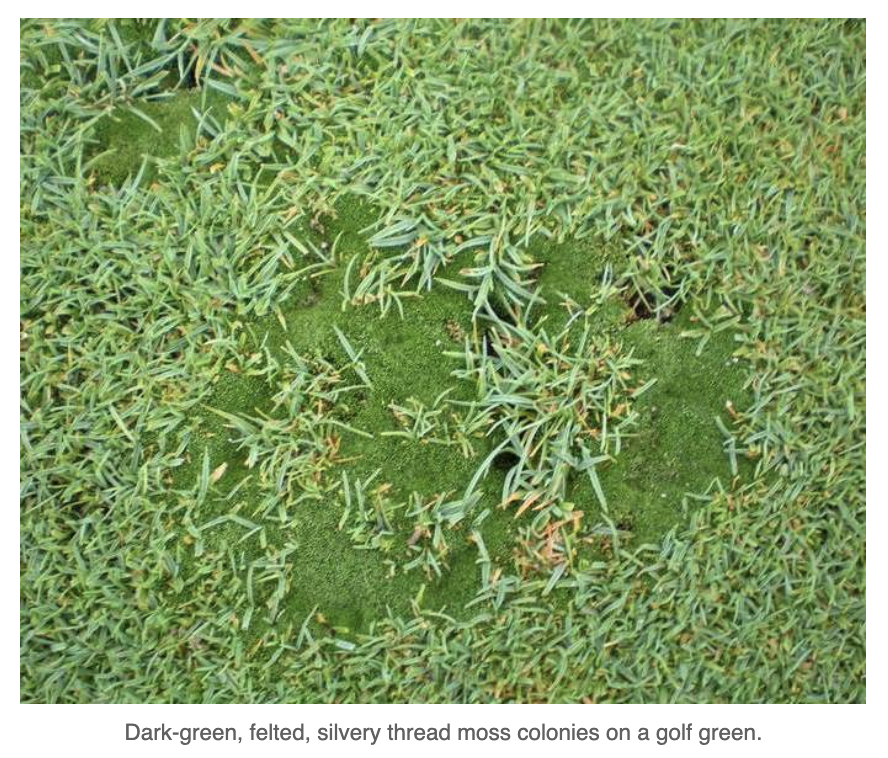
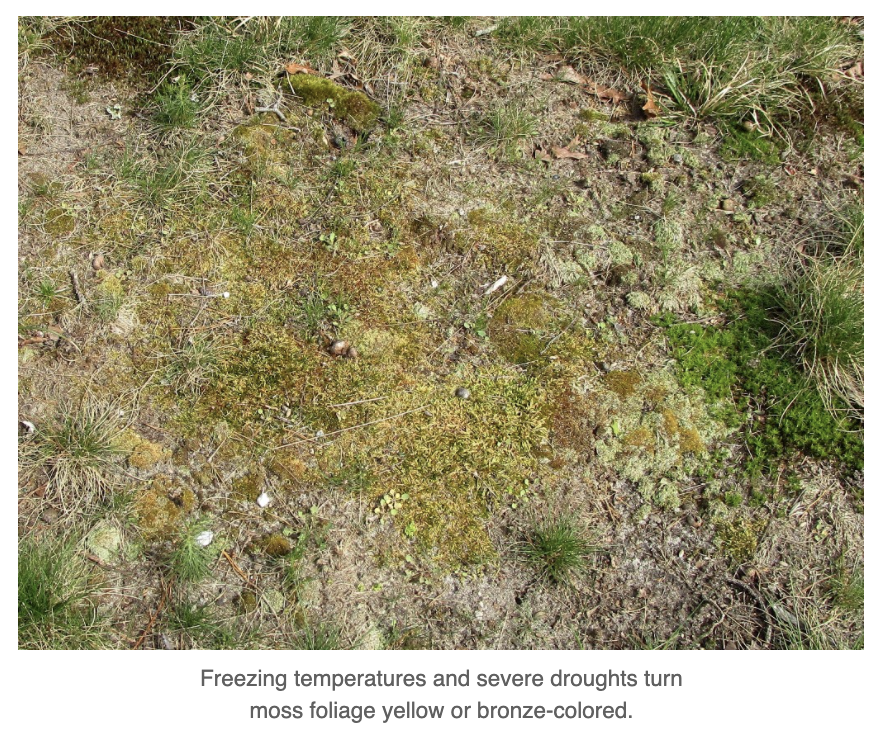
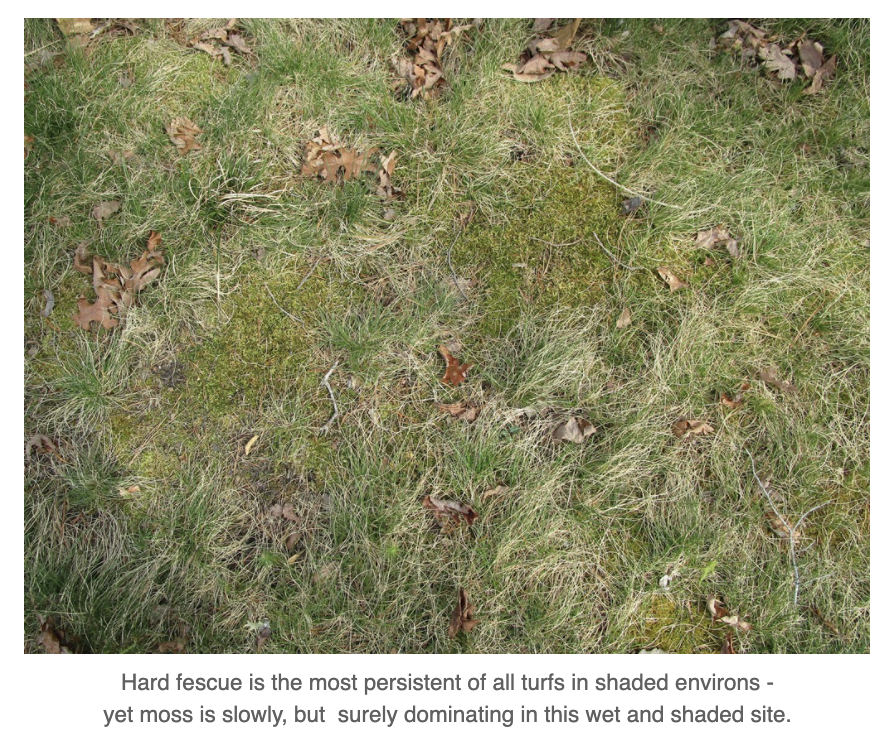
Mosses are primitive plants. There are many moss species, however, few if any true botanist in all of North America remain who can identify different moss species. Silvery thread (Bryum argenteum) is the most common species found in association with turf and is perennial. Moss develops in felted, appressed and green or yellow-green colonies. Although mosses usually grow in shady and moist places, they are capable of growing in full sun, while surviving periods of extreme heat and drought stress. Moss can be found on slopes or knolls, and other droughty areas, which are prone to frequent scalping. Moss also is prevalent in weak lawns, perennial gardens and wherever soil is bare in landscapes. Under severe drought stress, silvery thread moss becomes completely dehydrated, and enters a drought dormant state. Eventually, rain re-hydrates desiccated leaves and stems and metabolic activity is stimulated. Moss can survive just about any stress, including icy winter conditions. In winter, freezing temperatures discolor leaves and they may appear brown, reddish-brown, orange or yellow. Leaves normally appear badly discolored in winter, but as summer approaches new green stems and leaves are produced. Stems and leaves are probably > 98% water, and no thatch is produced.

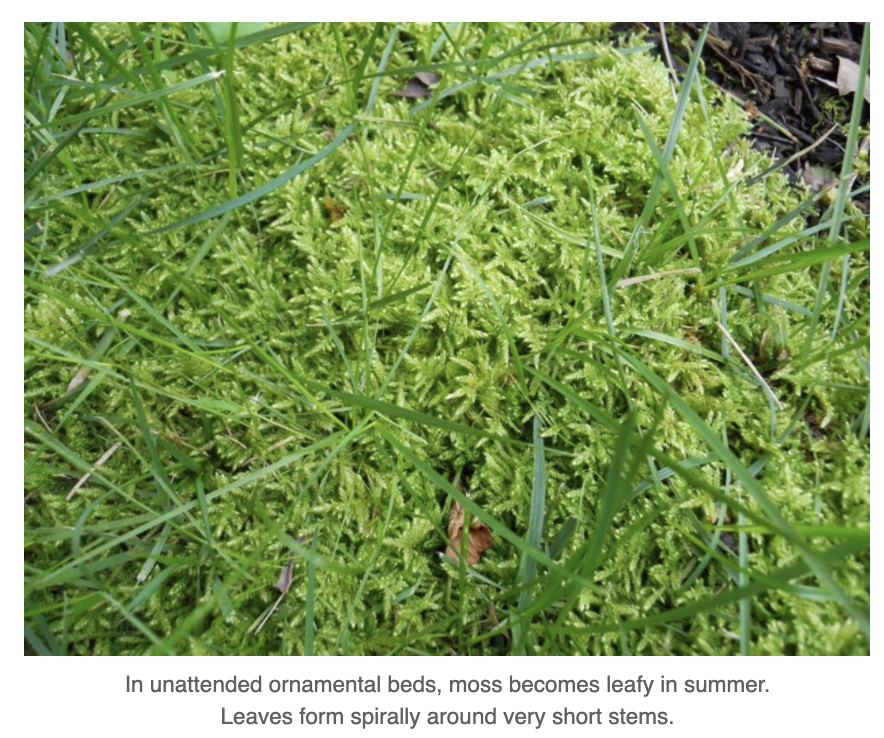
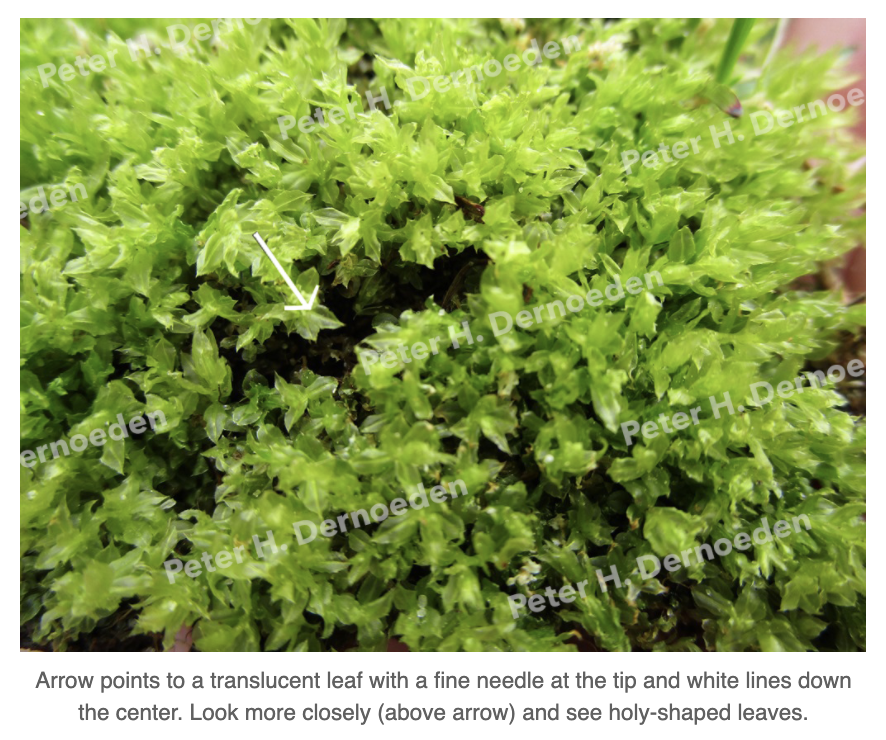
Moss is composed of density packed leaves that form in whorls or spirals around very short stems-maybe 1/16th or 0.06”. It would take “Superman” vison to be able to discern leaf shape, and their tiny and delicate characteristics, without a microscope. Basically, leaves are paper-thin and somewhere between holy leaf-shaped and arrow-shaped. There are no spines/needles like on holy leaf margins, but there usually is a fine, tiny needle that extends from leaf tips. Leaves are delicate and translucent, with two whitish vein-like lines down leaf centers.
Mosses have no sophisticated vascular system (i.e., no conductive tissues that move water and nutrients from roots to stems and leaves), but somehow they get it done via capillary action. Capillary means wicking action; like dipping a brush into paint and the liquid “wicks-up” into the hairs. Mosses are anchored by root-like, wiry and brown rhizoids; the entire mat of brown rhizoids and green tissue are about 0.5’ thick. Rhizoid mats acts like a sponge to hold water and soil nutrients, which allows for capillary action to move water and nutrients upwards to be absorbed directly by green stems and leaves. Mosses have a complicated life cycle and water is required for reproduction to occur. Mosses are mostly dispersed as spores (primitive seed) or as dislodged fragments of plants and rhizoids (e.g., via mowing; raking, edging, and other equipment). Spore bearing capsules are produced on top of leafless, reddish-brown stalks. Capsules initially are green and upon maturity turn a bronze or red-brown color. Spores are important for long distance distribution of moss and are resistant to desiccation. When spores land on moist soil surfaces, they germinate to produce minute branching filaments, which soon develop rhizoids, stems and leaves. Hence, periods of wet and overcast weather promote the establishment of moss from spores.
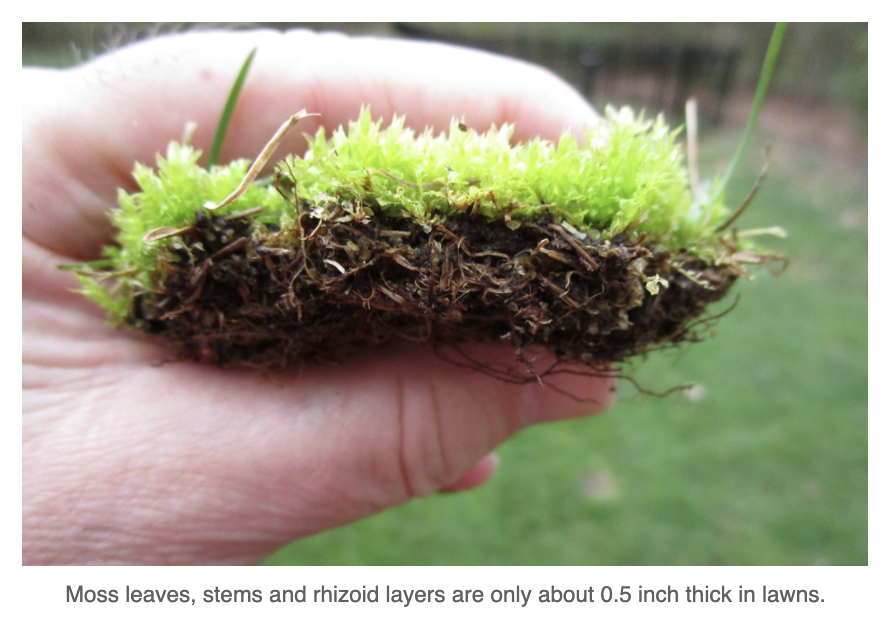
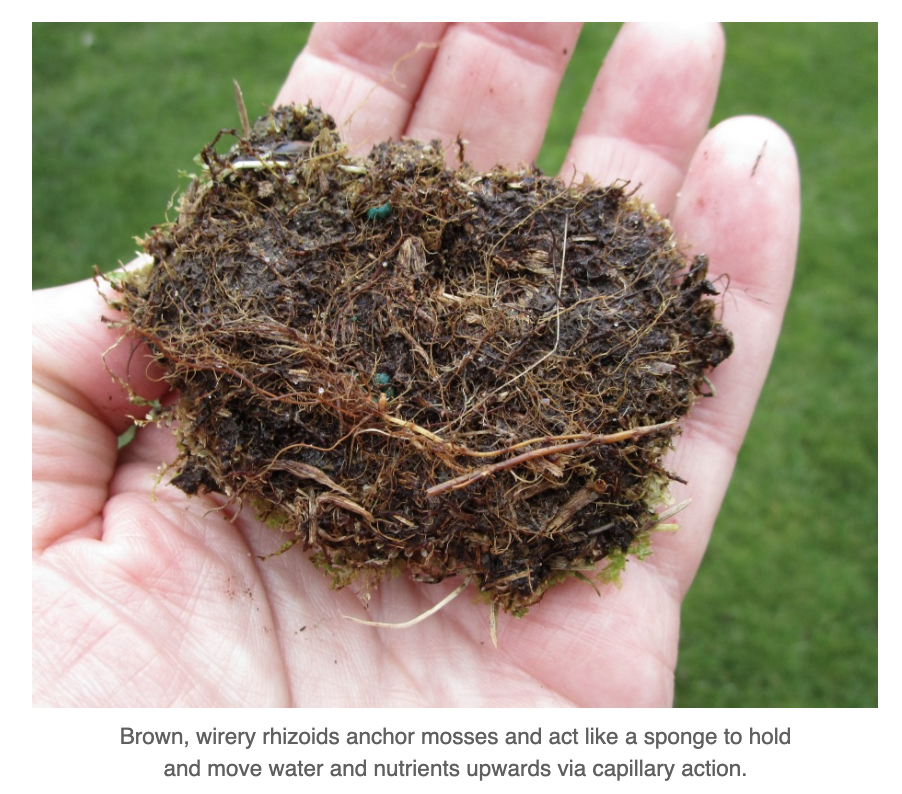
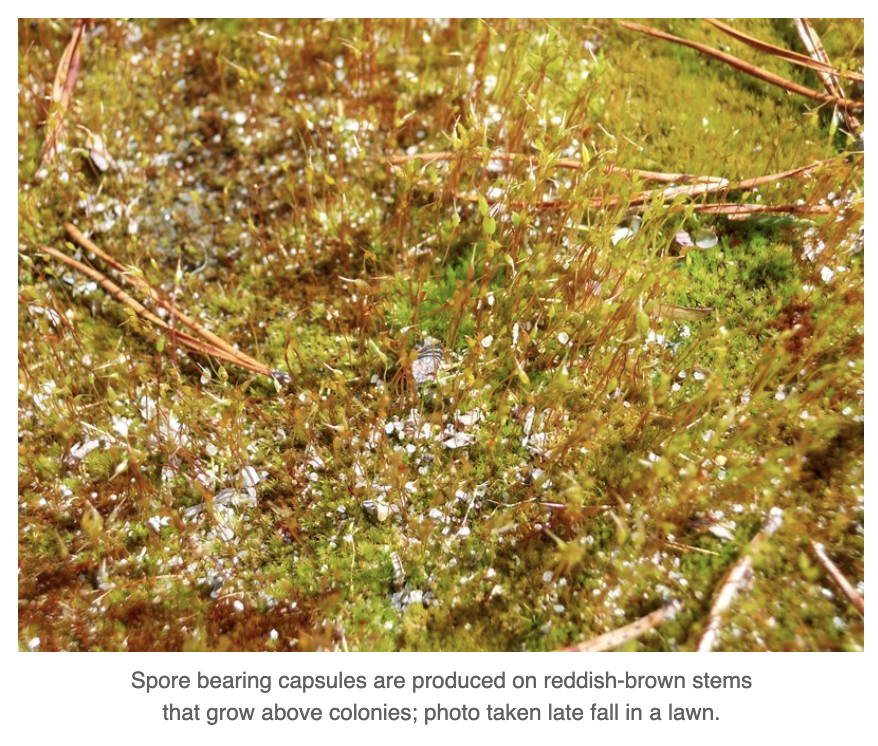
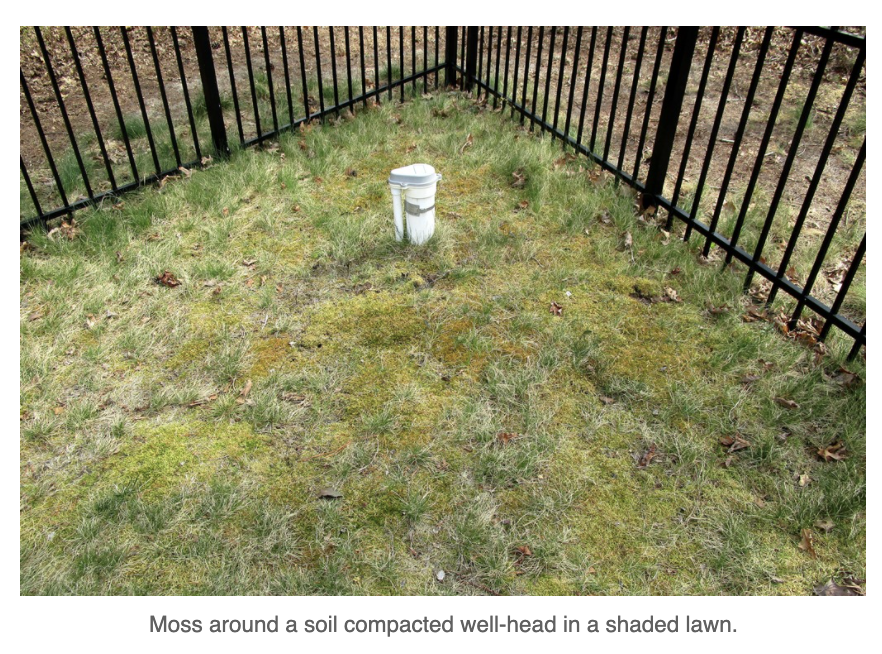
Moss Management in Lawns: Cultural moss management is aimed at correcting those soil or cultural conditions that provide moss their competitive edge. In lawns, this would require improving sunlight and air circulation via shrub and tree removal, increasing mowing height, alleviating soil compaction, and maintaining proper nitrogen fertility and soil pH levels. Hand raking to remove moss colonies and re-establishment with sod is the best approach. Seeding seems to be doomed to failure because seedling and young plants just cannot compete well in environs that favor moss growth and competiveness. As noted below, it is not unusual for sodding to fail within a year or two given wet and shaded environments that promote moss invasiveness.
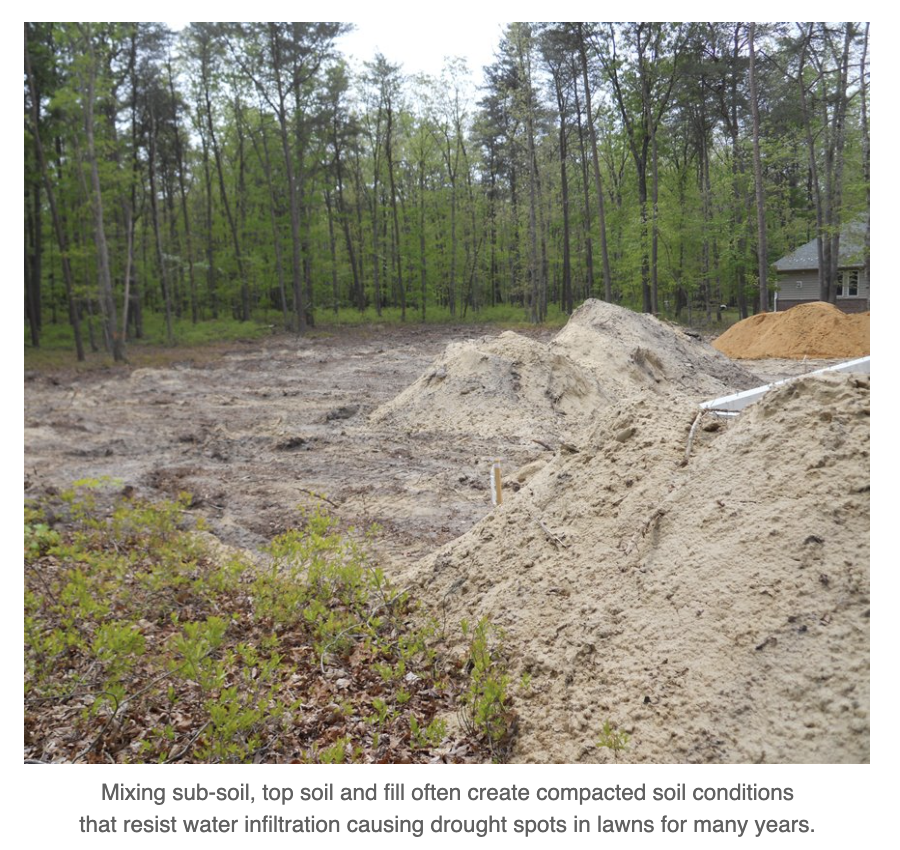
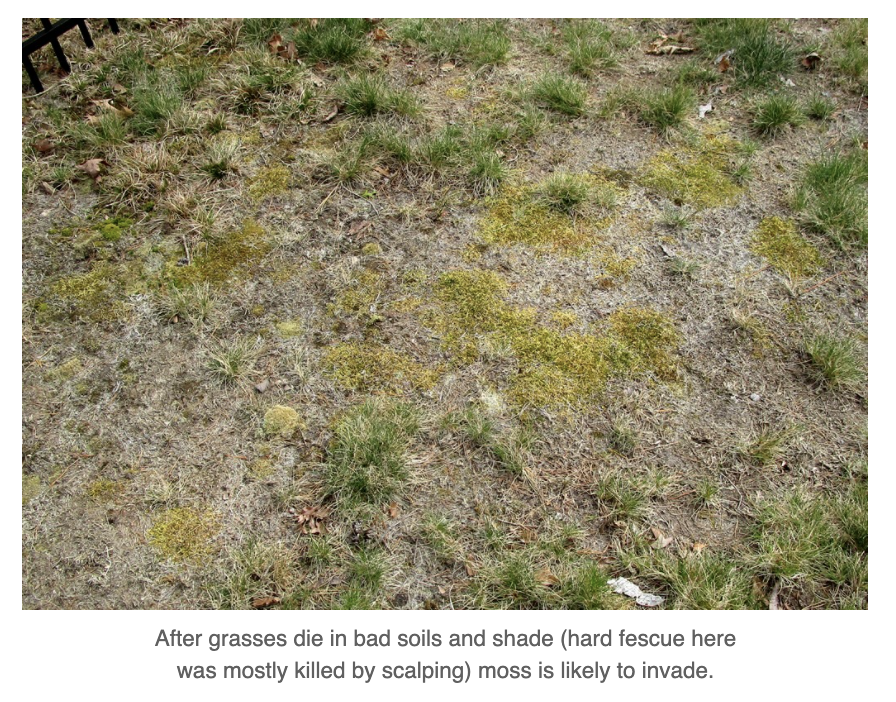
Many soil problems are created by badly disturbing soil structure during home construction. Top soil is seldom separated and stored for final grading. Most top and subsoils are mixed, and fills may be introduced to contour slopes needed to ensure water can surface drain away from structures. Mixing different soil types (e.g., sand, silts and clays from topsoil, sub-soil and fills) create layers that will prevent normal movement of water downwards to support turf roots. Mixing also can create compaction zones from which water run-offs, and turf dies from drought. These mixing problems are very difficult to diagnose after lawns are established and there generally are no easy fixes. It often is advised to plant fine- fescues, where there is shade and generally poor soil conditions. Not even fine-leaf fescues, however, can persist for more than a few years in hopelessly poor and droughty soil situations. If there is any shade to maintain a moist soil environment, moss commonly becomes established and can even out-compete the highly hearty hard fescues. Scalping is a major cause of death for all fine-leaf fescues and promoting moss encroachment.
Mercury-based fungicides, which were removed from the market by 1980, were highly effective in controlling moss on golf greens. Some fungicides like chlorothalonil (Daconil, many others) and mancozeb (Dithane, many others ) often provide short-term suppression of moss on greens. In more recent years, carfentrazone (i.e., Quicksilver) has become the most consistently effective material available for moss control on greens; although it can take multiple applications for success. Research conducted by Steve McDonald, MSc. [President of Turfgrass Disease Solutions], has found that even multiple applications of Quicksilver will not control moss in lawns.
In turf management manuals dating back many decades, homeowners were advised they should “burn-out” moss with materials like iron sulfate, ammonium sulfate , soaps, sodium bicarbonate, and copper hydroxide in an effort to desiccate/burn or otherwise suppress moss. Such efforts were mostly a band-aide approach, since mosses are incredibly adapted to most stresses and invariably survive. Indeed, even Round-up (glyphosate) is ineffective in controlling moss.
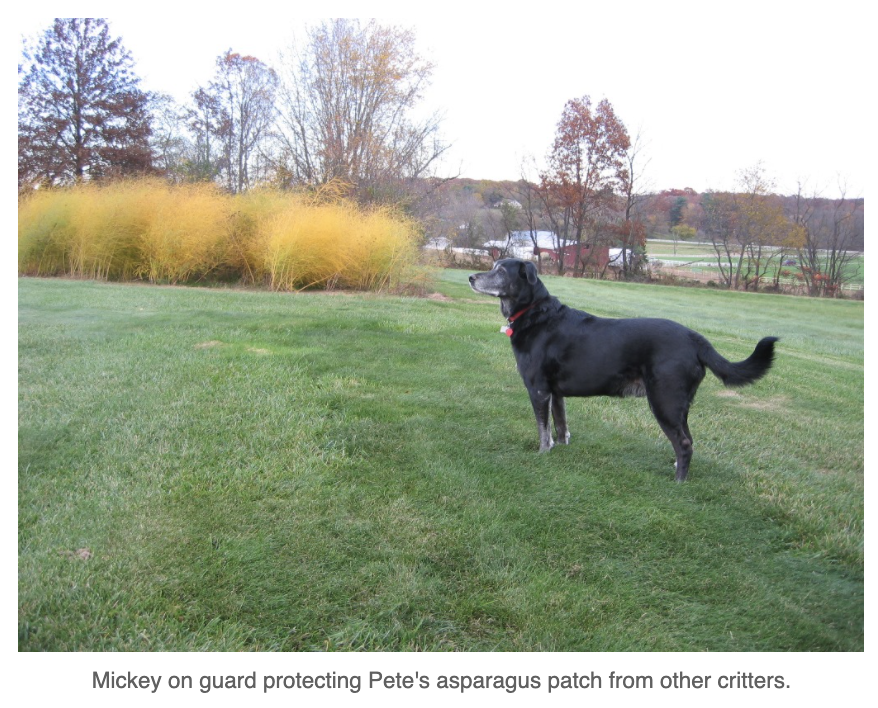
In reality, folks just don’t want to remove their trees and shrubs, and impose costly management techniques, that are not likely to work out. Hand raking helps in the short-run, but is tough to re-establish these areas with seed; sod does have a chance as noted above. I had an asparagus patch. Every spring, I would remove all the dead stems and moss, which was promoted by the shading of the asparagus ferns. Then, I would burn the piles, and removed the debris (it was worth it-best tasting asparagus anywhere). Once the bed was clean, I would spray the area with Round-up plus a premergence herbicide. Each succeeding spring the moss was back, and I repeated the operation for about 25 years.
I once traveled to Japan for an International Turf Conference. Along the way, we visited an ancient garden where moss is considered a highly desirable cover in shaded environments. The bottom line is: if multiple efforts to physically remove, burn-out and/or desiccate moss fail and turf cannot be re-established, it is time to cease the unequal struggle. After all, moss is green most of the year, controls erosion, has no pest issues, and does not require irrigation, fertilizer or mowing. Now that you have a better understanding of moss –maybe you will have learned to appreciate and accept this resilient primitive plant cover in shady and/or hopelessly soil compacted lawn environs.
Thanks for reading! For more articles and information, visit the Dr. Pete's Turf Tips Archive.